
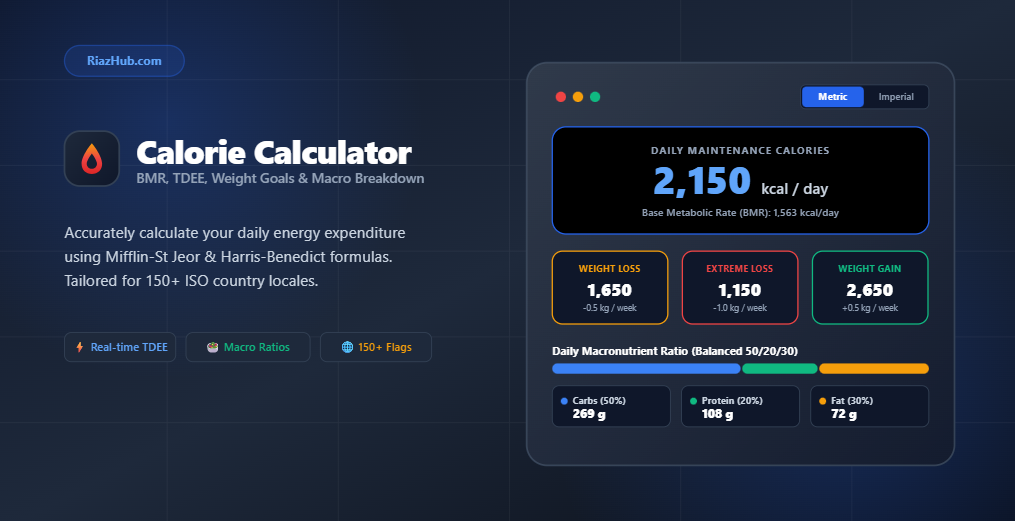
🔥 Try the Online Calorie Calculator
Calculate your BMR, TDEE, weight loss pace, and custom macro targets in seconds.
1. Understanding Basal Metabolic Rate (BMR)
Your Basal Metabolic Rate (BMR) represents the minimum amount of energy (in calories or kilojoules) your body burns at complete rest during a 24-hour period. Even while sleeping or resting, your body requires continuous energy to perform essential life-sustaining biological functions, such as cell respiration, blood circulation, hormone synthesis, brain function, and body temperature regulation.
Our tool supports two of the most widely accepted scientific equations for calculating BMR:
A. Mifflin-St Jeor Equation (Default / Recommended)
Published in 1990, the Mifflin-St Jeor equation is recommended by the Academy of Nutrition and Dietetics for its high accuracy in modern populations.
• Women: BMR = (10 × weight in kg) + (6.25 × height in cm) – (5 × age in yrs) – 161
B. Harris-Benedict Equation (Revised Roza & Shizgal 1984)
Originally introduced in 1919 and updated in 1984, the Harris-Benedict equation remains a trusted clinical benchmark.
• Women: BMR = 447.593 + (9.247 × weight in kg) + (3.098 × height in cm) – (4.330 × age in yrs)
2. Calculating Total Daily Energy Expenditure (TDEE)
Because humans do not spend the entire day lying in bed, your BMR must be adjusted to account for daily movement, physical activity, and exercise. This complete total is known as your Total Daily Energy Expenditure (TDEE) or Maintenance Calories.
TDEE is calculated by multiplying your BMR by an Activity Multiplier factor:
| Activity Level | Multiplier | Description |
|---|---|---|
| Sedentary | 1.200 | Little or no exercise, desk job |
| Lightly Active | 1.375 | Light exercise or sports 1–3 days/week |
| Moderately Active | 1.550 | Moderate exercise or sports 3–5 days/week |
| Very Active | 1.725 | Hard exercise or sports 6–7 days/week |
| Extra Active | 1.900 | Very hard exercise, physical labor job, or twice daily training |
3. Weight Goals: Calorie Deficit vs. Calorie Surplus
Once your maintenance energy expenditure (TDEE) is known, you can establish specific daily energy targets based on your personal fitness goals:
- Weight Loss (-500 kcal/day): A daily energy deficit of 500 calories creates a weekly deficit of 3,500 kcal, which equates to losing approximately 0.5 kg (1 lb) of fat per week.
- Extreme Weight Loss (-1000 kcal/day): A daily deficit of 1,000 calories targets a loss of approximately 1.0 kg (2 lbs) per week. (Note: Calorie intake should generally remain above 1,200 kcal/day for women and 1,500 kcal/day for men to ensure adequate micronutrient intake).
- Weight Gain (+500 kcal/day): A daily caloric surplus of 500 calories supplies the extra energy needed to synthesize new muscle tissue alongside resistance training, resulting in ~0.5 kg (1 lb) of gain per week.
4. Optimizing Daily Macronutrient Splits
While total calorie balance determines weight changes, the composition of those calories—your macronutrients—determines your body composition (fat vs muscle ratio) and energy levels.
- Protein (4 kcal/g): Essential for muscle repair, tissue recovery, and satiety.
- Carbohydrates (4 kcal/g): The primary energy source for high-intensity exercise and brain metabolism.
- Fats (9 kcal/g): Crucial for hormone production, cell membrane integrity, and nutrient absorption.
The RiazHub Calorie Calculator allows you to instantly toggle between popular macronutrient distribution profiles:
- Balanced (50% Carbs / 20% Protein / 30% Fat): Ideal for general health and balanced diets.
- High Protein (40% Carbs / 40% Protein / 20% Fat): Optimal for muscle preservation during weight loss or muscle building.
- Low Carb (20% Carbs / 40% Protein / 40% Fat): Designed for lower carb sensitivity or endurance training.
- Keto (5% Carbs / 25% Protein / 70% Fat): Tailored for ketogenic diets emphasizing fat adaptation.
5. Global Regional Support & Energy Units
Our tool supports over 150+ ISO Country Locales with official flag emojis and dynamic number formatting using JavaScript’s native Intl.NumberFormat API. Furthermore, users can seamlessly switch between standard Calories (kcal) and Kilojoules (kJ) (where 1 kcal = 4.184 kJ) as well as Metric (cm, kg) and Imperial (feet/inches, lbs) units.
Ready to Calculate Your Calorie & Macro Target?
Access the full interactive tool on RiazHub.com now.