
Mastering Hebrew Number to Words: Polar Gender Concordance, Dual Forms & Commercial Cheque Law
Writing currency figures in written words is one of the most critical legal safeguards in commercial banking, corporate accounting, and public administration. In the State of Israel, drafting a legally binding commercial bank draft (המחאה בנקאית) or issuing a formal tax invoice (חשבונית מס) requires rigorous adherence to the linguistic edicts of the Academy of the Hebrew Language (האקדמיה ללשון העברית) and the statutory mandates of the Israeli Bills of Exchange Ordinance [New Version] Section 8(b).
Because Hebrew grammar features unique polar gender concordance, dedicated dual noun-numeral forms (צורת הזוגי), and intricate construct state inflections (יחסי סמיכות), converting numbers to words by hand is notoriously prone to grammatical slips. To address these complexities with zero risk of computational error, financial institutions and businesses leverage the Hebrew Number to Words Converter & Currency Spellout Studio, an interactive, browser-based linguistic and commercial cheque drafting suite.
1. The Academy of the Hebrew Language: Polar Gender Concordance (התאם המין הקוטבי)
The hallmark of Hebrew computational linguistics is polar gender agreement. Unlike Indo-European languages where numerals simply match the grammatical gender of the governing noun, Semitic cardinal numerals exhibit an inverted morphological pattern for numbers between 3 and 10:
- Masculine Nouns Mandate Feminine-Ending Numerals: The Israeli national currency unit, the Shekel (שקל), is masculine. Therefore, counting shekels requires the numeral form ending with the suffix -ah (ה) or -at:
1 שקל = שקל אחד | 2 שקלים = שני שקלים | 3 שקלים = שלושה שקלים | 5 שקלים = חמישה שקלים | 10 שקלים = עשרה שקלים
Writing “שלוש שקלים” or “חמש שקלים” is considered an invalid grammatical violation in legal contracts.
- Feminine Nouns Mandate Unmarked Base Numerals: The fractional currency subunit, the Agora (אגורה), is feminine. Consequently, counting agorot requires the base, unmarked numeral forms:
1 אגורה = אגורה אחת | 2 אגורות = שתי אגורות | 3 אגורות = שלוש אגורות | 5 אגורות = חמש אגורות | 75 אגורות = שבעים וחמש אגורות
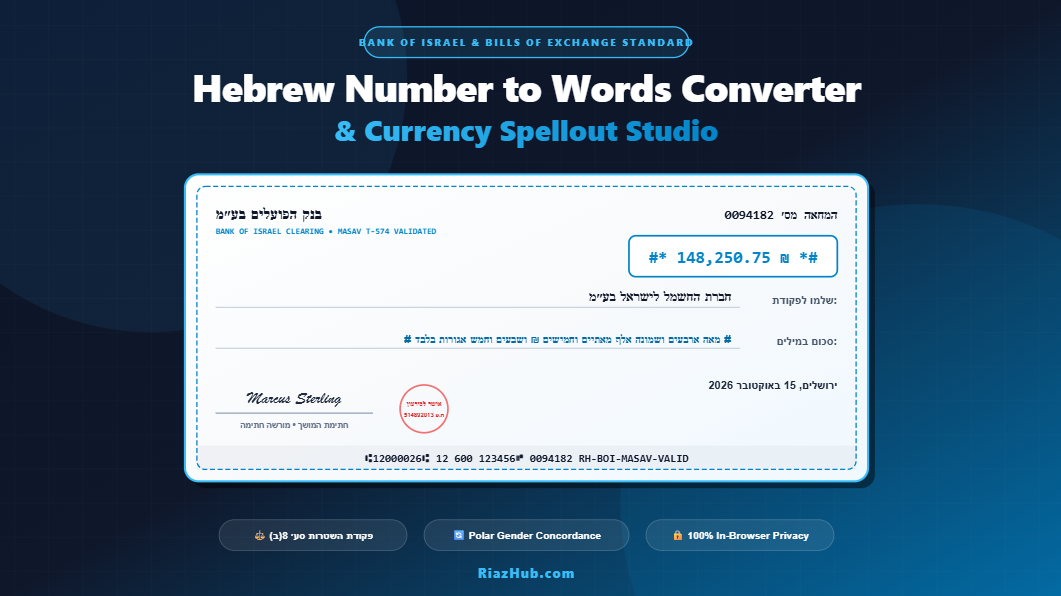
When processing compound figures such as 148,250.75 ₪, both masculine and feminine branches must be evaluated independently: the whole shekels use masculine polarity (מאה ארבעים ושמונה אלף מאתיים וחמישים שקלים חדשים), while the fractional agorot use feminine polarity (שבעים וחמש אגורות). You can observe this exact dual-gender alignment in real time using the Hebrew Number to Words Converter & Currency Spellout Studio.
2. Dual Morphology (צורת הזוגי): מאתיים vs. אלפיים
Biblical and Modern Hebrew preserve a robust dual number system (זוגי) for measures, time units, and fundamental financial denominations. The Academy of the Hebrew Language strictly prohibits replacing dual forms with analytical combinations:
| Numeric Figure | Standard Academy Form (תקני) | Prohibited Grammatical Error (שגוי) | Classification |
|---|---|---|---|
| 200 | מאתיים (Matayim) | שתי מאות | Strict Dual Metric Form |
| 2,000 | אלפיים (Alpayim) | שני אלפים | Strict Dual Thousands Form |
| 3,000 to 10,000 | שלושת אלפים, עשרת אלפים | שלושה אלף | Construct State Plural (סמיכות) |
| 11,000+ | אחד עשר אלף, עשרים אלף | אחד עשר אלפים | Cardinal Singular Scale |
For amounts from 3,000 through 10,000, Hebrew demands the construct state plural form אלפים (e.g., ארבעת אלפים, חמשת אלפים). However, once an amount crosses 11,000, the rule shifts back to the singular noun אלף (e.g., שלושים וחמישה אלף).
⚡ Experience Flawless Hebrew Currency Verbalization
Eliminate manual errors and ensure complete statutory compliance for Israeli commercial bank drafts, accounting vouchers, and cross-border settlements up to 30 digits.
3. Israeli Bills of Exchange Ordinance § 8(b): Statutory Word Supremacy
Why does the written Hebrew text matter so much in modern Israeli banking? The answer lies directly in Section 8(b) of the Israeli Bills of Exchange Ordinance [New Version] (פקודת השטרות [נוסח חדש], סעיף 8(ב)), which states:
“Where the sum payable is expressed in words and also in figures, and there is a discrepancy between the two, the sum denoted by the words is the sum payable.”
This fundamental doctrine—analogous to Uniform Commercial Code (UCC) § 3-114 in American commercial law—establishes that handwritten or typed words possess ultimate legal authority over numerical figures. If an altered cheque shows ₪150,000 in numbers but the words line spells out “חמישה עשר אלף שקלים חדשים בלבד” (₪15,000), clearing houses like Masav (מרכז סליקה בנקאי) and Israeli clearing banks will honor only the lower words figure.
4. Commercial Cheque Framing: Protective Hashes & Bilvad Closures
To prevent fraudulent insertions on the cheque paper, Bank of Israel clearance regulations recommend framing both the numeric and written amounts with bounding delimiters:
- Protective Bounding Hashes: Bounding the verbal line between hashes or asterisks prevents fraudsters from inserting additional words on either side:
# מאה אלף שקלים חדשים בלבד #. - The Mandatory ‘בלבד’ (Bilvad) Terminal Closure: Appending בלבד (Only) signals that no further subunits or amounts follow.
- Crossed Cheque Directives (שרטוט קרוס): Specifying למוטב בלבד (A/C Payee Only) restricts the cheque so that it cannot be endorsed or negotiated to third parties, requiring direct deposit into the named beneficiary’s bank account.
The Hebrew Number to Words Converter & Currency Spellout Studio automatically stages these protective clauses onto high-DPI commercial bank check drafts, ready for digital archival or physical printing.
5. Multi-Currency Support for Cross-Border Corporate Settlements
Modern Israeli enterprises frequently transact in foreign currencies while maintaining legal documentation in Hebrew. The system supports full declension profiles for:
- Israeli New Shekel (ILS / ₪): Masculine major (שקל חדש / שקלים חדשים), feminine minor (אגורה / אגורות).
- US Dollar (USD / $): Masculine major (דולר ארה”ב), masculine minor (סנט / סנטים).
- Euro (EUR / €): Masculine invariant major (אירו), masculine minor (סנט).
- British Pound Sterling (GBP / £): Feminine major (לירה שטרלינג / לירות שטרלינג), masculine minor (פני).
- Saudi Riyal (SAR / ר.ס): Masculine major (ריאל סעודי / ריאלים), feminine minor (חלאלה / חלאלות).
- UAE Dirham (AED / ד.إ): Masculine major (דירהם), masculine minor (פילס).
6. Complete 100% Client-Side Privacy Guarantee
Commercial financial documents contain sensitive proprietary information: supplier identities, tax ID numbers (ח.פ. / עוסק מורשה), transaction sizes, and executive signatures. Unlike cloud-dependent converters that send numerical payloads across third-party servers, the Hebrew Number to Words Converter & Currency Spellout Studio runs entirely in-browser. All BigInt arithmetic, polar grammatical parsing, HTML5 canvas bank draft rendering, and export generation execute locally inside your browser’s private sandbox.
7. Step-by-Step Guide: How to Generate Hebrew Financial Vouchers
- Enter Numeric Amount: Type your target figure (e.g.,
148250.75) into the amount input field. - Verify the Standalone Words Box: Instantly inspect the dedicated סכום במילים (Words Only) box located right below the input and use the 1-click copy button for rapid paste actions.
- Configure Cheque Parameters: Add the drawee bank, branch number, payee name, value date, and cheque number.
- Review the Live Visualizer: Switch between the High-DPI Bank Draft, Dual-Language Words Deck (Hebrew + English mirror), Commercial Accounting Voucher Slip, and Dossier Card Studio.
- Export with 1-Click: Download lossless PNG graphics, print-ready PDF vouchers, formatted Markdown slips, or CSV ledger logs formatted with official site naming.
Ready to Streamline Your Hebrew Financial Drafting?
Access the full suite of Hebrew computational linguistics, commercial bank draft staging, and statutory verification tools today.
Frequently Asked Questions (FAQ)
Why is it “שלושה שקלים” instead of “שלוש שקלים”?
In Hebrew grammar, numbers between 3 and 10 follow polar gender agreement: masculine nouns take the numeral form with a feminine suffix (שלושה, חמישה, עשרה), whereas feminine nouns take the unmarked base form (שלוש, חמש, עשר).
Can I write “שתי מאות” instead of “מאתיים”?
No. The Academy of the Hebrew Language strictly mandates the dual form מאתיים (Matayim) for 200 and אלפיים (Alpayim) for 2,000. Analytical expressions like “שתי מאות” are grammatically incorrect in Israeli financial drafting.
What happens if the numbers and words differ on an Israeli bank cheque?
Under Section 8(b) of the Israeli Bills of Exchange Ordinance [New Version], the amount expressed in words legally supersedes the amount written in figures.
Does this tool send my financial figures to an external server?
No. The Hebrew Number to Words Converter & Currency Spellout Studio processes 100% of the linguistic syntax and canvas visualizers inside your client-side browser session.
📜 Universal Hebrew Number to Words Studio
Accurate Hebrew Number-to-Words Converter according to the Academy of the Hebrew Language (האקדמיה ללשון העברית), Israeli Bills of Exchange Ordinance § 8(b), Commercial Cheque Staging, and Accounting Voucher Engine. 100% Client-Side In-Browser Computation.
תקן רשות המסים והוראות ניהול פנקסים
תאריך: 15/10/2026
שם המוטב (הנפרע): חברת החשמל לישראל בע״מ
| תיאור התנועה / חשבון | סכום במילים | חובה (₪) | זכות (₪) |
|---|---|---|---|
| הוצאות ספקים וחשבונות שוטפים | - | - | 0.00 |
| מע"מ תשומות (17%) | מחושב כחוק | - | 0.00 |
| חשבון עו"ש בנק נמשך (הפועלים) | זיכוי בנקאי בהמחאה | 0.00 | - |
1. כללי התאם המין הדקדוקי הקוטבי (Polar Gender Agreement)
בעברית חל כלל מיוחד על המספרים 3 עד 10: שמות עצם ממין זכר (כגון שקל) מצריכים מספר בעל סיומת -ה/ת (צורה הנשמעת נקבית, כגון שלושה שקלים, חמישה שקלים, עשרה שקלים). לעומת זאת, שמות עצם ממין נקבה (כגון אגורה) מצריכים מספר בצורת הבסיס חסרת הסיומת (שלוש אגורות, חמש אגורות, שבעים וחמש אגורות).
2. צורת הזוגי (Dual Forms) וכללי הסמיכות
על פי החלטות האקדמיה ללשון העברית, חובה להשתמש בצורת הזוגי הייעודית: המספר 200 הוא אך ורק מאתיים (ולא «שתי מאות»), והמספר 2,000 הוא אך ורק אלפיים (ולא «שני אלפים»). עבור 3,000 עד 10,000 משתמשים בצורת הסמיכות: שלושת אלפים, ארבעת אלפים, ששת אלפים, עשרת אלפים. מעבר לכך משתמשים בצורת היחיד «אלף» (כגון מאה אלף, עשרים אלף).
3. פקודת השטרות [נוסח חדש] סעיף 8(ב)
החוק הישראלי קובע מפורשות: "היה הסכום שצריך לפרעו מפורש במלים וגם בספרות, ויש הבדל ביניהם, הסכום המפורש במלים הוא הסכום שצריך לפרעו." זוהי עליונות משפטית מוחלטת של המילים הכתובות על פני המספרים למניעת הונאות וזיופים.