
Mastering Swahili Currency Spellouts: The Definitive Guide to Number-to-Words Conversion, East African Cheque Staging, and Financial Law
Writing large numbers in Standard Swahili (Kiswahili Sanifu) presents unique computational and morphological complexities. Unlike English or French, Swahili features a rich Bantu noun class concordance system (Ngeli za Nomino), distinctive counting roots that inflect differently depending on the noun class, invariable Arabic-origin numerals, a rigid syntactic ruleset governing the conjunction «na» (and), and a deeply entrenched regional commercial convention utilizing «laki» to denote one hundred thousand.
To bridge the gap between digital ledger balances and legally unimpeachable Swahili financial documentation, professionals rely on the Universal Swahili Number to Words Converter & Currency Spellout Studio. This browser-based suite transforms raw figures into grammatically verified Swahili phrases, renders high-DPI security cheques compliant with East African Cheque Truncation Systems (CTS), and formats corporate vouchers—all without transmitting sensitive accounting figures over external servers.
1. The Computational Linguistics of Swahili Numerals: BAKITA & CHAKITA Standards
Standard Swahili orthography is governed by regulatory statutory bodies: the Baraza la Kiswahili la Taifa (BAKITA) in Tanzania and the Chama cha Kiswahili cha Taifa (CHAKITA) in Kenya. In numerical computation, Swahili numerals fall into two distinct etymological classifications:
A. Inflected Bantu Counting Roots vs. Invariable Arabic Loanwords
Numbers one through five and number eight originate from native Proto-Bantu roots. When used adjectivally with general nouns, their prefixes harmonize with the corresponding Bantu noun class (e.g., vitabu viwili, watu watatu, shilingi mbili). However, numbers six, seven, and nine were borrowed centuries ago through Indian Ocean maritime trade from Arabic and remain strictly invariable across all noun classes:
| Digit | Swahili Word | Etymological Origin | Morphological Behavior |
|---|---|---|---|
| 1 | moja (-moja) | Bantu Root | Variable Concordance (shilingi moja, mtu mmoja) |
| 2 | mbili (-wili) | Bantu Root | Variable Concordance (shilingi mbili, watu wawili) |
| 3 | tatu (-tatu) | Bantu Root | Variable Concordance (shilingi tatu, watu watatu) |
| 4 | nne (-nne) | Bantu Root | Variable Concordance (shilingi nne, watu wanne) |
| 5 | tano (-tano) | Bantu Root | Variable Concordance (shilingi tano, watu watano) |
| 6 | sita | Arabic Loanword (ستة) | Invariable across all noun classes |
| 7 | saba | Arabic Loanword (سبعة) | Invariable across all noun classes |
| 8 | nane (-nane) | Bantu Root | Variable Concordance (shilingi nane, vitabu vinane) |
| 9 | tisa | Arabic Loanword (تسعة) | Invariable across all noun classes |
| 10 | kumi | Bantu Root (makumi) | Base decimal radix |
B. The Syntax of the Conjunction «na» in Compounding
One of the most frequent grammatical mistakes in informal financial writing is the misplaced insertion of the conjunction «na» (and). According to BAKITA directives:
- Tens and Units: «na» is mandatory between tens and units:
ishirini na moja(21),arobaini na nane(48),tisini na tano(95). - Hundreds and Subsequent Digits: «na» connects the hundred group to whatever follows:
mia moja na kumi(110),mia mbili na hamsini(250),mia saba na tano(705). - Compound Thousands: When articulating thousands alongside hundreds and tens, each grammatical tier flows naturally:
elfu moja mia nne na hamsini(1,450).
When utilizing the Swahili Number to Words Studio, the engine autonomously parses each digit triplet according to these morphosyntactic placement rules, preventing grammatical discrepancies that could invalidate bank clearing.
C. The Commercial «Laki» (100,000) Convention vs. Metric Radix
In commercial accounting across Kenya and Tanzania, the word «laki» represents a distinct unit of one hundred thousand (100,000), adopted from regional Indian Ocean commercial accounting. For example:
- With Laki:
148,250is verbalized as «laki moja arobaini na nane elfu mia mbili na hamsini». - Standard Triplet Radix: The same figure can be written without the commercial term as «elfu mia moja arobaini na nane mia mbili na hamsini».
Both forms are legally recognized throughout East Africa. The studio gives finance professionals full flexibility by offering a dedicated toggle between commercial «Laki» and standard metric radix formulations.
Need Instant, Error-Free Swahili Spellouts?
Convert any corporate amount into fully compliant BAKITA Swahili words, preview East African CTS bank cheques, and download PDF-ready vouchers in one click.
2. East African Banking Law: The Bills of Exchange Act & Statutory Word Supremacy
In East African commercial jurisprudence, commercial cheques and bills of exchange are governed by statutory legislation:
- Kenya: The Bills of Exchange Act (Cap 27, Laws of Kenya).
- Tanzania: The Bills of Exchange Act (Cap 215, Laws of Tanzania).
- Uganda: The Bills of Exchange Act (Cap 68, Laws of Uganda).
Section 9(2) of the Bills of Exchange Act:
“Where the sum payable is expressed in words and also in figures, and there is a discrepancy between the two, the sum denoted by the words is the sum payable.”
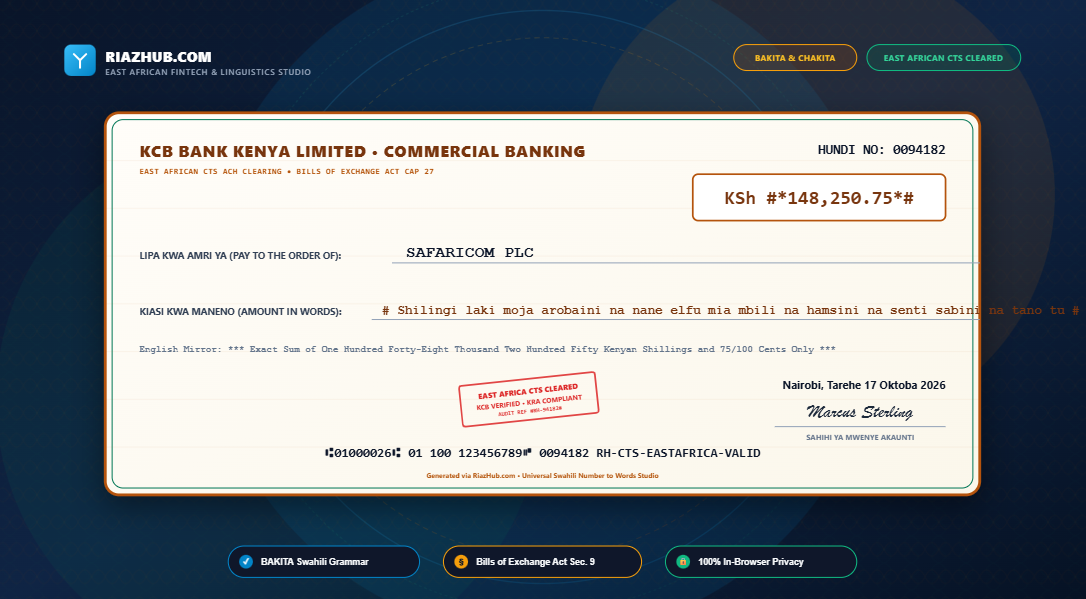
This fundamental statutory principle means that if a cheque bears KSh 148,250.75 in the numeric box but the verbalized words line reads Shilingi laki moja na arobaini elfu... (omitting the eight thousand), commercial banks and clearing houses are mandated by law to honor the written words, not the numbers. This makes the accuracy of written Swahili paramount for accountants, controllers, and legal counsel.
The Crucial Role of the Terminal Marker «Tu» (Only)
In Swahili commercial transactions, terminating the amount line with the word «Tu» (Only) or «Bila Chenji» when no fractional cents exist is an indispensable anti-fraud safeguard. Without a definitive terminal closure, an unauthorized party could intercept a signed draft and fraudulently append additional words (e.g., modifying «Shilingi elfu hamsini» into «Shilingi elfu hamsini na elfu mia mbili»).
Commercial banking standards in Nairobi and Dar es Salaam dictate enclosing both numeric boxes and written words lines inside protective boundary hashes and asterisks:
#*KSh 148,250.75*#
# Shilingi laki moja arobaini na nane elfu mia mbili na hamsini na senti sabini na tano tu #
The Swahili Currency Spellout Studio automatically injects these protective anti-fraud delimiters into every generated draft.
3. East African Cheque Truncation System (CTS) and Cheque Staging
Under directives issued by the Central Bank of Kenya (CBK) and the Bank of Tanzania (BoT), commercial banks operate on an automated Cheque Truncation System (CTS). Cheques are physically scanned at presenting bank branches, converted into high-resolution monochrome and grayscale images, and transmitted electronically through the Automated Clearing House (ACH).
For a cheque to pass CTS clearing without rejection, several staging criteria must be satisfied:
- Security Guilloche Background: The paper draft must incorporate fine guilloche line patterns that distort upon unauthorized digital photocopying or manual alteration.
- Legible MICR / CTS Clearing Line: The bottom line must render standard magnetic ink character recognition fields, including the bank transit routing code, account serial, cheque serial number, and transaction clearing code.
- Cheque Crossing Directives: Drawing parallel lines with «A/C PAYEE ONLY / Kwa Akaunti ya Mlipwaji Tu» guarantees that the paying bank cannot disburse cash over the teller counter, requiring deposit directly into the payee’s verified account.
- Official Clearance Chop / Stamp: Corporate drafts require verifiable accounting authorization stamps displaying verification codes and registration numbers.
The built-in High-DPI Canvas Cheque Visualizer in the Universal Swahili Cheque Studio renders an authentic East African commercial bank draft (KCB Bank, Equity Bank, CRDB Bank, or Stanbic format) complete with Guilloche security tint, Swahili date lines, and CTS MICR strips, ready for export as high-resolution PNG or PDF printouts.
4. Multi-Currency Support & Dual-Language Word Mirroring
East African enterprises frequently engage in international import-export operations spanning the EAC, COMESA, Europe, the Middle East, and North America. The studio features a complete multi-currency ISO 4217 matrix paired with an English UCC § 3-114 mirror translation:
| ISO Code | Swahili Currency Name | Major Unit | Subunit (Senti / Minor) | English Mirror Equivalent |
|---|---|---|---|---|
| KES | Shilingi ya Kenya | Shilingi (KSh) | Senti (1/100) | Kenyan Shillings and Cents |
| TZS | Shilingi ya Tanzania | Shilingi (TSh) | Senti (1/100) | Tanzanian Shillings and Cents |
| UGX | Shilingi ya Uganda | Shilingi (USh) | Zero Decimals | Ugandan Shillings |
| USD | Dola ya Marekani | Dola ($) | Senti (1/100) | US Dollars and Cents |
| EUR | Yuro | Yuro (€) | Senti (1/100) | Euros and Cents |
| GBP | Pauni ya Uingereza | Pauni (£) | Peni (1/100) | Pounds Sterling and Pence |
| SAR | Riyali ya Saudia | Riyali (ر.س) | Halala (1/100) | Saudi Riyals and Halalas |
| AED | Dirhamu ya Falme za Kiarabu | Dirhamu (د.إ) | Fils (1/100) | UAE Dirhams and Fils |
When preparing cross-border contracts or international bank wires, cross-checking the Swahili words against the English mirror ensures that bilateral agreements satisfy both the domestic legal standards of the East African Community and the Uniform Commercial Code (UCC) requirements of international counterparties.
Convert Corporate Invoices into Swahili Instantly
Generate payment vouchers with automated VAT calculations (16% KRA / 18% TRA) and export branded CSV accounting ledgers directly from your browser.
5. Corporate Accounting Vouchers (Vocha ya Malipo) & Tax Compliance
Beyond banking cheques, formal internal financial controls in East Africa require audited documentation for every ledger disbursement. Corporate payment vouchers (Vocha ya Malipo) serve as primary audit evidence during regulatory inspections by the Kenya Revenue Authority (KRA) and the Tanzania Revenue Authority (TRA).
The studio generates standardized corporate payment voucher slips detailing:
- Tax Identification Registration: Displays verified taxpayer PINs (KRA PIN:
P051234567Zor TRA TIN:123-456-789). - Standard VAT Apportionment: Automatically calculates net operating expenses and computes Value Added Tax (16% statutory rate in Kenya or 18% in Tanzania).
- Double-Entry General Ledger Allocations: Outlines debit and credit chart-of-accounts allocations (e.g.,
GL-4100 ICT Operating Expensesvs.GL-2200 Input VAT Recoverable). - Authorization Sign-Off Blocks: Formatted dual signature lines for the preparing accountant and the Chief Financial Comptroller.
Users can download these vouchers formatted in clean Markdown (.md) for direct inclusion into corporate ERP repositories, or trigger lossless PDF generation using optimized print stylesheets.
6. Complete Client-Side Security & Financial Privacy Guarantees
In modern corporate finance, data privacy is non-negotiable. Submitting proprietary invoice amounts, beneficiary names, payroll figures, or corporate bank details to external cloud-hosted conversion APIs poses severe cybersecurity risks, including data harvesting, industrial espionage, and non-compliance with data protection legislation (such as the Kenya Data Protection Act, 2019).
The Universal Swahili Number to Words Converter & Currency Spellout Studio is engineered with a strict 100% Client-Side Architecture:
- Zero Server Transmission: All BigInt radix parsing, string synthesis, and HTML5 Canvas draft rendering execute exclusively in your local browser’s JavaScript engine.
- Offline Capability: Once loaded, the tool functions flawlessly without an active internet connection, making it ideal for remote field accountants and banking compliance officers.
- No Tracking or Storage: Sensitive corporate parameters are never logged, cached on remote servers, or transmitted across third-party endpoints.
7. Step-by-Step Guide: How to Generate Swahili Bank Cheques & Vouchers
Follow these simple steps to verbalize your figures and create certified drafts:
- Input the Numeric Amount: Enter your figure (e.g.,
148250.75) into the numeric input field. The dedicated Kiasi kwa Maneno container directly below will instantly output the grammatically verified Swahili phrase. - Select Currency & Conventions: Choose your currency (e.g.,
KES - Shilingi ya Kenya). Open the preferences drawer to customize hundred-thousand grouping (Laki vs. Elfu Mia Moja) and cents formatting. - Specify Beneficiary & Cheque Parameters: Enter the payee name (e.g.,
Safaricom PLC), cheque serial number, issuing bank, city jurisdiction, and date. - 1-Click Copy or Export: Click the tactile «Nakili Maneno» button for instant clipboard access, download high-DPI cheque graphics (PNG), export the accounting voucher (Markdown), or generate an audit-ready CSV register.
Conclusion: Elevating East African Financial Integrity
Accurate linguistic spellout of monetary sums is not merely a stylistic preference; it is a binding legal necessity that safeguards enterprises against cheque fraud, regulatory penalties, and clearing disputes across East Africa.
By combining strict BAKITA and CHAKITA grammatical standards with Central Bank CTS compliance directives and client-side privacy, the Universal Swahili Number to Words Converter & Currency Spellout Studio on RiazHub provides financial controllers, legal professionals, and procurement officers with an indispensable utility for their daily commercial operations.
Try the Free Universal Swahili Spellout Studio
Experience zero-latency, private, and mathematically verified Swahili currency spellouts right now on RiazHub.
Universal Swahili Number to Words Converter & Cheque Studio
Convert numeric currency figures into grammatically rigorous Swahili words (kiasi cha fedha kwa maneno) according to BAKITA standards. Format East African CTS compliant commercial bank drafts, generate accounting payment vouchers, inspect Bantu conjunction structures, and preview anti-fraud bank cheques.
| Maelezo ya Malipo (Description) | Akaunti ya Leja (Ledger Account) | Kiasi (Amount) |
|---|---|---|
| Malipo ya ankara ya huduma za mawasiliano na teknolojia | GL-4100 / ICT Operating Expenses | KSh 127,802.37 |
| Kodi ya Ongezeko la Thamani (VAT @ 16%) | GL-2200 / Input VAT Recoverable | KSh 20,448.38 |
| JUMLA KUU (TOTAL PAYABLE) | KSh 148,250.75 | |
Katika sarufi ya Kiswahili sanifu, kiunganishi «na» hutumika kuunganisha makumi na mamoja (mfano: ishirini na tano, arobaini na nane), pamoja na kuunganisha mamia na yale yanayofuata (mfano: mia mbili na hamsini, mia saba na tano).
Tofauti na lugha nyingine, nambari zenye asili ya Kibantu (kama vile -moja, -wili, -tatu, -nne, -tano, -nane) hubadilika kulingana na ngeli, ilhali nambari zenye asili ya Kiarabu (kama vile sita, saba, tisa, kumi, ishirini) hazibadiliki.
Nchini Kenya, Tanzania na Uganda, neno «laki» linatambulika kisheria na kibiashara kuwakilisha fungu la elfu mia moja (100,000). Katika uandishi wa hundi, kiasi kama 148,000 huandikwa kwa kawaida kama «laki moja arobaini na nane elfu» au mfumo wa kawaida wa hesabu «elfu mia moja arobaini na nane». Mfumo huu unakubali chaguo zote mbili.
Kifungu cha 9 cha Sheria ya Hundi (Kenya Cap 27 na Tanzania Cap 215) kinaeleza wazi: "Where the sum payable is expressed in words and also in figures, and there is a discrepancy between the two, the sum denoted by the words is the sum payable." Hii inamaanisha kwamba iwapo nambari ina hitilafu, maneno ndiyo yanayotambuliwa kisheria.
Neno «Tu» (Only) mwishoni mwa kiasi cha maneno linazuia mhalifu yeyote kuongeza neno jingine kwa hila. Vilevile, mistari miwili sambamba (A/C PAYEE ONLY au Kwa Akaunti ya Mlipwaji Tu) inalazimisha benki kuweka fedha hizo kwenye akaunti ya benki ya mlipwaji pekee na kuzuia malipo ya fedha taslimu dirishani.