
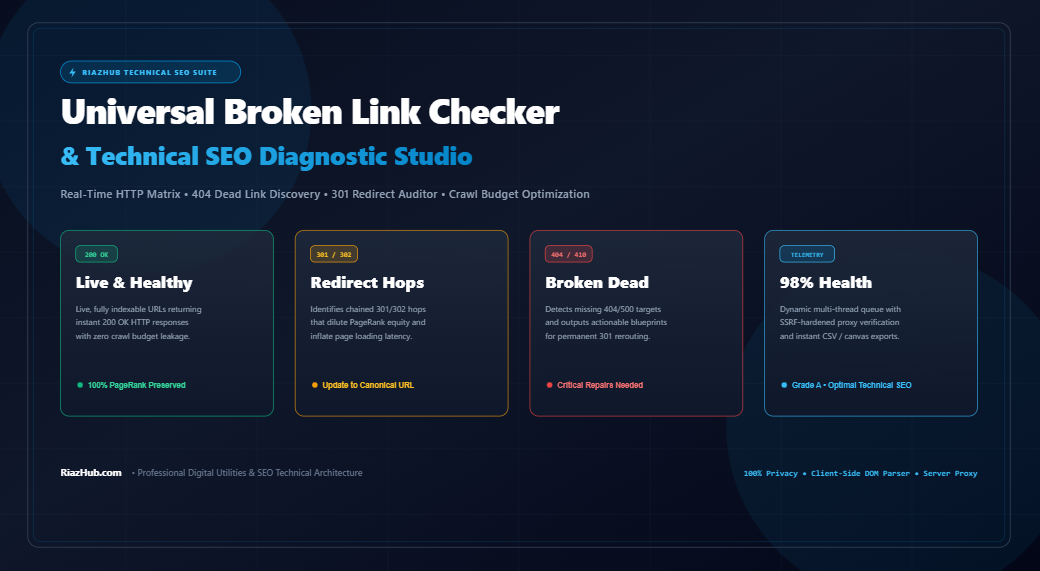
Mastering Link Health: The Complete Guide to Broken Link Audits, HTTP Status Code Diagnostics, and Technical SEO Optimization
To tackle this persistent challenge with zero third-party tracking or bloated server scrapers, RiazHub developed the free Universal Broken Link Checker & Technical SEO Audit Studio. In this comprehensive technical guide, we dissect the anatomy of broken links, analyze the precise mechanics of HTTP status codes, explore the impact of redirect chains, and demonstrate how you can maintain 100% hyperlink health across your web properties.
Audit raw HTML markup, markdown documentation, or batch URL manifests without leaving your browser or installing heavy crawling desktop software.
1. The Hidden Cost of Broken Links on Organic Search Rankings
Search engines like Google, Bing, and DuckDuckGo view the web through the prism of a giant mathematical graph. URLs represent nodes, and hyperlinks represent directed edges. When Googlebot, Bingbot, or other automated spiders traverse your website, they rely entirely on those edges to discover new documents, evaluate semantic topical clusters, and calculate PageRank equity distribution.
When a link points to a non-existent URL (such as a 404 Not Found or a 500 Internal Server Error), three severe SEO penalties occur simultaneously:
- Crawl Budget Depletion: Search engines allocate a finite crawl quota to each domain based on host response latency, overall domain trust, and server health. When crawlers hit dead-ends, that crawl bandwidth is permanently squandered rather than indexing valuable new articles or updated commercial landing pages.
- Link Equity Voiding (PageRank Decay): High-performing pages accumulate backlinks and authority over time. When internal outbound links from these power pages point to dead URLs, that accumulated equity flows straight into an unrecoverable digital void instead of circulating through your internal linking architecture.
- Degraded User Experience & High Bounce Signals: Real visitors who encounter unexpected 404 error screens bounce back to the search engine results page (SERP) within seconds. This rapid “pogo-sticking” behavior sends clear algorithmic signals indicating low content quality and unfulfilled user search intent.
2. Deciphering the HTTP Status Diagnostic Matrix
Every time a browser, crawler, or automated probe requests an internet resource, the receiving web server responds with a standardized 3-digit HTTP status code. Understanding these status codes is foundational to diagnosing technical website architecture.
When you run an analysis using the RiazHub Broken Link Checker Studio, links are automatically categorized into a unified HTTP status diagnostic matrix:
| Status Code Range | Classification | Common Statuses | SEO Impact & Recommended Action |
|---|---|---|---|
| 2xx Success | Live, Healthy & Indexable | 200 OK |
Target resource exists and returned valid content. No remedial action needed. |
| 3xx Redirection | Rerouted Request | 301 Moved Permanently302 Found (Temporary)308 Permanent Redirect |
Link resolves via a redirect hop. Update the source anchor directly to the canonical final URL to eliminate latency and preserve link equity. |
| 4xx Client Errors | Dead / Missing Target | 404 Not Found410 Gone403 Forbidden |
Critical failure. Restore the deleted asset, update the hyperlink, or implement an immediate 301 redirection to a relevant replacement page. |
| 5xx Server Errors | Server Crash / Gateway Down | 500 Internal Error502 Bad Gateway503 Unavailable |
Target hosting server collapsed or timed out. Contact host administrator or replace with a stable alternative resource. |
| 0 / Network Error | Connection / DNS Failure | DNS Lookup FailedSSL Handshake Error |
Domain registration expired, nameservers unreachable, or invalid SSL certificate. Requires immediate domain verification. |
3. The Technical Nuance: 404 Not Found vs. 410 Gone
A frequent point of confusion among webmasters is knowing when to allow a 404 Not Found versus purposefully issuing a 410 Gone status code:
- HTTP 404 Not Found: Informs search engine bots that the server cannot currently locate the resource. Because pages are sometimes accidentally unpublished or misconfigured, search engines like Google will keep a 404 URL in their crawl index and re-attempt crawling it repeatedly for weeks or months.
- HTTP 410 Gone: Explicitly declares that the resource was deliberately and permanently expunged, with no forwarding address. Search engine crawlers interpret a 410 response as an instruction to de-index the URL rapidly, freeing up crawl budget significantly faster.
Before conducting site migrations or major content cleanups, running a diagnostic sweep with the RiazHub Link Health Auditor guarantees that you know which legacy links are dead before they impact your organic visibility.
Analyze Anchor Texts, Rel Attributes (noopener, noreferrer, nofollow), and Insecure HTTP Mixed Content in real-time.
4. The Dangers of Redirect Chains & Insecure Mixed Content
Broken links are not the only silent killers in technical website architecture. Subtle configuration issues such as multi-hop redirect chains and insecure mixed content introduce latency and browser security warnings:
A. Why Redirect Chains Dilute SEO Performance
When an author links to http://example.com/blog, which redirects to https://example.com/blog, which then forwards to https://example.com/blog/, a redirect chain is created. Each hop adds 100ms to 400ms of Time to First Byte (TTFB) latency. If a crawler encounters four or more consecutive hops, it will frequently abandon the crawl entirely, discarding any transmitted link equity. The golden rule of link architecture: internal hyperlinks must always point directly to the final canonical destination URL.
B. Insecure HTTP Mixed Content
If your website operates under secure HTTPS encryption (as modern web standards mandate), linking out to unencrypted http:// assets or pages can trigger browser warning badges, violate strict Content Security Policies (CSP), and create vulnerabilities for man-in-the-middle (MITM) snooping. The RiazHub SEO Audit Studio proactively flags unencrypted protocols so you can upgrade targets to secure HTTPS before publishing.
5. How the RiazHub Link Audit Studio Works Under the Hood
Unlike legacy desktop link crawlers that overwhelm local CPU resources or cloud-based software that forces you into expensive monthly subscriptions, RiazHub utilizes a modern, hybrid client-server architecture:
- In-Browser Client-Side DOM Parsing: When you paste raw HTML or markdown text, your browser’s native
DOMParserand high-speed regular expressions extract all<a href>,<link href>, and<img src>attributes locally in memory. Your private text, unreleased draft articles, and credentials never touch a remote database. - SSRF-Hardened Server Proxy Verification: Because web browsers enforce Cross-Origin Resource Sharing (CORS) security restrictions that block direct cross-domain HTTP requests, status probes are routed through an SSRF-hardened WordPress server proxy. The proxy blocks private/loopback IP addresses (such as
127.0.0.1and192.168.0.0/16) to prevent server-side request forgery, executing authentic HEAD probes with automated GET range fallback. - Mathematical SEO Health Score Calculation: The system applies a weighted penalty formula to evaluate the technical stability of your URL set:
SEO Health Score (%) = max(0, 100 - (Broken / Total × 100) - (Redirects / Total × 25)) - Multi-Format Audit Export: Once the audit concludes, webmasters can generate a 1-click formatted CSV spreadsheet, copy all dead links directly to the clipboard, export high-DPI social audit card certificates (1200×630 canvas), or print a clean PDF report for stakeholders.
6. Best Practice Checklist for Website Health Maintenance
To ensure your digital properties maintain optimal search engine performance, implement this recurring technical hygiene workflow:
- Audit Prior to Publication: Before publishing substantial guides or landing pages, paste the raw HTML into the Broken Link Checker Studio to catch typos and defunct source references.
- Review Quarterly Redirect Maps: Identify 301 and 302 redirects and update the originating hyperlinks to point directly to the newest destination URL.
- Enforce Target Security Standards: Ensure all external links opening in new browser tabs (
target="_blank") includerel="noopener noreferrer"to protect against reverse tab-nabbing security exploits. - Monitor Domain Expirations: External outbound links occasionally expire and are acquired by domain squatters who repurpose them for malicious spam. Routine link sweeps safeguard your readers and brand credibility.
Eliminate dead-end 404 links, streamline crawl budget, and safeguard your search rankings today.
Universal Broken Link Checker & HTTP Matrix
Scan web pages, raw HTML markup, or bulk URLs to discover dead 404 targets, chained redirects, insecure HTTP mixed content, and anchor text anomalies in real time.
Ingestion Deck
| Status | Target URL & Anchor | Type | Rel Attributes | Latency | Inspect |
|---|---|---|---|---|---|
| Paste links or sample HTML and click Start Link Audit to initiate HTTP verification. | |||||