
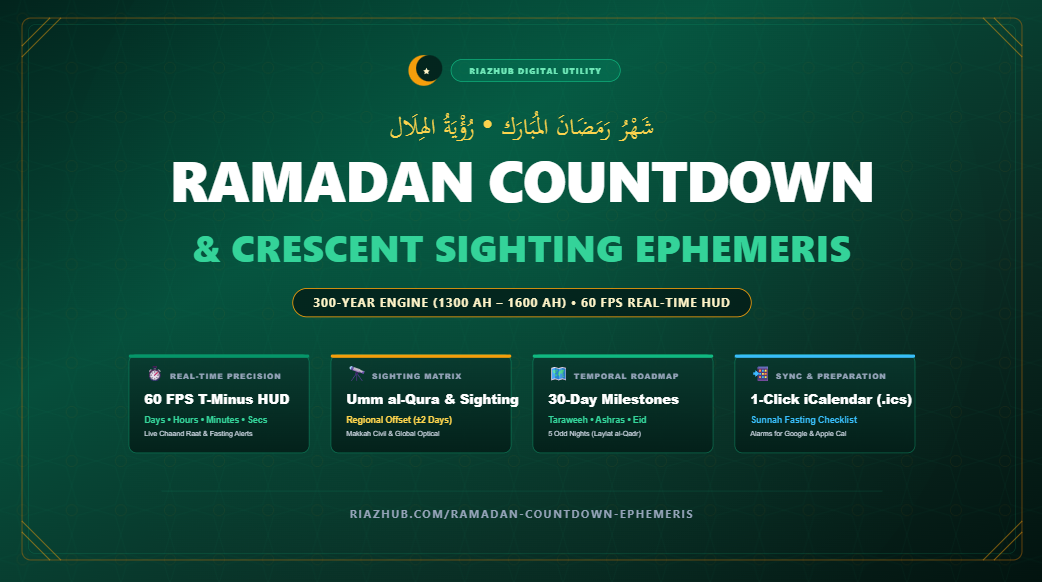
Universal Ramadan Countdown & Crescent Sighting Ephemeris: The Complete Guide to Islamic Horology & Spiritual Preparation
The arrival of the blessed month of Ramadan (شَهْرُ رَمَضَانَ المُبَارَك) represents the spiritual pinnacle of the Islamic lunar calendar. For more than 1.9 billion Muslims across the globe, determining the exact inception of the month known traditionally as Ghurrat Ramadan (غُرَّةُ شَهْرِ رَمَضَان) governs the commencement of obligatory dawn-to-sunset fasting, nightly Taraweeh congregational prayers, and community vigils. To provide unrivaled precision for both immediate spiritual milestones and long-term academic planning, the Universal Ramadan Countdown & Crescent Ephemeris Studio on RiazHub delivers an in-browser astronomical engine spanning 300 years (1300 AH to 1600 AH / 1882 CE to 2175 CE).
⚡ Quick Access to the Live Tool
Looking to check your remaining days, calibrate local moon-sighting offsets, download your official Ramadan iCalendar (.ics) file, or generate custom welcoming greeting cards? Launch the interactive Ramadan Countdown & Ephemeris Studio on RiazHub.com right inside your browser with 100% privacy and zero server-side tracking.
1. The Sacred Foundations of Ramadan & the Lunar Horizon
The divine significance of Ramadan is enshrined directly within the Holy Quran:
“The month of Ramadan [is that] in which was revealed the Qur’an, a guidance for the people and clear proofs of guidance and criterion. So whoever sights [the new moon of] the month, let him fast it…”
Surah Al-Baqarah (2:185)
Unlike the solar Gregorian calendar which adheres to the 365.2422-day tropical solar cycle, the Islamic Hijri calendar operates on a purely lunar calendar system composed of 12 synodic months. Each synodic month represents the duration between two successive conjunctions of the Moon and the Sun (new moon birth), averaging approximately 29.530588 days. As a direct mathematical consequence, an Islamic lunar year spans 354 or 355 days roughly 10 to 12 days shorter than a standard solar year.
This fundamental astronomical divergence causes Ramadan to migrate backwards through the Gregorian calendar seasons over a repeating 33-year solar cycle. To explore how seasonal daylight variations shift fasting duration from winter chill to summer heat across centuries, researchers and worshippers frequently consult the multi-century projection tables inside the RiazHub Ramadan Countdown & Ephemeris Tool.
2. Moon-Sighting Fiqh: Physical Sighting vs. Astronomical Calibration
The determination of the 1st of Ramadan has historically involved careful observation of the nascent crescent moon (Hilal) following the sunset of the 29th day of Sha’ban. The Messenger of Allah (ﷺ) established the legal precedent in a foundational Hadith recorded in Sahih al-Bukhari (1909):
“Fast when you see it (the crescent) and break your fast when you see it; and if it is obscured from you, complete the month of Sha’ban as thirty days.”
In modern horology and global Islamic jurisprudence, three prevailing sighting conventions have emerged:
- Umm al-Qura Calendar (Official Saudi Arabia / Makkah Baseline): The civil astronomical calendar calculated for the coordinates of the Holy Ka’bah in Makkah al-Mukarramah. It decrees the new month if the geocentric conjunction occurs before sunset and the moon sets strictly after sunset at Makkah.
- Global Naked-Eye Moonsighting (Ru’yat al-Hilal): Followed extensively throughout South Asia, parts of the UK, and traditional communities worldwide. It requires credible human optical sighting of the crescent. Because the moon must attain sufficient elongation and altitude above the western horizon to be visible to the unaided eye, this convention typically commences one day after the astronomical birth.
- Astronomical Criteria (Fiqh Council of North America – FCNA & ECFR): Employs strict scientific parameters requiring the moon to be born before 12:00 Universal Time (UTC) and to set after sunset at a predetermined horizon point, providing years of advance certainty for community scheduling.
Because local geography, atmospheric turbidity, and national crescent observation committees can result in regional variations of ±1 or ±2 days, users can calibrate these parameters in real time using the Universal Ramadan Sighting Calibration Matrix.
3. The 300-Year Projection Engine (1300 AH to 1600 AH)
A central architectural breakthrough of the RiazHub Ramadan Ephemeris Studio is its continuous 300-year dual-calendar calculation engine. While conventional widgets offer single-year static dates, this engine computes and cross-references dates spanning:
- Hijri Range: 1300 AH to 1600 AH (spanning three complete centuries of Islamic history).
- Gregorian Equivalents: 1882 CE to 2175 CE.
- Mathematical Ephemeris: Integrates high-precision Tabular Islamic Julian Day Number (JDN) equations seamlessly merged with verified Umm al-Qura civil ephemeris data for modern decades.
Below is a concise sample excerpt from the multi-century projection ephemeris:
| Hijri Year | 1st of Ramadan (Gregorian) | Weekday | Season | Est. Fasting Window |
|---|---|---|---|---|
| 1445 AH | March 11, 2024 | Monday | Late Winter / Spring | ~13 – 14 Hours |
| 1446 AH | March 1, 2025 | Saturday | Winter | ~12 – 13 Hours |
| 1447 AH | February 18, 2026 | Wednesday | Mid Winter | ~11 – 12 Hours |
| 1448 AH | February 8, 2027 | Monday | Peak Winter | ~11 Hours (Shortest Fast) |
| 1451 AH | January 6, 2030 | Sunday | Deep Winter | ~10.5 Hours (First 2030 Ramadan) |
| 1452 AH | December 26, 2030 | Thursday | Winter Solstice | ~10.5 Hours (Second 2030 Ramadan) |
Note on the Double Ramadan Phenomenon in 2030 CE: Because the lunar year is roughly 11 days shorter than the solar year, the year 2030 CE will feature two distinct Ramadans, Ramadan 1451 AH in early January and Ramadan 1452 AH in late December. You can observe and verify this astronomical occurrence directly on the RiazHub Ramadan Multi-Year Ephemeris Matrix.
4. Key Interactive Capabilities of the Studio
The application is engineered as an all-in-one horology and spiritual productivity studio. Here is an overview of the core modules accessible on the platform:
A. Split Flip-Card T-Minus Countdown HUD (60 FPS)
The primary display provides high-frequency, millisecond-calibrated flip clock units displaying Days, Hours, Minutes, and Seconds remaining until the anticipated crescent sighting night (Chaand Raat) and the dawn of the 1st of Ramadan. When Ramadan arrives, the HUD automatically transforms into a celebratory status monitor indicating the current day of fasting (e.g., “Day 12 of 30 — Ramadan Mubarak”).
B. Complete 30-Day Ramadan Milestones Roadmap
Rather than merely tracking day one, the milestone roadmap outlines the critical spiritual transitions of the entire month:
- Chaand Raat & 1st Taraweeh: The sighting evening marking the official commencement of congregational night prayers after Isha.
- 1st of Ramadan: The initial dawn-to-sunset fast.
- 10th of Ramadan: Conclusion of the First Ashra of Divine Mercy (أيام الرحمة).
- 20th of Ramadan: Conclusion of the Second Ashra of Divine Forgiveness (أيام المغفرة) and the sunnah entry into Itikaf seclusion.
- The Blessed Odd Nights (21st, 23rd, 25th, 27th, 29th): The heightened search for Laylat al-Qadr (The Night of Decree), with focal emphasis on the 27th night.
- 1st of Shawwal (Eid al-Fitr): The global Islamic celebration marking the conclusion of the holy month.
C. Pre-Ramadan Spiritual Habit & Sunnah Fasting Checklist
True preparation for Ramadan begins months prior, particularly during Rajab and Sha’ban. The studio features an integrated spiritual readiness tracker allowing believers to monitor:
- Making up missed obligatory fasts from the preceding year (Qada / قضاء).
- Voluntary Sunnah fasts during Sha’ban, following the prophetic practice.
- Setting daily Quran Tilawah schedules to complete the 30 Juz.
- Establishing daily Istighfar and Dhikr routines.
Progress is saved persistently using browser-based localStorage, guaranteeing that your personal goals remain private and intact without needing an account.
D. Prophetic Crescent Sighting Dua & Audio Reciter
Upon viewing the new moon, the Prophet Muhammad (ﷺ) taught believers to recite:
اللَّهُمَّ أَهِلَّهُ عَلَيْنَا بِالْيُمْنِ وَالإِيمَانِ وَالسَّلامَةِ وَالإِسْلامِ، رَبِّي وَرَبُّكَ اللَّهُ
“Allāhumma ahillahu ‘alaynā bil-yumni wal-īmān, was-salāmati wal-Islām, Rabbī wa Rabbukallāh.”
“O Allah, bring this crescent moon upon us with security, faith, safety, and Islam. My Lord and your Lord is Allah.”
— Jami’ at-Tirmidhi 3451 (Sahih)
The tool features an integrated native SpeechSynthesis audio reciter that articulates the Arabic supplication in pristine acoustic cadence, enabling users and families to learn and recite it accurately together.
E. High-Resolution Social Welcoming Card Generator (1200×630)
Need an elegant, customized Ramadan greeting banner for WhatsApp, Instagram, Facebook, or Twitter/X? The studio’s HTML5 Canvas generator produces instant 1200×630 social cards in four distinct themes:
- Sacred Emerald: Rich emerald radial gradients with gilded gold trim.
- Imperial Gold: Warm amber arabesque luxury framing.
- Midnight Navy: Cosmic deep blue tailored for nocturnal Laylat al-Qadr aesthetics.
- Desert Sand: Warm terracotta and desert motifs evoking historic Hijazi landscapes.
You can download the generated card in uncompressed PNG format with a single click at the RiazHub Welcoming Card Studio.
F. 1-Click iCalendar (.ics) Alarms Export
Never miss Chaand Raat, the first pre-dawn Suhoor meal, or the pivotal 27th night of Laylat al-Qadr. The tool compiles and downloads standardized .ics calendar files that sync seamlessly with Apple Calendar, Google Calendar, Microsoft Outlook, and mobile operating systems.
5. How to Integrate the Tool into Your Personal & Community Routine
Whether you are an individual planning your annual vacation around the last 10 days of Ramadan, an Islamic school administrator organizing academic schedules, or a community mosque coordinator publishing prayer calendars, here is the recommended workflow:
- Select Target Year: Select your desired Hijri year (from 1300 AH up to 1600 AH). The Gregorian calendar automatically locks into alignment.
- Calibrate Sighting Method: Choose between Umm al-Qura, Global Naked-Eye, or FCNA standards depending on your national or local mosque affiliation.
- Apply Regional Day Offsets: If your local crescent committee observes a 1-day variation from Makkah, toggle the -1 or +1 day stepper to calibrate the entire milestone timeline.
- Download iCal Alarms: Click “Add Ramadan to Calendar (.ics)” to export pre-configured notification reminders directly to your smartphone.
- Track Daily Spiritual Goals: Open the preparation checklist accordion to establish fasting readiness weeks before the first Taraweeh prayers commence.
6. Frequently Asked Questions (FAQ)
Why does Ramadan begin on different days across different countries?
Because the new crescent moon is first visible along a curved parabolic “visibility parabolic zone” that shifts westward across Earth as the planet rotates, western nations frequently observe the crescent hours before eastern nations. Additionally, some countries adhere strictly to local physical sighting with the naked eye, while others follow official Makkah ephemeris or astronomical calculation, leading to legitimate 24-hour regional variations. You can adjust for your locality easily via the regional offset tuner on RiazHub.
How does the studio guarantee user privacy?
All Julian Day Number calculations, countdown timer arithmetic, checklist updates, canvas card rendering, and iCalendar file generations execute 100% locally inside your client browser. No cookies, tracking tokens, IP addresses, or personal spiritual notes are ever dispatched to or stored on an external server.
Can I use the tool to look up historical Ramadan dates?
Yes. The ephemeris projection engine spans backward to 1300 AH (1882 CE) and forward to 1600 AH (2174 CE), making it an invaluable scholarly resource for historical verification, family ancestry milestone mapping, and long-term event scheduling.
Conclusion: Welcome the Blessed Month with Knowledge & Purpose
Ramadan is far more than a duration of dietary abstinence; it is a sacred season of spiritual rejuvenation, divine mercy, and Quranic immersion. By pairing ancient astronomical sunnah with cutting-edge digital precision, believers worldwide can now approach the blessed month with enhanced horological clarity and spiritual readiness.
Bookmark and explore the Universal Ramadan Countdown, Crescent Sighting Ephemeris & Spiritual Preparation Studio on RiazHub today, and share the countdown with your family, friends, and community as we await the blessed crescent moon.
Universal Ramadan Countdown & Ephemeris غُرَّةُ شَهْرِ رَمَضَانَ المُبَارَك (١٣٠٠ هـ - ١٦٠٠ هـ)
High-precision 300-year Hijri projection engine (1300 AH to 1600 AH), moon-sighting calibration matrix, ticking countdown HUD, 30-day temporal milestone roadmap, and spiritual preparation suite.
The Prophetic Crescent Sighting Dua
| Hijri Year | 1st Ramadan (CE) | Weekday | Season | Fast Window | Action |
|---|
📖 Essential Fiqh, Astronomical Ephemeris & Fasting Virtues Guide
- Days 1 to 10: The First Ashra of Divine Mercy (أيام الرحمة).
- Days 11 to 20: The Second Ashra of Divine Forgiveness (أيام المغفرة).
- Days 21 to 30: The Final Ashra of Deliverance from the Fire (العتق من النار), featuring Sunnah Itikaf and the intense search for Laylat al-Qadr (the Night of Decree) during the five odd nights (21st, 23rd, 25th, 27th, and 29th).