
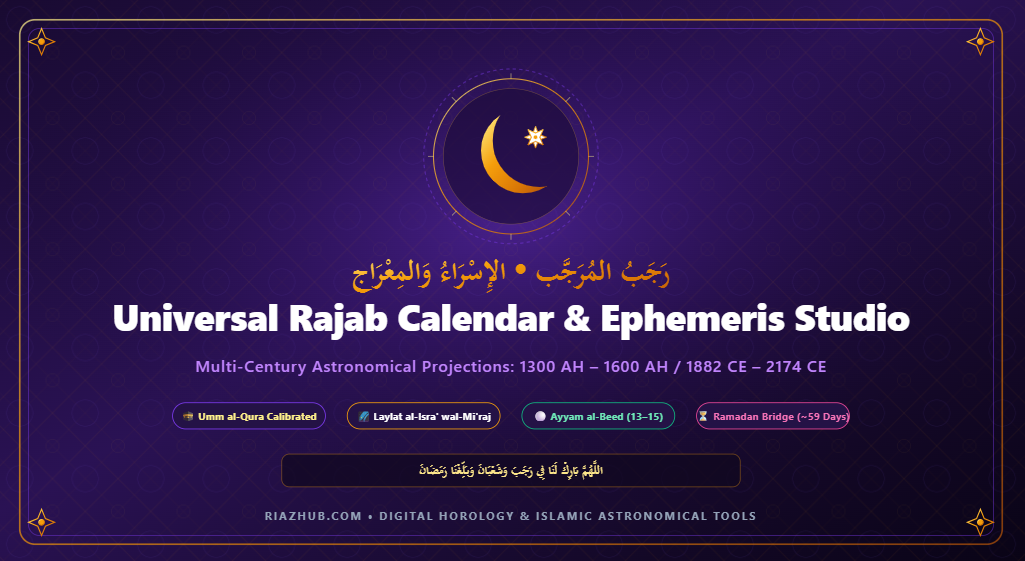
Universal Rajab Calendar, Sacred Month Ephemeris & Isra’ wal-Mi’raj Horology Guide
To assist Muslims worldwide in planning voluntary fasts, commemorating historical milestones, and aligning their civil schedules with authentic lunar sighting criteria, the interactive Universal Rajab Calendar & Sacred Month Ephemeris Studio offers astronomical projections spanning three full centuries (1300 AH to 1600 AH / 1882 CE to 2174 CE). In this detailed guide, we explore the theological status of Rajab, the historical miracle of Al-Isra’ wal-Mi’raj, voluntary fasting chronologies, and how modern digital ephemeris calculations harmonize tradition with astronomical precision.
Need to determine the exact Gregorian dates for 1st Rajab, Ayyam al-Beed, or Laylat al-Isra’ wal-Mi’raj for any year between 1300 AH and 1600 AH? Access our real-time calibrated calculator with customizable regional moon sighting offsets (-2 to +2 days) and 1-click calendar sync.
1. Theological Foundations: Why is Rajab Sacred?
The sanctification of four specific months is deeply rooted in the Holy Qur’an. In Surah At-Tawbah (9:36), Allah ﷻ declares:
إِنَّ عِدَّةَ الشُّهُورِ عِندَ اللَّهِ اثْنَا عَشَرَ شَهْرًا فِي كِتَابِ اللَّهِ يَوْمَ خَلَقَ السَّمَاوَاتِ وَالأَرْضَ مِنْهَا أَرْبَعَةٌ حُرُمٌ ۚ ذَٰلِكَ الدِّينُ الْقَيِّمُ ۚ فَلَا تَظْلِمُوا فِيهِنَّ أَنفُسَكُمْ
“Verily, the number of months with Allah is twelve months in the Register of Allah from the day He created the heavens and the earth; of them, four are sacred (hurum). That is the correct religion, so wrong not yourselves therein…”
Surah At-Tawbah (9:36)
The Prophet Muhammad ﷺ explicitly identified these four sacred periods in an authentic tradition narrated by Abu Bakrah (رضي الله عنه) and recorded in Sahih al-Bukhari (3197):
“The division of time has turned to its original form which was current when Allah created the Heavens and the Earth. The year is of twelve months, out of which four months are sacred: Three are in succession Dhul-Qa’dah, Dhul-Hijjah and Al-Muharram and (the fourth is) Rajab of (the tribe of) Mudar, which comes between Jumada and Sha’ban.”
Titles and Classical Descriptions of Rajab
Classical scholars and Arabic linguists noted several revered epithets associated with this solitary sacred month:
- Rajab al-Fard (The Solitary Month): Unlike Dhul-Qa’dah, Dhul-Hijjah, and Muharram which occur consecutively, Rajab stands distinct and isolated as the seventh lunar month.
- Rajab al-Asabb (The Month of Outpouring): Early ascetics dubbed it Al-Asabb because divine mercy, forgiveness, and spiritual blessings are said to pour down abundantly upon sincere supplicants who make Istighfar.
- Rajab al-Asamm (The Silent Month): In pre-Islamic and early Islamic Arabia, weapons were laid down and the clash of swords ceased in veneration of the sanctified month.
2. The Spiritual Trimester: Preparing for Ramadan
Early scholars characterized the progression through Rajab, Sha’ban, and Ramadan as a seasonal spiritual cultivation cycle. The great Sufi scholar Imam Abu Bakr al-Warraq al-Balkhi (رحمه الله) observed:
“The month of Rajab is the month to sow seeds; the month of Sha’ban is the month to irrigate the crops; and the month of Ramadan is the month to reap the harvest.”
He further analogized: “Rajab is like the wind, Sha’ban is like the rain-bearing clouds, and Ramadan is like the downpour of rain.” Those who cultivate righteous habits and cleanse their hearts in Rajab find themselves effortlessly prepared to embrace the intensive fasting and nightly prayers (Qiyam) of Ramadan.
The Prophetic Supplication for the Sacred Trimester
When the crescent of Rajab was sighted, the Beloved Messenger ﷺ would supplicate for barakah (divine blessing) throughout this preparatory season:
اللَّهُمَّ بَارِكْ لَنَا فِي رَجَبَ وَشَعْبَانَ وَبَلِّغْنَا رَمَضَانَ
Transliteration: “Allāhumma bārik lanā fī Rajaba wa Sha’bāna wa ballighnā Ramaḍān.”
Translation: “O Allah, grant us blessings in the months of Rajab and Sha’ban, and allow us to reach the blessed month of Ramadan.”
Visitors utilizing the Rajab Ephemeris Horology Studio can listen to a native audio recitation of this sacred prayer directly inside their browser, copy the authentic Arabic Tashkeel typography, and review spiritual commentaries.
3. Laylat al-Isra’ wal-Mi’raj: The Miraculous Night Journey & Heavenly Ascension
The 27th night of Rajab is traditionally commemorated across the Islamic world as Laylat al-Isra’ wal-Mi’raj (ليلة الإسراء والمعراج) one of the most consequential miracles in prophetic history. Occurring during a period of immense sorrow following the deaths of Sayyidah Khadijah (رضي الله عنها) and the Prophet’s protective uncle Abu Talib (the Year of Sorrow / ‘Am al-Huzn), this divine ascension served as profound heavenly solace.
Surah Al-Isra’ (17:1) immortalizes this miraculous journey:
سُبْحَانَ الَّذِي أَسْرَىٰ بِعَبْدِهِ لَيْلًا مِّنَ الْمَسْجِدِ الْحَرَامِ إِلَى الْمَسْجِدِ الْأَقْصَى الَّذِي بَارَكْنَا حَوْلَهُ لِنُرِيَهُ مِنْ آيَاتِنَا ۚ إِنَّهُ هُوَ السَّمِيعُ الْبَصِيرُ
To accurately forecast when the 27th of Rajab will fall in upcoming civil years, researchers and community leaders can consult the Universal Rajab Calendar tool, which highlights Laylat al-Isra’ wal-Mi’raj with synchronized Gregorian dates and a live T-minus countdown HUD.
4. Voluntary Fasting Chronology & Devotional Blueprint
While classical jurisprudence (Fiqh) does not prescribe an obligation to fast the entirety of Rajab, scholars across all four Sunni schools encourage regular voluntary (Nafl) fasts following the Sunnah of the Prophet Muhammad ﷺ:
| Observance | Hijri Dates | Spiritual Significance & Evidence |
|---|---|---|
| Sacred Entry | 1st of Rajab | Marking the start of the Sacred Trimester; setting sincere intentions for the approach to Ramadan. |
| Sunnah Fasting | Mondays & Thursdays | The Prophet ﷺ said: “Deeds are presented on Mondays and Thursdays, and I love that my deeds be presented while I am fasting.” (Tirmidhi 747). |
| The White Days (Ayyam al-Beed) | 13th, 14th, 15th Rajab | Fasting during the full moon days of each lunar month, which the Prophet ﷺ commended as equivalent to fasting the entire year (Bukhari 1975). |
| Isra’ wal-Mi’raj Reflection | 27th of Rajab | Observed through nightly Tahajjud prayers, Quran recitation, and optional voluntary fasting on the subsequent day. |
The built-in habit tracker on RiazHub’s Rajab Calendar automatically records your completed fasts, tracks daily Istighfar goals, and updates an interactive spiritual preparation meter saved securely in your browser.
5. Astronomical Ephemeris & Multi-Century Horology (1300 AH to 1600 AH)
Islamic calendar dates are fundamentally lunar, governed by the synodic orbit of the Moon which averages 29.530588 days. Consequently, an Islamic lunar year comprises 354 or 355 days approximately 10 to 12 days shorter than the Gregorian solar year. Because of this orbital delta, Rajab retrogrades through all four seasons over an approximate 33-year cycle.
Bridging historical records from 1300 AH (1882 CE) up to future horizons in 1600 AH (2174 CE) requires combining verified civil almanac archives with rigorous astronomical arithmetic:
- The Umm al-Qura Calendar Standard: Saudi Arabia’s official civil ephemeris based on the astronomical conjunction (New Moon) occurring before sunset at the horizon of Makkah al-Mukarramah.
- Global Crescent Sighting (Ru’yat al-Hilal): Requiring physical naked-eye or optical crescent sighting, which can introduce a 1-day or 2-day variation in regions such as the United Kingdom, Pakistan, India, and North America.
- Julian Day Number (JDN) Transformation: Algorithmic conversion using the Fliegel-Van Flandern methodology to calculate astronomical day indices continuously without leap-century discrepancies.
Never miss an Ayyam al-Beed fast or the 27th night of Rajab. With the RiazHub Universal Rajab Tool, you can generate compliant .ics calendar files that instantly populate Google Calendar, Apple Calendar, and Microsoft Outlook with pre-fasting Suhoor alarms.
6. How to Use the Universal Rajab Calendar Studio on RiazHub
Designed with client-side privacy, responsive aesthetics, and fluid touch controls, navigating the utility takes just a few clicks:
- Select Your Target Year: Use the bidirectional year steppers to jump anywhere between 1300 AH and 1600 AH (or Gregorian 1882 CE to 2174 CE). Changing one year input automatically synchronizes the other.
- Calibrate Moon Sighting: Choose between the Umm al-Qura Standard, Global Crescent Sighting, or Astronomical Rules. Adjust the day offset slider from -2 to +2 days to match your local Islamic authority.
- Monitor Real-Time Countdowns: View live ticking flip clocks showing days, hours, minutes, and seconds remaining until 1st Rajab, 27th Rajab, and the arrival of Ramadan.
- Explore the 30-Day Grid: Click on any date cell in the 7-column calendar to open detailed devotional recommendations, mark individual fasts, or export single-day calendar reminders.
- Generate Social Media Announcement Cards: Navigate to the Social Card Generator tab to render crisp 1200×630 cards in Royal Violet, Emerald Oasis, Imperial Gold, or Midnight Slate themes ready for immediate download.
7. Frequently Asked Questions (FAQ)
Is it mandatory to fast in Rajab?
No. There is no obligatory fasting in Rajab; fasting obligations are specific to the month of Ramadan. However, voluntary fasts—especially on Mondays, Thursdays, and the 13th, 14th, and 15th (The White Days) carry immense spiritual rewards.
Why do Rajab dates vary by 1 or 2 days across different countries?
The variation arises from differing moon sighting criteria. Some jurisdictions strictly follow local naked-eye crescent observation, while others follow official astronomical calculations (such as the Umm al-Qura calendar). The Universal Rajab Calendar on RiazHub allows you to manually apply offsets to mirror your local community’s verified announcements.
Is my fasting checklist data private?
Yes. 100% of computations, calendar generations, and habit tracking logs run entirely inside your web browser via localStorage. Zero personal records or dates are ever sent to external servers.
Conclusion: Welcoming the Season of Divine Mercy
The arrival of Rajab is a divine invitation to awaken the heart, abandon transgressions, and establish the spiritual rhythm that will carry you triumphantly into Sha’ban and Ramadan. By combining ancient prophetic traditions with modern horological precision, believers can plan their worship thoughtfully and stay mindfully attuned to the sacred calendar.
Universal Rajab Calendar & Sacred Month Studio
Explore the sacred month of Rajab (رَجَب المُرَجَّب), project exact astronomical dates across 1300 AH to 1600 AH (1882 CE to 2174 CE), calculate Laylat al-Isra' wal-Mi'raj (27th), track live countdowns to Ramadan, and plan voluntary Sunnah fasts.
✨ The Spiritual Horizon: Road to Ramadan
Rajab is the gateway into the sacred trimester. Early scholars noted: "Rajab is the month to sow seeds, Sha'ban to irrigate, and Ramadan to reap the harvest."
Rajab Calendar Grid
Complete 30-Day Astronomical Projection🕋 The Night Journey (Al-Isra')
The physical night journey from the Sacred Mosque (Al-Masjid al-Haram) in Makkah to the Farthest Mosque (Al-Masjid al-Aqsa) in Jerusalem aboard the miraculous heavenly mount, Al-Buraq, led by Archangel Jibril (Gabriel) علیہ السلام.
🌌 The Heavenly Ascension (Al-Mi'raj)
The celestial ascension of the Prophet Muhammad ﷺ from Jerusalem through the seven heavens, meeting past messengers (Adam, Isa, Yahya, Yusuf, Idris, Harun, Musa, and Ibrahim علـيهم السلام), culminating at Sidrat al-Muntaha (The Lote Tree of the Utmost Boundary).
🕌 The Divine Gift of the Five Daily Prayers
The obligation of Salah was gifted directly beyond the heavenly veils. Originally commanded as fifty daily prayers, it was mercifully reduced to five through divine compassion, while retaining the full spiritual reward of fifty prayers.
✨ Spiritual Etiquette for the 27th Night
Commemorated through increased voluntary prayers (Tahajjud), recitation of the Holy Qur'an, deep contemplation on the status of the Beloved Prophet ﷺ, sincere repentance (Tawbah), and voluntary fasting on the following day.
📖 Significance of Rajab, The Sacred Months & Prophetic Horology
- Mondays & Thursdays: The days when deeds are presented before Allah ﷻ.
- Ayyam al-Beed (The White Days - 13th, 14th, and 15th): Sunnah fasts during the full moon days of every lunar month.
- General Voluntary Fasts: Increasing voluntary fasting as physical and spiritual conditioning for Ramadan.