
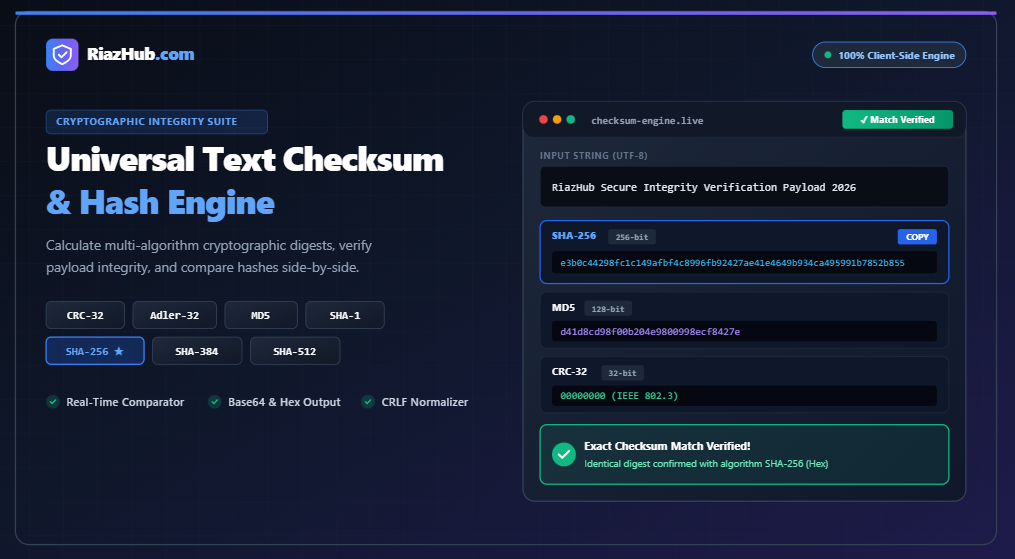
Universal Text Checksum Generator & Cryptographic Hash Engine: The Complete Guide to Data Integrity and Verification
1. What is a Text Checksum & Cryptographic Hash Engine?
At its simplest, a checksum (or hash digest) is a deterministic mathematical algorithm that converts an arbitrary block of data—ranging from a single character to gigabytes of source code—into a fixed-length string of hexadecimal or Base64 characters.
No matter how many times you feed the exact same input string into the algorithm, it will always return the exact same output digest. However, changing even a single byte, punctuation mark, or whitespace will completely transform the resulting fingerprint. This phenomenon is known as the Avalanche Effect.
Modern engineers, system administrators, and security specialists rely on tools like the RiazHub Text Checksum Generator to:
- Detect accidental data corruption caused by noisy network connections, dropped packets, or failing storage media.
- Detect deliberate malicious tampering, code injections, or man-in-the-middle payload alterations.
- Validate software downloads and package dependencies (such as NPM, PyPI, Maven, and Linux packages) against vendor-published release manifests.
- Audit API webhook signatures for platforms like Stripe, GitHub, and Shopify.
Calculate & Verify 7 Checksums in Real Time
Generate CRC-32, Adler-32, MD5, SHA-1, SHA-256, SHA-384, and SHA-512 digests in sub-milliseconds with 100% in-browser client-side privacy.
2. Checksums vs. Cryptographic Hashes: Understanding the Difference
Although developers frequently use the terms checksum, hash, and digest interchangeably, there is a fundamental mathematical and security distinction between error-detecting checksums and collision-resistant cryptographic hash functions:
| Algorithm | Bit Length | Primary Category | Collision Resistant? | Ideal Use Case |
|---|---|---|---|---|
| CRC-32 | 32-bit (8 hex chars) | Error-Detection Checksum | ❌ No (Easily forged) | Ethernet, ZIP archives, PNG chunks, quick file integrity |
| Adler-32 | 32-bit (8 hex chars) | Error-Detection Checksum | ❌ No (Easily forged) | Zlib compression streams, fast in-memory verification |
| MD5 | 128-bit (32 hex chars) | Legacy Message Digest | ❌ Vulnerable to collisions | File deduplication, non-cryptographic checksums, legacy APIs |
| SHA-1 | 160-bit (40 hex chars) | Legacy Cryptographic | ❌ Vulnerable (SHAttered) | Git commit tree IDs, legacy certificate backward compatibility |
| SHA-256 | 256-bit (64 hex chars) | Standard Cryptographic | ✅ Yes (Gold Standard) | TLS/SSL certificates, Bitcoin/Blockchain, package manifests, APIs |
| SHA-384 | 384-bit (96 hex chars) | Cryptographic Digest | ✅ Yes (High Security) | Government communications (NSA Suite B), enterprise PKI |
| SHA-512 | 512-bit (128 hex chars) | Military-Grade Cryptographic | ✅ Yes (Maximum Strength) | Financial transactions, high-security archival, shadow password hashing |
CRC-32 and Adler-32 are designed exclusively for detecting transmission errors, not resisting deliberate adversary attacks. MD5 and SHA-1 have known collision vulnerabilities. For password storage or digital signatures, always use modern keyed hash constructions or algorithms like SHA-256, SHA-512, bcrypt, or Argon2.
3. In-Depth Breakdown of the 7 Checksum & Hash Algorithms
1. CRC-32 (Cyclic Redundancy Check)
Introduced as an IEEE 802.3 telecommunications standard, CRC-32 performs polynomial division modulo 2 on raw binary data. It calculates a compact 32-bit (8-character hexadecimal) integer checksum. Because it requires minimal CPU cycles and can be implemented with efficient bit-shift lookup tables, CRC-32 is ubiquitous in Ethernet frame checks, ZIP file headers, PNG image metadata, and SATA disk controllers.
2. Adler-32
Invented by Mark Adler for the widely celebrated zlib compression library, Adler-32 computes two 16-bit 1’s-complement checksums (accumulated modulo 65521) and concatenates them into a single 32-bit integer. Adler-32 prioritizes computation speed in software over the mathematical error-distribution strengths of CRC-32, making it an excellent lightweight integrity check during stream compression.
3. MD5 (Message Digest Algorithm 5)
Designed by Ronald Rivest in 1991 (RFC 1321), MD5 processes 512-bit blocks through 64 nonlinear bitwise operations to generate a 128-bit (32 hexadecimal character) fingerprint. While cryptographers demonstrated collision attacks in 2004, MD5 remains extraordinarily common across Unix file verification (md5sum), database row deduplication, and S3 object verification.
4. SHA-1 (Secure Hash Algorithm 1)
Published by NIST in 1995 (FIPS PUB 180-1), SHA-1 produces a 160-bit (40-character hex) digest. SHA-1 served as the global backbone of TLS certificates and digital signatures for two decades and continues to serve as the foundational content-addressable storage mechanism inside Git revision trees.
5. SHA-256 (The Industry Workhorse)
Part of the SHA-2 family established by the National Security Agency (NSA) and NIST (FIPS PUB 180-4), SHA-256 computes a 256-bit (64-character hex) digest. It is currently the world’s most widely implemented cryptographic hash algorithm, powering HTTPS certificate chains, Docker container image signatures, GitHub release assets, and Bitcoin proof-of-work consensus. You can quickly generate SHA-256 strings with the RiazHub Checksum Suite.
6. SHA-384 & SHA-512
Operating on 64-bit words (unlike SHA-256’s 32-bit words), SHA-512 computes a massive 512-bit (128-character hex) digest with 80 operational rounds. SHA-384 is a truncated variant offering 384 bits of collision protection. On modern 64-bit multi-core processors, SHA-512 frequently executes even faster than SHA-256 while offering military-grade resistance against quantum computing attacks.
4. The Hidden Traps in Text Checksum Generation: Line Endings & Encodings
When generating checksums for strings, configuration tokens, or source code snippets across different operating systems, developers frequently encounter checksum mismatches even when the text looks visually identical. Two hidden factors cause 99% of these issues:
A. Windows CRLF vs. Unix LF Line Endings
Operating systems handle newlines differently:
- Windows (CRLF): Appends Carriage Return + Line Feed (
\r\n, 2 bytes). - Linux & macOS (LF): Appends Line Feed only (
\n, 1 byte).
Because cryptographic hash engines process exact binary byte sequences, a single newline difference will yield a completely different SHA-256 hash. The RiazHub Checksum Generator includes a built-in “Normalize Line Endings (CRLF → LF)” switch that converts all line endings to Unix standards before hashing, ensuring flawless cross-platform validation.
B. UTF-8 Multi-Byte Character Encodings
Plain ASCII characters (A-Z, 0-9) occupy 1 byte each. However, international scripts (Arabic, Urdu, Cyrillic, Chinese), currency signs (€, £, ¥), and emojis (🔥, ⚡) consume between 2 and 4 bytes in UTF-8. The RiazHub tool applies strict TextEncoder() UTF-8 binary parsing, ensuring reliable checksum outputs regardless of language or script.
Unlike legacy online hashing websites that upload your strings to remote PHP servers, the RiazHub Checksum Engine runs 100% locally in your web browser using native Web Crypto API and bitwise JavaScript logic. Your sensitive passwords, API keys, JSON configurations, and source code never leave your device.
5. How to Use the RiazHub Text Checksum Generator & Verification Tool
- Input Your Text or Upload a File: Type or paste text into the source textarea, or drag and drop any
.txt,.md,.csv,.log, or.jsondocument directly onto the dropzone. - Configure Formatting Options: Toggle UPPERCASE (HEX), enable Include Base64 Output Mode, or turn on Normalize Line Endings according to your testing specifications.
- Perform Real-Time Verification: Paste an expected checksum into the Checksum Comparator box. The tool automatically compares the string against all 7 calculated algorithms simultaneously and illuminates the exact matching card in glowing green.
- Copy or Export Manifests: Copy individual digests with 1-click clipboard buttons, or download comprehensive audit reports in formatted JSON or CSV/TXT manifests for archival.
6. Frequently Asked Questions (FAQ)
Start Generating & Verifying Checksums Now
Access the free, client-side, multi-algorithm cryptographic verification suite on RiazHub.
Universal Text Checksum Generator
Calculate multi-algorithm checksums, cryptographic hashes, and verify data integrity in real time with instant side-by-side comparison. All operations run 100% locally in your browser.
Checksums, Cryptographic Hashes & Verification Guide
While both produce fixed-length string fingerprints of arbitrary input data, their design purposes and mathematical guarantees differ significantly:
- Error-Detection Checksums (CRC-32, Adler-32): Designed for ultra-fast computational speed to catch accidental bit errors caused by network noise, disk corruption, or transmission glitches. They are not cryptographically secure and can be easily forged or modified by an attacker.
- Cryptographic Hashes (SHA-256, SHA-512, SHA-384): Designed with mathematical one-way pre-image resistance and collision resistance. Changing even a single character in the input completely randomizes the entire output digest (the avalanche effect), making deliberate tampering computationally infeasible.
Checksums serve as verifiable proofs of data integrity across modern engineering workflows:
- Software Releases: Developers publish SHA-256 checksums alongside application installers, packages, and ISO images so users can verify that the downloaded file has not been corrupted or tampered with by man-in-the-middle attacks.
- Webhook & API Authentication: Systems like Stripe, GitHub, and Shopify use cryptographic HMAC hashes to verify that incoming HTTP payloads genuinely originate from their servers and have not been altered in transit.
- Database & Content Deduplication: Large-scale object storage systems (like AWS S3 with MD5 / SHA-256) store checksum metadata to quickly identify identical files and prevent silent bit rot during long-term archival.
Cryptographic hash engines operate on raw byte arrays, not high-level visual text. Subtle invisible byte differences will produce completely distinct checksums:
- Line Endings: Windows operating systems terminate lines with Carriage Return + Line Feed (
\r\n, 2 bytes), whereas Linux and macOS use Line Feed only (\n, 1 byte). Enable the Normalize Line Endings toggle in this tool to ensure consistency when comparing cross-platform outputs. - Character Encoding: This tool strictly applies the standardized UTF-8 character encoding, ensuring consistent binary representations across international scripts, emojis, and special characters.
100% In-Browser Local Processing: All cryptographic and checksum calculations (using the native Web Crypto API and bitwise JavaScript logic) execute strictly inside your local device's memory. No plain text, secret keys, passwords, files, or computed hashes are ever sent to our servers or any third-party network.