
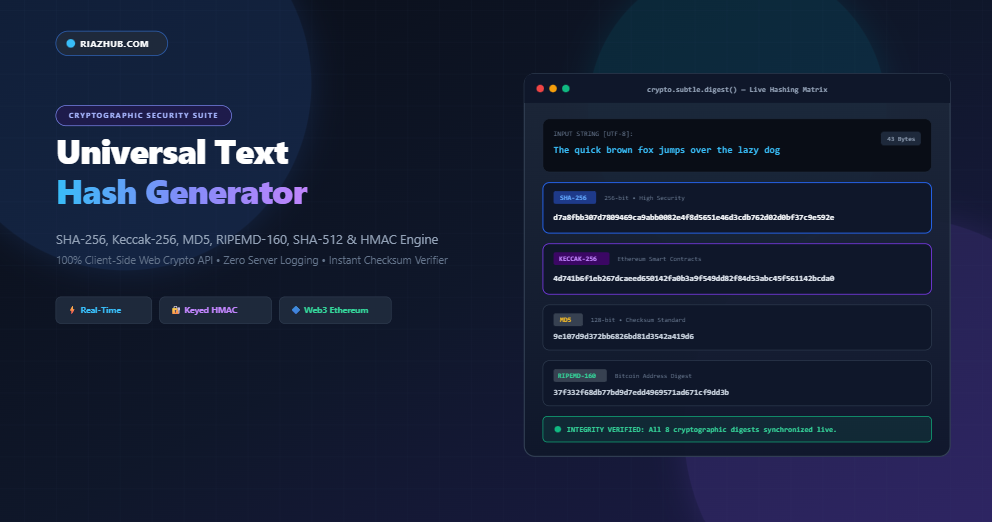
Universal Text Hash Generator & Cryptographic Digest Suite: The Complete Developer Guide
Understand one-way cryptographic algorithms, evaluate MD5, SHA-1, SHA-256, SHA-512, RIPEMD-160, Keccak-256, and generate secure HMAC signatures client-side in real time.
1. Introduction: What is Cryptographic Hashing?
In modern software architecture, cybersecurity, and distributed networks, cryptographic hash functions serve as the mathematical foundation of data integrity, password storage, digital signatures, and blockchain consensus.
A cryptographic hash function takes an input string or binary payload of arbitrary length and produces a fixed-size output string known as a hash value, digest, or checksum. Regardless of whether your input consists of a single letter or an entire multi-gigabyte database backup, the resulting digest will always conform to the exact bit length mandated by that algorithm (e.g., 256 bits for SHA-256).
2. Fundamental Properties of Secure Cryptographic Hashes
To be classified as cryptographically secure, a hashing algorithm must satisfy four critical mathematical properties:
- Determinism: The identical input string will always produce the exact same hash output across every computer architecture, compiler, and programming runtime.
- Pre-image Resistance (One-Way): Given a hash digest
H, it must be computationally impossible to reconstruct the original input messageMsuch thatHash(M) = H. - Second Pre-image Resistance: Given a known input
M1, it must be computationally infeasible to find a second distinct messageM2such thatHash(M1) = Hash(M2). - Collision Resistance: It must be practically impossible to discover any two arbitrary distinct inputs
M1andM2that yield an identical hash value. - The Avalanche Effect: A minor perturbation in the input (such as flipping a single bit or changing a comma to a period) must drastically and unpredictably alter the entire resulting digest.
3. The Cryptographic Algorithm Matrix: Comparison & Specifications
Developers frequently work with diverse algorithm families based on industry specifications, legacy constraints, or blockchain protocols. You can compute all of these simultaneously using the RiazHub Universal Text Hash Generator.
| Algorithm | Digest Length | Hex Characters | Security Tier | Primary Modern Use Case |
|---|---|---|---|---|
| SHA-256 | 256 bits (32 bytes) | 64 hex chars | High Security | Web APIs, TLS certificates, Bitcoin mining, Git signatures |
| Keccak-256 | 256 bits (32 bytes) | 64 hex chars | Web3 Standard | Ethereum EVM, smart contracts, ERC-20 tokens, address hashing |
| SHA-512 | 512 bits (64 bytes) | 128 hex chars | Military Grade | High-security authentication, financial ledgers, password key derivation |
| SHA-384 | 384 bits (48 bytes) | 96 hex chars | High Security | Enterprise TLS suites, federal cryptography standards (NSA Suite B) |
| RIPEMD-160 | 160 bits (20 bytes) | 40 hex chars | Crypto Standard | Bitcoin address generation (Base58Check P2PKH), PGP signatures |
| SHA-1 | 160 bits (20 bytes) | 40 hex chars | Legacy | Git object identification, legacy file integrity checks |
| MD5 | 128 bits (16 bytes) | 32 hex chars | Deprecated | Fast file deduplication, checksum verification, database indexing |
4. Deep Dive into Keyed HMAC Authentication
While standard hashes verify that data has not been accidentally corrupted, they do not verify who generated the message. An attacker intercepting an HTTP payload could modify the message, recompute a fresh SHA-256 hash, and forward both to the recipient.
To solve this, developers employ Keyed-Hash Message Authentication Codes (HMAC). HMAC combines a cryptographic hash function with a pre-shared Secret Key:
HMAC(K, m) = Hash((K' ⊕ opad) || Hash((K' ⊕ ipad) || m))Where K' is the normalized secret key, opad is outer padding (0x5c repeated), ipad is inner padding (0x36 repeated), and m is the plaintext message.
Because only authorized parties possess the secret key, HMAC guarantees both integrity (the message was unchanged) and authenticity (the message originated from an authentic sender).
5. Web3 & Ethereum: Understanding Keccak-256
Developers transitioning from traditional web development to decentralized Web3 ecosystems frequently encounter Keccak-256.
When the Ethereum network launched in 2015, the NIST SHA-3 standardization process was still in its finalizing stages. Ethereum adopted the original sponge-construction algorithm designed by the Keccak team, which uses a specific padding byte (0x01) rather than the final standardized NIST SHA-3 padding (0x06).
As a result, Ethereum smart contracts and Solidity functions like keccak256(abi.encodePacked(...)) produce digests that differ from standard NIST SHA-3. The RiazHub cryptographic suite specifically implements the native Ethereum-compatible Keccak-256 engine for smart contract verification.
6. How to Use the Universal Text Hash Generator
Follow these simple steps to generate, compare, and export cryptographic digests:
- Provide Input: Open the Universal Text Hash Generator. Type or paste your plaintext, API payload, or token directly into the source textarea. You can also drag and drop local files (
.txt,.json,.env,.sql,.csv). - Choose HMAC or Standard Mode: If you need API request signing, toggle the “Enable Keyed HMAC Mode” switch and input your secret key in either UTF-8 or Hex format.
- Instant Multi-Algorithm Computation: All 7 cryptographic digests (SHA-256, Keccak-256, MD5, SHA-1, SHA-512, SHA-384, RIPEMD-160) are calculated in real time as you type.
- Verify Expected Checksums: Paste an expected checksum into the comparator box. If your input produces a matching digest, the corresponding algorithm card will glow green with a “Match Verified” banner.
- Export Results: Copy individual digests with 1-click clipboard buttons, or download a complete audit manifest in structured JSON or CSV format.
7. Privacy & Browser Security: Why Client-Side Processing Matters
When hashing sensitive plaintexts such as database passwords, webhook signing secrets, encryption salts, or API authorization tokens, sending those raw strings to an external backend server poses significant security risks.
The RiazHub Text Hash Generator operates 100% inside your browser using the W3C Web Cryptography API (window.crypto.subtle) alongside optimized native bitwise JavaScript engines. Zero plaintexts or secret keys ever leave your machine, eliminating man-in-the-middle risks, server log leaks, and regulatory compliance concerns.
8. Frequently Asked Questions (FAQ)
Can I reverse a SHA-256 or MD5 hash back into the original password?
No. Cryptographic hash functions are strictly one-way and cannot be mathematically decrypted. However, weak or common passwords can be discovered using precomputed rainbow tables or brute-force dictionary lookups, which is why developers must salt passwords and use key-stretching functions like Argon2 or bcrypt for credential storage.
Why do line endings (CRLF vs. LF) change the calculated hash?
Windows operating systems traditionally use Carriage Return + Line Feed (\r\n) for newlines, whereas Unix, Linux, and macOS use Line Feed (\n). Because every byte matters in hashing, text with identical visible lines will produce completely different hashes across operating systems unless line endings are normalized.
What is the difference between Hexadecimal and Base64 output digests?
Hexadecimal represents each byte of the raw binary digest using two hex characters (0-9, a-f). Base64 encodes 3 binary bytes into 4 ASCII characters, resulting in a more compact string that is 33% shorter than hex representation.
Universal Text Hash Generator
Compute standard cryptographic hashes, SHA/MD5 digests, Ethereum Keccak-256 tokens, and HMAC authentication keys with instant checksum integrity verification in real time.
Cryptographic Hashing, Salt & Security Standards Guide
window.crypto.subtle) and optimized client-side bitwise engines. No plaintexts, secret keys, passwords, or computed digests are ever transmitted over the network or stored on RiazHub servers.