
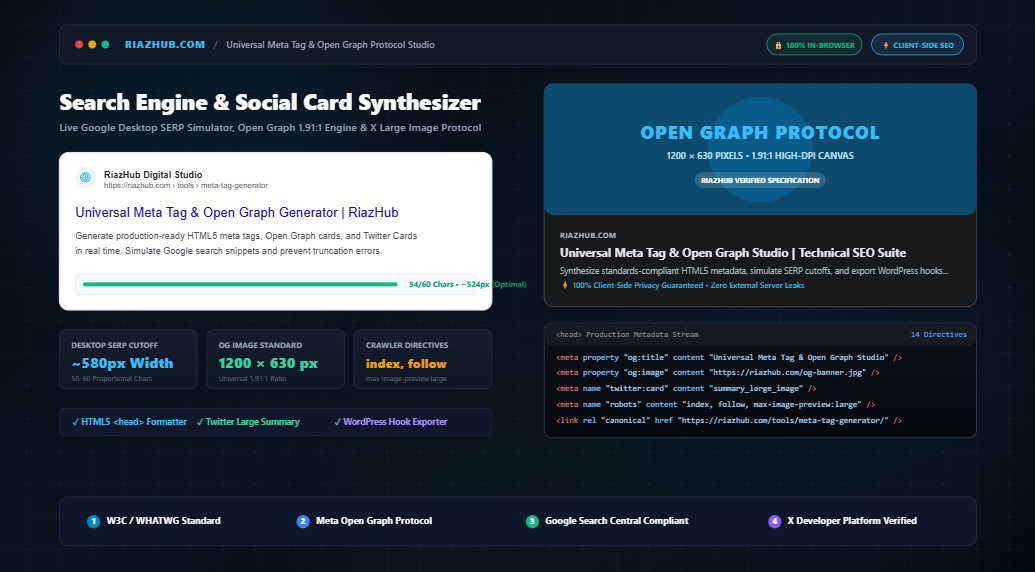
In the modern digital landscape, the difference between an organic impression and an organic click often boils down to a sliver of screen real estate. Whether a user encounters your webpage through Google’s desktop search results, a mobile discover card, or a link shared across LinkedIn, Slack, WhatsApp, and X (formerly Twitter), your content is represented almost entirely by its metadata directives.
Yet, despite being foundational to web development for three decades, metadata implementation remains one of the most error-prone facets of technical SEO. Webmasters frequently run into premature title truncations, broken Open Graph thumbnails, missing crawler directives, and awkward mobile snippet cutoffs.
To resolve these challenges without guessing or risking private draft leaks, webmasters rely on the Universal Meta Tag & Open Graph Generator & Social Card Visualizer on RiazHub. In this comprehensive technical guide, we dissect the anatomy of high-performance metadata, explain the underlying proportional pixel metrics behind Google search results, explore social graph specifications, and show you how to synthesize flawless metadata in real time.
1. The Four Pillars of Modern Metadata Architecture
Modern web browsers and search engine crawlers interpret metadata through four distinct protocol layers:
- Standard HTML5 Head Directives: Document titles, charset definitions, responsive viewport settings, canonical URLs (RFC 6596), and robots indexing flags.
- The Open Graph (OG) Protocol: Developed by Facebook and universally adopted by LinkedIn, Pinterest, Slack, and WhatsApp to transform flat links into rich, interactive media cards.
- Twitter / X Cards Protocol: Specialized directives (such as
twitter:card="summary_large_image") that command maximum feed real estate on X timelines. - Mobile Application Directives: Directives like
theme-colorand mobile viewport scaling that influence Android Chrome and Apple iOS browser UI chrome.
2. Google SERP Snippet Optimization: Pixels vs. Characters
For years, digital marketers have repeated the rule of thumb: “Keep your title tags under 60 characters and your descriptions under 160 characters.” While character counts provide a convenient benchmark, they are technically inaccurate.
The Proportional Pixel Width Reality
Google’s desktop search results render titles in Arial 18px regular. Arial is a proportional font, meaning individual characters occupy variable horizontal space. For instance:
- An uppercase “W” or “M” consumes approximately 18 to 20 pixels.
- A lowercase “i”, “l”, or pipe “|” consumes only 4 to 5 pixels.
Consequently, a title tag composed of 55 wide characters can easily exceed Google’s desktop cutoff container of ~580 to 600 pixels, causing Google to append an ellipsis (...) and truncate critical brand signals or calls-to-action. Conversely, a title consisting of 65 narrow characters might fit comfortably within the pixel allowance.
When designing metadata, relying on a dedicated pixel estimator like the one integrated inside the RiazHub Meta Tag & Open Graph Studio guarantees that your titles stay within safe SERP container boundaries before you deploy to production.
| Directive | Recommended Character Count | Container Pixel Cutoff | Primary Search Engine Impact |
|---|---|---|---|
<title> |
50 – 60 Characters | ~580px (Desktop) / ~620px (Mobile) | Direct Algorithmic Ranking Factor & SERP Click Anchor |
<meta name="description"> |
140 – 160 Characters | ~960px (Desktop) / ~680px (Mobile) | Organic Click-Through Rate (CTR) Driver (Indirect SEO) |
<link rel="canonical"> |
Absolute RFC 6596 URL | N/A | Consolidates Page Authority & Eliminates Duplicate Penalties |
<meta name="robots"> |
Directive Combination | N/A | Crawl Budget Control, Indexing Permissions, Snippet Sizing |
3. The Open Graph Protocol: Crafting 1200 × 630 High-DPI Cards
Introduced by Facebook in 2010 and governed by the Open Graph Protocol specification, Open Graph meta tags turn ordinary hyperlinks into rich social objects.
When a link lacks Open Graph tags, social network crawlers attempt to guess the heading and scrape the first image found in your document’s DOM. This frequently results in tiny icons, tracking pixels, or advertisement banners being selected as the hero image, devastating click-through engagement.
The Golden 1.91:1 Ratio (1200 × 630 Pixels)
The universal industry standard for Open Graph images is 1200 × 630 pixels, representing an aspect ratio of 1.91:1.
- High-DPI Retina Displays: 1200px width ensures the banner remains crisp on modern smartphones and 4K desktop screens.
- Center Safe Zone: Always center focal points and typography. When platforms crop cards on mobile newsfeeds, peripheral edges are trimmed first.
- File Size Constraints: Keep OG image file sizes below 5MB (ideally under 1MB) in JPG, PNG, or WebP format so crawler bots do not time out during link scraping.
<!-- Production Open Graph Protocol Implementation -->
<meta property="og:type" content="website" />
<meta property="og:url" content="https://riazhub.com/meta-tag-open-graph-generator-social-card-visualizer-seo" />
<meta property="og:title" content="Universal Meta Tag & Open Graph Generator | RiazHub" />
<meta property="og:description" content="Generate production-ready HTML5 meta tags, simulate Google SERP and live social feeds with client-side privacy." />
<meta property="og:image" content="https://riazhub.com/assets/og-hero-banner.jpg" />
<meta property="og:image:width" content="1200" />
<meta property="og:image:height" content="630" />
<meta property="og:site_name" content="RiazHub" />
<meta property="og:locale" content="en_US" />
4. Twitter / X Cards: Unlocking the Large Hero Format
The X platform crawler natively falls back to standard Open Graph tags if Twitter-specific tags are omitted. However, relying on fallback behavior defaults your post to a miniature thumbnail card.
To force X to render an expansive, full-width timeline image card that drives significantly higher organic click-through rates, you must explicitly declare:
<meta name="twitter:card" content="summary_large_image" />
<meta name="twitter:site" content="@RiazHub" />
<meta name="twitter:creator" content="@MRiazKhanG" />
<meta name="twitter:title" content="Universal Meta Tag & Open Graph Generator" />
<meta name="twitter:description" content="Audit character lengths, preview social cards, and generate clean WordPress hooks." />
<meta name="twitter:image" content="https://riazhub.com/assets/twitter-card-banner.jpg" />
By configuring both twitter:site and twitter:creator, your brand and content authors receive verified attribution on every social share. You can verify and preview how your card renders across feeds using the live Twitter / X card simulator on RiazHub.
5. Modern Robots Directives: Guiding Search Engine Crawlers
Beyond titles and descriptions, search engine crawlers look to the <meta name="robots"> directive to understand how they are permitted to parse, index, and display your content:
indexvs.noindex: Instructs Google whether to include the document in search results.followvs.nofollow: Tells crawlers whether to follow links on the page and pass link equity.max-image-preview:large: Crucial for Google Discover! Authorizes Google to display large, high-resolution thumbnail images in search results and Discover feeds.max-snippet:-1: Authorizes Google to display text snippets without arbitrary character length restrictions.noarchive: Prevents Google from storing a cached version of the page for public viewing.
A recommended modern directive for high-visibility commercial articles is:
<meta name="robots" content="index, follow, max-image-preview:large, max-snippet:-1, max-video-preview:-1" />6. Step-by-Step Implementation in WordPress, Shopify & Custom Stacks
Option A: WordPress via Child Theme (functions.php)
If you do not want to bloat your WordPress installation with heavy third-party plugins, you can inject clean metadata directly into the wp_head hook:
// Paste inside your child theme's functions.php or Code Snippets plugin
add_action('wp_head', function() {
    if (is_front_page()) {
        ?>
        <title>RiazHub | High-Performance Webmaster Tools & Digital Utilities</title>
        <meta name="description" content="Explore client-side web utilities, SEO analyzers, and canonical tools built for modern webmasters." />
        <link rel="canonical" href="https://riazhub.com/" />
        <meta property="og:type" content="website" />
        <meta property="og:image" content="https://riazhub.com/og-hero.jpg" />
        <meta name="twitter:card" content="summary_large_image" />
        <?php
    }
}, 1);
Option B: Custom HTML5 & Next.js / Headless Apps
In static HTML5 files, paste the compiled directives directly between the opening <head> and closing </head> tags. For React or Next.js applications, incorporate them inside the next/head component or the App Router’s Metadata API object.
7. The 100% Client-Side Privacy Advantage
Many online SEO checkers send your unpublished titles, internal development URLs, and staging server links to external cloud APIs for parsing. This presents a serious confidentiality risk for pre-launch products and confidential client campaigns.
The Universal Meta Tag & Open Graph Studio at RiazHub is engineered with 100% client-side privacy architecture. Every string compilation, pixel-width estimation, DOM simulation, and 1200×630 canvas dossier rendering occurs entirely within your local web browser. Zero staging URLs, draft headlines, or client details are ever sent to an external server.
Summary: Metadata Checklist for Every New Page
- ✓ Title Tag: 50–60 characters, within ~580px width, primary keyword front-loaded.
- ✓ Meta Description: 140–160 characters, compelling call-to-action, natural keyword placement.
- ✓ Canonical Tag: Explicit absolute HTTPS URL preventing duplicate content issues.
- ✓ Open Graph Image: Exactly 1200 × 630 pixels (1.91:1 ratio) with centered typography.
- ✓ Twitter Card: Explicitly set to
summary_large_imagewith brand and creator handles. - ✓ Robots Directives: Configured with
max-image-preview:largeto capitalize on Google Discover.
Ready to generate, audit, and simulate your next webpage’s metadata? Visit the Universal Meta Tag & Open Graph Generator on RiazHub.com to generate flawless search and social tags in seconds.
Universal Meta Tag & Open Graph Studio
Generate search engine compliant HTML5 meta tags, Open Graph cards, and Twitter / X directives in real time. Simulate Google SERP and live social feeds with accurate character and pixel-width telemetry.
// WordPress snippet will appear here📚 Technical SEO, Open Graph Protocols & Search Standards Reference
og:title, og:description, og:image, and og:url. Without these tags, crawlers attempt to guess thumbnail images and headings, often leading to broken or distorted previews. Properly implemented Open Graph tags ensure a consistent, branded, high-CTR presentation across all social platforms.
og:title, og:description, and og:image) if Twitter-specific tags are absent. However, explicitly declaring twitter:card="summary_large_image" is mandatory if you want the expansive, high-engagement full-width banner card instead of the miniature square thumbnail. Adding twitter:site and twitter:creator also grants proper attribution to your brand and authors.