
The Definitive Guide to Keyword Density, Multi-N-Gram Frequency & Algorithmic Over-Optimization in Modern SEO
For decades, digital marketers and content creators have debated a deceptively simple question: How many times should a target search query appear inside an article? In the early days of algorithmic search indexing, webmasters calculated keyword frequencies down to rigid decimal points, attempting to reverse-engineer mathematical formulas that could trick search bots into rewarding their pages with top rankings.
Today, search algorithms powered by bidirectional transformer models (BERT), Multitask Unified Models (MUM), and neural vector embeddings (Gemini) no longer parse content as disconnected collections of strings. Instead, they interpret documents conceptually, evaluating contextual depth, semantic entity completeness, and user search intent satisfaction.
However, this technological evolution does not render keyword density obsolete. Rather, it transforms keyword monitoring from an aggressive ranking trick into a vital defensive quality control. Over-saturating an article with repetitive terminology triggers severe algorithmic demotions under Google’s Helpful Content System and Search Essentials. Conversely, failing to introduce your core subject in high-priority structural positions leaves search engines guessing your thematic intent.
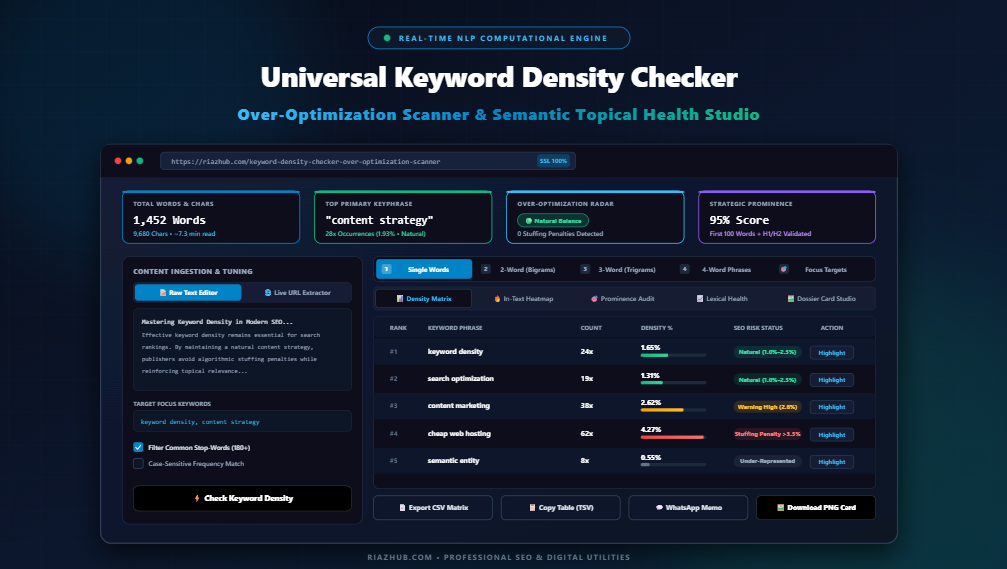
To balance this delicate dynamic with mathematical precision, digital practitioners utilize the RiazHub Keyword Density Checker & Over-Optimization Scanner. In this comprehensive guide, we examine the computational linguistic principles of keyword density, multi-n-gram frequency matrices, risk thresholds, and strategic keyword prominence.
⚡ Real-Time SEO Keyword Density & Penalty Radar
Audit single words, 2-word, 3-word, and 4-word phrases across live webpage URLs or raw text. Detect keyword stuffing hazards, inspect prominence in opening paragraphs and subheadings, and generate high-DPI density dossier cards 100% in-browser with zero server data storage.
1. What Is Keyword Density in Modern Natural Language Processing?
At its core, Keyword Density ($D_k$) measures the statistical proportion of a specific keyword or multi-word keyphrase relative to the total word count of an audited document. Expressed as a percentage, it demonstrates how frequently an author returns to a specific linguistic anchor.
Where:
- $F_k$: The exact occurrence frequency (count) of phrase $k$ throughout the text.
- $N$: The token length of the phrase ($N = 1$ for single words, $N = 2$ for bigrams, $N = 3$ for trigrams, and $N = 4$ for four-word phrases).
- $W_{\text{total}}$: The total corpus size, representing all valid word tokens extracted through boundary regular expressions ($\backslash b[A-Za-z0-9′-]+\backslash b$).
For instance, in a 1,500-word editorial piece where the 2-word phrase “cloud server” appears 15 times, the calculation yields:
This formula demonstrates why factoring in the length ($N$) of multi-word keyphrases is crucial. A three-word keyphrase appearing 15 times consumes three times as much editorial real estate as a single unigram appearing 15 times. The universal keyword density checker automatically factors in phrase lengths across 1, 2, 3, and 4-word clusters to deliver accurate mathematical percentages.
2. Algorithmic Over-Optimization & Google Penalty Risk Thresholds
Search engine engineering teams do not publish an exact mathematical threshold that automatically penalizes a web page. However, extensive empirical testing across millions of indexed documents has revealed distinct behavioral zones where search engine quality algorithms categorize content:
| Density Range (%) | Classification | Algorithmic Interpretation & SEO Impact |
|---|---|---|
| < 0.8% | Under-Represented | Minimal topical association. The target subject is mentioned so rarely that crawlers may fail to associate the page with primary informational queries. |
| 1.0% – 2.5% | Natural SEO Equilibrium | The gold standard of search optimization. Terminology appears naturally, reinforcing primary intent without degrading editorial readability or triggering automated filters. |
| 2.6% – 3.5% | Elevated Warning Zone | Borderline unnatural repetition. While acceptable in highly technical documentation or medical nomenclature, general consumer content in this range often sounds robotic. |
| > 3.5% | Stuffing Penalty Hazard | Critical algorithmic penalty risk. Explicitly violates Google Search Essentials guidelines regarding repetitive text. Signals low information gain and unnatural optimization. |
When Google’s automated systems identify unnatural keyword repetitions exceeding 3.5% density, the page is classified as artificial or spammy. Beyond automated demotions, stuffed content causes visitors to bounce rapidly, inflating negative user experience signals and causing cascading declines across sitewide organic visibility.
3. The Significance of Multi-N-Gram Frequency Matrices
The most common limitation of basic word frequency counters is that they evaluate documents exclusively on a single-word (unigram) basis. If you write an article about “quantum computing hardware”, an unigram analyzer counts “quantum”, “computing”, and “hardware” as three isolated, independent events.
However, conversational human queries and natural language entities consist almost entirely of multi-word phrases. Consider how users search:
- 1-Word (Unigrams): Broad, ambiguous head terms (e.g., “hosting”, “shoes”, “vpn”).
- 2-Word (Bigrams): Categorical intents (e.g., “cloud hosting”, “running shoes”, “fast vpn”).
- 3-Word (Trigrams): Specific commercial or informational queries (e.g., “best cheap hosting”, “trail running shoes”, “vpn for gaming”).
- 4-Word (Fourgrams): High-intent, long-tail conversational questions (e.g., “how to setup hosting”, “best shoes for marathons”).
By utilizing the RiazHub keyword density tool, content teams can toggle seamlessly between 1-word, 2-word, 3-word, and 4-word matrices. This multi-layered granularity reveals hidden repetitive phrasing that would completely escape single-word tokenizers.
4. Keyword Prominence vs. Keyword Density: The Architectural Distinction
A frequent misconception among newer SEO copywriters is assuming that keyword density and keyword prominence are synonymous. In reality, they evaluate completely different dimensions of on-page optimization:
- Keyword Density evaluates frequency volume (quantity relative to total text size).
- Keyword Prominence evaluates spatial placement and architectural hierarchy (where and how early the term appears).
Search engine document parsers assign substantially greater semantic weight to words appearing in high-impact structural zones:
- Zone 1: The Opening 100 Words (40% Weight): Introducing your primary subject in the introductory paragraph signals document intent immediately, preventing crawl budget wastage.
- Zone 2: Subheadings H1, H2, and H3 (35% Weight): Structured heading tags define the conceptual outline of your article. Search engines use headings to map entity relationships.
- Zone 3: Concluding Summary (25% Weight): Summarizing key takeaways in your final 100 words reinforces topical completeness and contextual cohesion.
An article with a modest, natural keyword density of 1.4% that features its target phrase in the title, opening 100 words, and an H2 subheading will consistently outrank an article with an aggressive 3.2% density that hides all its keywords in middle body paragraphs.
5. Stop-Word Filtering & Lexical Diversity (Type-Token Ratio)
In computational lexicography, stop-words refer to structural and functional terms—such as prepositions (in, at, with), articles (the, a, an), auxiliary verbs (is, are, was), and conjunctions (and, but, or)—that bind sentences together but convey minimal topical information.
Without stop-word filtering, any frequency counter will report that the word “the” or “and” represents your highest-density keyword (often exceeding 6% to 8%). The online keyword density scanner includes an integrated 180+ word curated English stop-word corpus that strips out grammatical filler, enabling writers to analyze pure semantic substance.
Measuring Vocabulary Richness: Type-Token Ratio (TTR)
Another essential metric computed in modern computational analysis is the Type-Token Ratio (TTR), which measures the lexical richness of a document:
Content written by genuine subject-matter experts naturally exhibits high vocabulary variety (high TTR), employing synonyms, related contextual entities, and specialized terminology. Conversely, low-quality or AI-generated filler copy often recycles the same limited vocabulary repeatedly, leading to a depressed TTR that flags the content as superficial.
6. Dual-Mode Content Ingestion: Raw Copy vs. Live URL Extraction
Editorial workflows require flexibility. Sometimes you are auditing an unpublished Google Doc draft; other times, you need to dissect a published competitor page or audit an existing URL on your own website.
The RiazHub over-optimization tool features a dual-mode ingestion architecture:
- Mode 1: Raw Text & Markdown Copy Editor: Provides an instant real-time editing environment with character telemetry, live debounced calculations, and immediate recalculation as you type or paste.
- Mode 2: Secure Live Webpage URL Fetcher: Connects to an internal, SSRF-protected WordPress server bridge. The bridge fetches public URLs, enforces strict timeout controls, and algorithmically removes HTML noise:
- Strips
<script>and<style>asset tags. - Removes global navigation menus (
<nav>and<header>). - Eliminates footer boilerplate and legal links (
<footer>). - Excludes sidebar widgets and advertisements (
<aside>). - Isolates pure, uncorrupted body editorial copy for mathematically accurate analysis.
- Strips
7. Step-by-Step Tutorial: How to Audit Your Content
Follow this standard operational workflow to audit any piece of content prior to publication:
- Step 1: Ingest Your Content: Open the Keyword Density Checker Studio. Select “Raw Text / Copy” to paste your draft, or switch to “Live Webpage URL” to fetch an existing public page.
- Step 2: Define Focus Target Keywords: In the Focus Keywords input bar, enter your target terms separated by commas (e.g.,
seo optimization, keyword density, content marketing). The tool instantly generates real-time badges indicating occurrence counts, density percentages, and introductory placement status. - Step 3: Review the Overview KPI HUD: Check the top 4 metric cards:
- Total words, character count, and estimated silent reading time.
- Top primary keyphrase density and status label.
- Over-optimization radar (confirming zero keyword stuffing penalty flags).
- Strategic prominence index score (aim for 80% to 100%).
- Step 4: Inspect Multi-N-Gram Granularity: Click through the segmented N-Gram tabs (
1️⃣ Single Words,2️⃣ 2-Word Bigrams,3️⃣ 3-Word Trigrams, and4️⃣ 4-Word Phrases). Verify that no commercial phrase exceeds the 2.5% natural threshold. - Step 5: Navigate the In-Text Heatmap Highlighter: Click the “Highlight” button next to any keyword in the table. The tool switches to the Heatmap panel, tinting every occurrence across the text and providing
◀ PrevandNext ▶controls to audit distribution clusters visually. - Step 6: Generate Your Dossier Card & Export: Switch to the “Dossier Card Studio” tab. Choose your preferred aesthetic palette (Cyber Azure, Technical Emerald, Deep Obsidian, or Slate Navy) and click “Download PNG Card” to save a 1200×630 audit certificate for your editorial archives or client deliverables.
8. Real-World Editorial Case Studies
Case Study A: The 2,500-Word In-Depth Industry Guide
A software company produced an exhaustive guide on “enterprise cloud migration”. Initially, their draft had a 3.8% density for the primary keyword because authors repeated the full three-word title in almost every paragraph.
Using the over-optimization scanner, the team identified the stuffing hazard and substituted exact-match repetitions with semantic variations (e.g., “infrastructure modernization”, “hybrid transition”, “workload shifting”). The resulting density dropped to a healthy 1.6%, while the Type-Token Ratio rose from 38% to 54%, resulting in superior indexation across hundreds of long-tail queries.
Case Study B: E-Commerce Product Category Page
An e-commerce retailer selling “ergonomic desk accessories” had concise 300-word category descriptions. Because the copy was short, mentioning the category name 12 times caused the density to spike to an alarming 6.0%. By consolidating references down to 4 strategic occurrences (opening line, one subheader, and product feature bullet points), the page achieved natural compliance and avoided automated demotion.
9. Frequently Asked Questions (FAQ)
▼
▼
▼
▼
▼
▼
Ready to Audit Your Content for Optimal Search Health?
Eliminate guesswork from your on-page optimization. Use the free, browser-based Universal Keyword Density Checker & Over-Optimization Scanner on RiazHub today to guarantee natural, penalty-free content excellence.
Universal Keyword Density Checker & SEO Over-Optimization Studio
Analyze single words and multi-word n-gram phrases across live URLs or text, evaluate keyword density against search engine stuffing penalties, audit strategic keyword placement, and highlight semantic clusters.
| Rank | Keyword Phrase | Count | Density % | SEO Risk Status | Action |
|---|---|---|---|---|---|
| Enter or paste text to generate the multi-n-gram frequency matrix. | |||||
Prominence Optimization Index
Evaluates presence across opening paragraph (40%), subheadings (35%), and concluding summary (25%).