
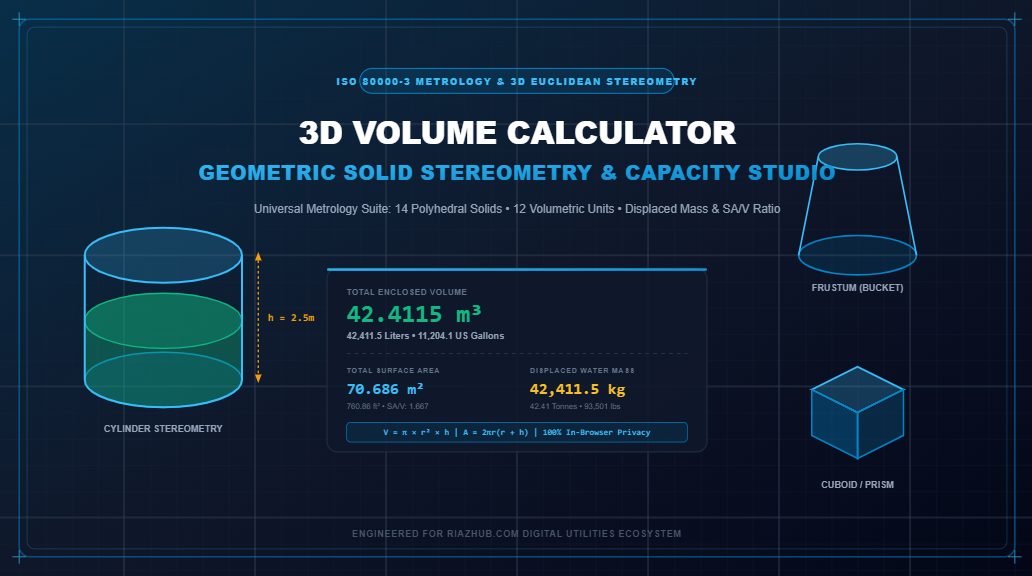
Mastering 3D Stereometry: The Complete Guide to Geometric Solid Volume, Total Surface Area, and Liquid Capacity
Whether you are sizing an industrial petroleum storage tank, calculating the concrete pour required for foundational footings, estimating chemical reactor capacities, or determining the heat dissipation of cooling radiators, volumetric stereometry is at the heart of physical engineering.
Under international standardization (ISO 80000-3: Quantities and Units Space and Time), calculating the three-dimensional space enclosed by a boundary is coupled with evaluating its total boundary surface area. To solve these equations instantly with full mathematical derivations and 3D visual wireframes, you can utilize the interactive Universal 3D Volume Calculator, Geometric Solid Stereometry & Liquid Capacity Studio.
Key Engineering Law: When any three-dimensional solid is scaled geometrically by a factor of k, its total surface area expands quadratically ($k^2$), while its internal volumetric capacity expands cubically ($k^3$). This fundamental principle governs thermal efficiency, structural container design, and fluid hydrostatic pressure.
1. What is Euclidean Stereometry?
Stereometry (from ancient Greek stereos, meaning “solid”, and metron, meaning “measure”) is the branch of Euclidean geometry dedicated to computing the metric properties of solids in three-dimensional space ($R^3$). While planimetry examines two-dimensional planar figures (such as squares, ellipses, and polygons), stereometry evaluates polyhedra, curved solids of revolution, and composite geometric vessels.
In modern structural and mechanical engineering, stereometry addresses two intertwined questions:
- Volumetric Capacity ($V$): How much three-dimensional space or fluid substance can the container encapsulate?
- Total Surface Area ($A_{\text{total}}$): How much raw material (steel plate, composite shell, insulation cladding) is required to build the enclosure, and how rapidly will thermal energy dissipate across its boundary?
2. Formulations for 14 Fundamental and Complex 3D Solids
The 3D Volume Calculator Studio on RiazHub integrates 14 fundamental geometric forms. Below is the rigorous mathematical breakdown of each geometry:
1. Rectangular Prism / Cuboid (Box / Room)
Defined by three orthogonal linear dimensions: length ($l$), width ($w$), and height ($h$).
Total Surface Area: A = 2 × (l·w + l·h + w·h)
Lateral Surface Area: A_lat = 2h × (l + w)
2. Cube (Regular Hexahedron)
The Platonic solid consisting of six identical congruent square faces with edge length $s$.
Total Surface Area: A = 6 × s²
3. Right Circular Cylinder (Tank / Pipe)
A solid of revolution formed by revolving a rectangle around one of its sides. Characterized by radius $r$ (or diameter $d = 2r$) and axial height $h$.
Lateral Area (Cylinder Shell): A_lat = 2π × r × h
Base Ends (2 Disks): A_base = 2π × r²
Total Surface Area: A = 2π × r × (r + h)
4. Sphere (Ball / Globe)
The set of all points in three-dimensional space equidistant from a center point at radius $r$. The sphere encloses the maximum volume for a given surface area.
Total Surface Area: A = 4 × π × r²
5. Hemisphere
An exact half-sphere created by slicing a sphere with a plane passing through its center.
Curved Dome Area: A_dome = 2 × π × r²
Flat Circular Base Area: A_base = π × r²
Total Surface Area: A = 3 × π × r²
6. Right Circular Cone
Constructed by revolving a right-angled triangle around one of its legs, featuring base radius $r$ and vertical altitude $h$. Its slant height $s$ is governed by the Pythagorean theorem: $s = \sqrt{r^2 + h^2}$.
Lateral Area: A_lat = π × r × s
Total Surface Area: A = π × r × (r + s)
7. Conical Frustum (Truncated Cone / Bucket / Tumbler)
Formed by slicing a circular cone with a plane parallel to its base. Characterized by top radius $r_1$, bottom radius $r_2$, and vertical height $h$. Slant height is $s = \sqrt{(r_1 – r_2)^2 + h^2}$.
Lateral Surface Area: A_lat = π × (r₁ + r₂) × s
Total Surface Area: A = A_lat + π·r₁² + π·r₂²
You can simulate partial liquid levels and slurry fill capacities of buckets and hoppers using the Universal 3D Volume & Capacity Tool.
8. Square / Rectangular Pyramid
A polyhedron with a rectangular base of dimensions $l \times w$ and four triangular lateral faces tapering to an apex at height $h$.
Slant Heights: s_l = √((w/2)² + h²), s_w = √((l/2)² + h²)
Total Surface Area: A = (l × w) + (l × s_l) + (w × s_w)
9. Truncated Pyramid (Pyramidal Frustum)
The architectural geometry of civil foundations, earthworks, and hopper discharge chutes. For square top side $b$ and bottom side $a$:
Slant Height of Trapezoidal Faces: s = √(((a – b)/2)² + h²)
Total Surface Area: A = a² + b² + 2 × (a + b) × s
10. Triangular Prism (Wedge)
Composed of two parallel congruent triangular bases separated by an extrusion length $L$.
Base Triangular Faces (2): A_base = b × h_t
Lateral Rectangles (3): A_lat = (b + 2s) × L
Total Surface Area: A = A_base + A_lat
11. Triaxial Ellipsoid
A quadratic surface formed by deforming a sphere along three mutually perpendicular semi-axes: $a$, $b$, and $c$. While its volume is exact, its surface area utilizes Knud Thomsen’s formula ($p \approx 1.6075$) providing an error bound below $1.061\%$:
Surface Area ≈ 4π × [ ((a·b)^p + (a·c)^p + (b·c)^p) / 3 ]^(1/p)
12. Torus (Donut / O-Ring)
A solid of revolution generated by rotating a circle of minor radius $r$ around an coplanar axis at major radius $R$ ($R \ge r$).
Total Surface Area: A = 4π² × R × r
13. Capsule / Spherocylinder (Pill Tank)
A cylindrical core barrel of height $h$ and radius $r$, capped at both ends by matching hemispheres. Widely used for cryogenic vessels and propane tanks.
Lateral Cylinder Shell: A_lat = 2π × r × h
Two Hemispherical End Caps: A_caps = 4π × r²
Total Surface Area: A = 2π × r × (2r + h)
14. Regular Tetrahedron
The simplest Platonic solid, composed of four equilateral triangular faces with edge length $a$.
Total Surface Area: A = √3 × a² ≈ 1.73205 × a²
Compute Any Solid in Real-Time
Switch shapes, toggle diameter vs. radius, and test fill levels with live 3D wireframe feedback.
3. The Surface-to-Volume Ratio ($SA/V$) in Industrial Design
One of the most valuable engineering metrics calculated by the 3D Volume Studio is the Surface-to-Volume ratio ($SA/V$, measured in $\text{m}^{-1}$). This ratio dictates how physical bodies interact across thermodynamic and mechanical boundaries:
| Design Goal | Desired SA/V Ratio | Preferred Geometry | Engineering Rationale |
|---|---|---|---|
| Thermal Insulation & Cryogenic Storage | Minimized | Sphere or Low-Aspect Cylinder | Minimizes boundary area through which ambient heat can penetrate. |
| Heat Exchangers & Radiator Fins | Maximized | Thin Extruded Prisms or Fluted Tubes | Maximizes thermal radiation and convection into ambient air. |
| High-Pressure Gas Containment | Minimized | Sphere or Capsule (Spherocylinder) | Eliminates sharp stress concentrations and minimizes total wall metal required. |
4. Multi-Unit Volumetric Capacity Matrix
In engineering workflows, measurements frequently cross between SI metric standards and US Customary / British Imperial units. The Universal 3D Volume Calculator instantly normalizes inputs and evaluates 12 parallel capacity metrics:
- SI Metric Volumes: Cubic Meters ($\text{m}^3$), Liters ($\text{L}$), Milliliters ($\text{mL}$), Cubic Centimeters ($\text{cm}^3$ / $\text{cc}$).
- US Customary Liquid: US Gallons ($231\text{ in}^3$), US Fluid Ounces ($29.5735\text{ mL}$), US Quarts, US Pints.
- British Imperial Measures: Imperial Gallons ($4.54609\text{ L}$), Imperial Fluid Ounces ($28.413\text{ mL}$).
- Bulk Industrial Logistics: Cubic Feet ($\text{ft}^3$), Cubic Inches ($\text{in}^3$), Cubic Yards ($\text{yd}^3$), Petroleum Barrels ($\text{bbl} = 42\text{ US gal}$).
5. Substance Mass & Hydrostatic Displacement Physics
Volume alone does not reveal structural weight. By multiplying the calculated volume ($V$, in $\text{m}^3$) by the substance’s density ($\rho$, in $\text{kg/m}^3$), you obtain the displaced physical mass:
Mass (lbs) = Mass (kg) × 2.20462
For instance, filling a $10\text{ m}^3$ cylinder with pure water exerts $10,000\text{ kg}$ of hydrostatic load. Filling the identical vessel with structural concrete imposes $24,000\text{ kg}$ on the floor foundation, while gasoline imposes only $7,400\text{ kg}$.
6. Meniscus, Ullage & Thermal Liquid Expansion
When designing rigid tanks, calculating 100% geometric volume is only step one. Liquid expands with temperature variations according to its volumetric thermal expansion coefficient ($\beta$):
Storage vessels require a designated ullage (headspace cushion), typically 3% to 5% of total volume, to prevent hydraulic over-pressurization during solar heating. You can dial the real-time liquid fill slider from 0% to 100% on the 3D Volume Studio on RiazHub to analyze fill levels and partial tank capacities accurately.
Conclusion
Stereometric calculations bridge abstract geometry with real-world architectural design, packaging logistics, and industrial tank manufacturing. With support for 14 shapes, live isometric wireframes, complete mathematical derivations, and downloadable specification dossiers, RiazHub’s studio provides an all-in-one workbench for engineers, designers, and students alike.
Ready to evaluate your project’s 3D geometry? Access the free tool directly at:
https://riazhub.com/3d-volume-calculator-geometric-solid-stereometry-liquid-capacity-studio.
Universal 3D Volume Calculator, Geometric Solid Stereometry & Liquid Capacity Studio
High-precision 3D geometric metrology engine. Compute volume, total surface area, liquid capacities, and displaced material mass across 14 polyhedral solids with live isometric wireframes and derivation breakdowns.
🌐 SI Metric Volumes
🥛 US Liquid Capacity
🇬🇧 British Imperial Units
🏗️ Bulk Industrial Units
Lateral Surface Area
End / Base Area
Surface-to-Volume (SA/V)
Industrial Engineering Implications:
• Thermal Dissipation vs Retention: Vessels with higher SA/V ratios (such as radiators and cooling fins) shed heat rapidly to the ambient environment. In contrast, vessels with minimized SA/V ratios (such as spherical storage tanks and cylindrical silos) conserve heat and reduce costly insulation thickness.
• Structural Material Consumption: For any given liquid capacity, a sphere requires the absolute minimum surface area of structural steel or composite material to contain internal hydrostatic pressure.