
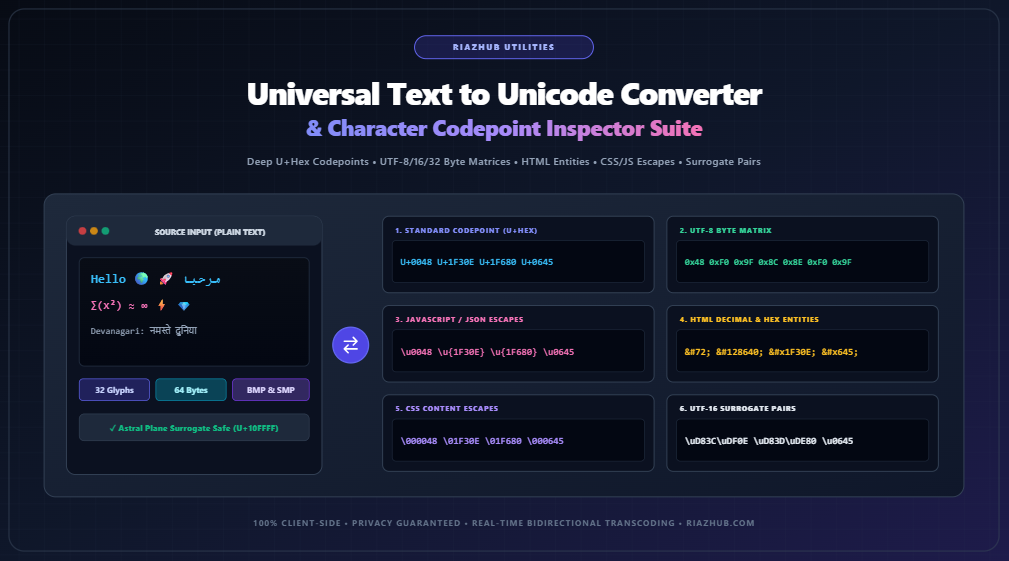
To eliminate ambiguity and give developers, cybersecurity analysts, and linguists total visibility into every byte of their strings, RiazHub offers the Text to Unicode Converter & Character Codepoint Inspector. In this comprehensive guide, we explore how Unicode structures over 1.1 million characters, how UTF-8, UTF-16, and UTF-32 encodings differ, and how you can harness this real-time utility for your daily workflows.
Inspect Codepoints & Decode Encodings Instantly
Deconstruct any character, emoji, or non-Latin script into exact U+Hex codepoints, surrogate pairs, and multi-format byte matrices with sub-millisecond precision.
1. The Foundation: What is Unicode & How Are Codepoints Structured?
Prior to Unicode, the digital world was fragmented by hundreds of conflicting legacy encoding systems (such as ASCII, ISO-8859-1, Windows-1252, and Shift-JIS). When text encoded in one standard was rendered by a system expecting another, symbols were replaced with garbled characters.
The Unicode Standard solves this by assigning every character across human history a unique, immutable integer called a Codepoint. Codepoints are universally designated in hexadecimal notation as U+XXXX, spanning from U+0000 to U+10FFFF. This creates a colossal address space of 1,114,112 possible codepoints, organized into 17 distinct planes:
Plane 0: Basic Multilingual Plane (BMP)
Range: U+0000 – U+FFFF. Encompasses virtually all modern written languages including Latin, Greek, Cyrillic, Arabic, Hebrew, Devanagari, and common CJK ideographs.
Plane 1: Supplementary Multilingual Plane (SMP)
Range: U+10000 – U+1FFFF. Home to modern emojis (🚀 U+1F680), mathematical alphanumeric symbols, musical notation, and historic scripts.
Plane 2: Supplementary Ideographic Plane (SIP)
Range: U+20000 – U+2FFFF. Dedicated to rare, historical, and specialized East Asian CJK unified ideographs.
Planes 14–16: Special Purpose & Private Use (PUA)
Range: U+E0000 – U+10FFFF. Reserved for variation selectors, language tags, and proprietary enterprise symbols.
Whenever you paste text into the RiazHub Unicode Inspector, the tool automatically scans every character and identifies its active Unicode Plane in real time.
2. Codepoints vs. Encodings: UTF-8, UTF-16, and UTF-32 Demystified
A common misconception is confusing Unicode with UTF-8. While Unicode is the abstract registry assigning numbers to glyphs, a Character Encoding defines how those numbers are translated into binary bytes in computer memory or network packets.
| Encoding | Byte Length per Glyph | Primary Advantages | Standard Use Case |
|---|---|---|---|
| UTF-8 | 1 to 4 Bytes (Variable) | 100% ASCII backwards compatibility, ultra compact for Western text. | Web standards (>98% of the Internet), Linux, JSON, APIs. |
| UTF-16 | 2 or 4 Bytes (Surrogates) | Balanced memory usage for 16-bit BMP Asian scripts. | JavaScript string engines, Java, Windows OS internals. |
| UTF-32 | 4 Bytes (Fixed) | Direct 1:1 mathematical index mapping for each codepoint. | Internal memory arrays, high-speed string slicing. |
The Astral Plane & Surrogate Pair Trap
In UTF-16 environments (like JavaScript’s default string architecture), codepoints above U+FFFF cannot fit in a single 16-bit code unit. Instead, they are split into a Surrogate Pair consisting of a High Surrogate (0xD800–0xDBFF) and a Low Surrogate (0xDC00–0xDFFF).
For example, the rocket emoji 🚀 (U+1F680) is stored in UTF-16 as two distinct code units: \uD83D\uDE80. Legacy tools that rely on naive string operations often split this emoji in half, causing broken symbols. The Text to Unicode Converter uses safe ES6 iterators ([...str]) and codePointAt() to ensure surrogate pairs are analyzed and decoded with 100% fidelity.
3. Supported Notation Formats in the Converter Suite
Different programming languages, markup engines, and style sheets require specific escape sequence syntaxes. The Universal Text to Unicode Converter supports instantaneous multi-format conversion:
- Standard Codepoints (
U+0041 U+1F680): The academic and specification standard for character identification. - Hex Notation (
0x0041 0x1F680): Formatted hex literals for C, C++, Rust, and low-level byte arrays. - JavaScript / JSON Escape (
\u0041/\u{1F680}): ES6 Unicode code point escape sequences for modern scripting. - CSS Escapes (
\000041/\01F680): 6-digit fixed escape strings for CSS pseudo-elementcontent:properties. - HTML Decimal Entities (
A/🚀): Safe numeric character references for HTML document templates. - HTML Hexadecimal Entities (
A/🚀): Hex-based HTML entities for XML, XHTML, and web parsers. - UTF-8 Byte Arrays (
0xF0 0x9F 0x9A 0x80): Raw byte matrices for network packet inspection and buffer debugging. - UTF-16 Surrogate Pairs (
\uD83D\uDE80): Explicit high/low surrogate representation for legacy platforms.
4. Step-by-Step: How to Use the Tool on RiazHub
Step 1: Input or Upload Your Text
Type or paste your text into the left-hand editor on the Text to Unicode tool page. You can also drag and drop .txt, .json, .html, or .js source files directly into the drop zone.
Step 2: Choose Your Target Format & Delimiters
Select your desired format (e.g., Standard Codepoint, CSS Escape, HTML Hex) and customize zero-padding (4-digit, 6-digit, or auto-fit), delimiter characters (space, comma, semicolon, newline, or custom), and letter casing (UPPERCASE vs lowercase).
Step 3: Switch Between Interactive Output Views
- Code Canvas Tab: Copy or export your transformed Unicode sequence.
- Character Inspector Tab: Inspect an interactive table breaking down every single glyph with its decimal value, plane name, UTF-8 byte stream, and HTML entity.
- Multi-Format Matrix Tab: View your entire string converted into all 8 major formats simultaneously with individual 1-click copy buttons.
Step 4: Bidirectional Decoding Mode
Need to turn obscure Unicode escape codes back into readable sentences? Toggle the “Decode: Unicode ➔ Text” mode. The tool automatically detects HTML entities, JS curly escapes, CSS hex sequences, and surrogate pairs, reconstructing pristine human-readable text instantly.
Try RiazHub’s Unicode Converter Suite Today
100% free, browser-based, and completely private with zero server transmission.
5. Practical Real-World Applications
A. Web Development & Cross-Browser Typography
When injecting custom icons or non-standard characters into CSS pseudo-elements (e.g., ::before { content: "\2713"; }), copying the exact 6-digit CSS escape from the Unicode Codepoint Inspector prevents rendering inconsistencies across Safari, Chrome, and Firefox.
B. Internationalization (i18n) and RTL Script Validation
Working with bidirectional languages such as Arabic, Urdu, or Hebrew requires validating invisible control characters like Right-to-Left Marks (RLM U+200F) or Left-to-Right Marks (LRM U+200E). The inspector table exposes these hidden characters clearly.
C. Cybersecurity & Input Sanitization Auditing
Security engineers use Unicode decomposition to detect Homoglyph attacks (where look-alike Cyrillic characters are substituted for Latin letters in phishing URLs) and bypass vulnerabilities in Web Application Firewalls (WAFs) caused by unnormalized UTF-8 overlong encodings.
Frequently Asked Questions (FAQ)
What is the difference between String.fromCharCode() and String.fromCodePoint()?
String.fromCharCode() only handles 16-bit code units (U+0000 to U+FFFF). When passed an astral plane codepoint (like 0x1F680), it wraps around and produces corrupted glyphs. Modern ES6 String.fromCodePoint() supports all 1,114,112 Unicode codepoints seamlessly.
Is my text data stored or sent to any remote server?
No. The Text to Unicode Converter executes 100% client-side inside your browser engine using native Web APIs. Zero text strings or credentials are ever sent to an external server.
Can I export my character breakdown report?
Yes. You can export both the converted plain text (.txt) and a complete character-by-character diagnostic audit report as structured JSON with a single click.
Universal Text to Unicode & Character Code Inspector Suite
Convert plain text to Unicode codepoints, UTF-8/16/32 byte matrices, HTML entities, and CSS/JS escape sequences with real-time bidirectional decoding and surrogate pair analysis.
Unicode Architecture, Encoding Standards & Codepoints Reference
Unicode is the global computing standard for consistent encoding, representation, and handling of text across virtually all writing systems, mathematical notations, and emojis. Unicode assigns each character a unique numerical identifier called a Codepoint, written conventionally as U+XXXX (where XXXX is a 4-to-6 digit hexadecimal number).
The Unicode codespace is divided into 17 Planes (numbered 0 to 16), providing a total capacity of 1,114,112 codepoints (U+0000 through U+10FFFF):
- Plane 0: Basic Multilingual Plane (BMP) (
U+0000toU+FFFF) — Contains characters for almost all modern languages (Latin, Arabic, Hebrew, Cyrillic, Greek, Devanagari, CJK Unified Ideographs). - Plane 1: Supplementary Multilingual Plane (SMP) (
U+10000toU+1FFFF) — Contains modern emoji pictographs (🚀U+1F680), mathematical symbols, musical notations, and ancient historic scripts (e.g., Egyptian Hieroglyphs, Linear B). - Plane 2: Supplementary Ideographic Plane (SIP) (
U+20000toU+2FFFF) — Contains rare and historical CJK Unified Ideographs. - Planes 14-16: Special Purpose & Private Use Areas (PUA) — Reserved for tags, variation selectors, and custom font symbols.
A Unicode Codepoint is an abstract numerical value, whereas an Encoding specifies how that number is represented as concrete binary bytes in memory or over a network:
- UTF-8: A variable-width byte encoding (1 to 4 bytes per character). ASCII characters (0-127) take exactly 1 byte (100% backward compatible). Latin extended and Arabic take 2 bytes, Asian CJK glyphs take 3 bytes, and modern emojis take 4 bytes. It is the dominant encoding of the World Wide Web (>98% of all websites).
- UTF-16: Encodes characters using 1 or 2 16-bit code units. Characters in the BMP (
U+0000toU+FFFF) take 2 bytes. Characters in astral planes (> U+FFFF) are split into a Surrogate Pair (High Surrogate + Low Surrogate), taking 4 bytes total. - UTF-32: A fixed-width 4-byte (32-bit) encoding where every single codepoint occupies exactly 4 bytes (e.g.,
0x0001F680). While simple to index, it uses significantly more memory.
Legacy JavaScript functions like String.fromCharCode() and str.charCodeAt() operate on 16-bit code units (UTF-16). When processing astral plane characters such as the rocket emoji 🚀 (U+1F680), legacy functions slice the character into two broken halves: High Surrogate 0xD83D and Low Surrogate 0xDE80.
This suite uses modern ES6+ iterators [...string], str.codePointAt(), and String.fromCodePoint(), guaranteeing 100% precision with zero glyph corruption or broken surrogate pairs.
100% Client-Side Privacy: All text conversions, character decomposition, matrix computations, and file exports occur entirely within your browser's local JavaScript execution engine. Zero bytes of your text, credentials, emojis, or code snippets are ever transmitted to an external server.