
The Ultimate Guide to Keyword Density, Multi-N-Gram Frequency & Modern Content Optimization
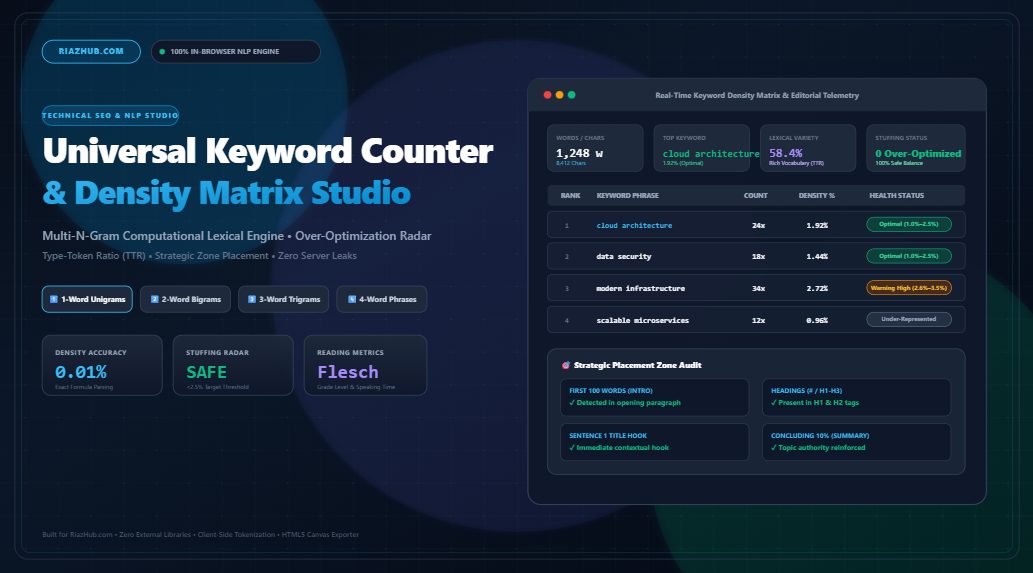
To achieve this crucial balance, technical content creators and SEO architects use the Universal Keyword Counter & Density Matrix Studio to audit single-word unigrams, multi-word phrases (bigrams, trigrams, and four-grams), and overall vocabulary richness prior to publication.
What Exactly is Keyword Density?
Keyword density represents the percentage of times a specific word or multi-word phrase appears in a body of text relative to the total number of words. The standard mathematical formula for single words is:
Mathematical FormulationDensity (%) = (Keyword Occurrences / Total Words) × 100
When evaluating multi-word phrases—such as “digital marketing strategy” (a 3-word trigram) the formula adjusts to account for the token length of the phrase:
Multi-Word Phrase Density FormulationDensity (%) = ((Phrase Occurrences × Phrase Word Length) / Total Words) × 100
By evaluating phrases using the RiazHub Keyword Counter & Density Matrix, you receive an accurate percentage that reflects how much real estate the entire phrase occupies within your manuscript.
The Four SEO Health Ranges: From Safe to Stuffing Hazard
While Google has never published a rigid “golden density number”, decades of empirical search engine analysis and algorithm patent disclosures reveal clear boundaries:
| Density Range | Classification | Algorithmic Impact & Recommendation |
|---|---|---|
| < 0.8% | Under-Represented | The keyword may lack sufficient relevance signal. Consider reinforcing it in natural contextual sentences. |
| 1.0% – 2.5% | Optimal SEO Balance | The sweet spot for natural authority. The topic is clear to search engines without sounding forced or repetitive. |
| 2.6% – 3.5% | Warning: High Density | Borderline risk. The prose may feel slightly repetitive to human readers. Review and substitute synonyms where possible. |
| > 3.5% | Critical Stuffing Hazard | High probability of triggering automated spam and helpful content filters. Immediate pruning required. |
You can verify your draft against these thresholds in seconds using the Keyword Counter & Density Matrix Studio, which automatically color-codes every detected phrase with its safety status.
Why Single-Word Counters Fail: The Power of N-Grams
Most basic word counter tools online only look at individual unigrams. For example, if you analyze an article about “cloud computing architecture”, a basic counter simply reports that “cloud” appears 20 times and “computing” appears 18 times. This provides zero visibility into whether you are repeating the complete compound term or scattering those words across unrelated paragraphs.
In Natural Language Processing (NLP), an n-gram is a contiguous sequence of n items from a given text. Analyzing multi-n-grams reveals the true conversational cadence of your content:
- 1-Word Unigrams: Isolates core subject nouns and thematic anchors (e.g., “server”, “latency”, “database”).
- 2-Word Bigrams: Identifies standard compound concepts and intent pairs (e.g., “cloud storage”, “data privacy”).
- 3-Word Trigrams: Captures specific technical terms and long-tail topics (e.g., “content delivery network”, “search engine optimization”).
- 4-Word Four-Grams: Surfaces complete editorial phrases and actionable queries (e.g., “how to build an”, “real-time data pipeline”).
The Universal Keyword Counter & Density Matrix Tool computes 1-word, 2-word, 3-word, and 4-word n-grams simultaneously, giving content editors a complete 360-degree blueprint of their writing patterns.
Understanding Type-Token Ratio (TTR) & Vocabulary Variety
Search quality raters and helpful content evaluation systems favor content written by subject matter experts. One of the strongest computational signals of authoritative writing is Lexical Diversity, measured via the Type-Token Ratio (TTR):
Type-Token Ratio FormulaTTR (%) = (Unique Words / Total Words) × 100
A high TTR (typically above 55%) demonstrates that an author uses a broad, sophisticated vocabulary with rich synonyms and related entity terminology. A low TTR (under 35%) indicates repetitive sentence structures, monotone delivery, and potential low-effort content generation.
Before publishing any in-depth pillar page or tutorial, run your text through the Keyword Density Studio on RiazHub to check your real-time TTR score and vocabulary health.
Strategic Keyword Placement: Where Placement Trumps Frequency
Modern search algorithms place vastly more weight on where keywords appear rather than how often they appear. Strategic placement establishes instant topical clarity without requiring unnatural repetition. Here are the four primary zones every article must optimize:
- The Opening 100 Words (The Hook): Introducing your primary focus term within the first paragraph signals immediate relevance to both human visitors and web crawlers.
- Sentence 1 Alignment: Incorporating your target concept into the opening sentence of the article or section anchors the search intent without delay.
- Structural Headings (H1, H2, and H3): Headings represent the structural outline of your topic. Placing semantic variations in subheadings validates topical depth.
- The Concluding 10% (The Summary): Reaffirming the core topic in your closing takeaways consolidates your authority and provides reader closure.
The dedicated Strategic Placement Inspector inside the Universal Keyword Counter & Optimization Studio instantly audits these four critical zones for all your target keywords with live checkmark feedback.
Step-by-Step Workflow: How to Optimize an Article
Follow this actionable 5-step checklist before hitting publish on any blog post, landing page, or client copy:
- Draft Naturally First: Write your manuscript focused on delivering maximum value and answering your readers’ questions. Do not count words while writing drafts.
- Paste into the Keyword Counter: Open the RiazHub Keyword Counter & Density Matrix and paste your text into the editor stage.
- Set Target Keywords & Filters: Enter your 2–3 target focus phrases in the Target Keyword bar. Ensure the “Filter Out Common Stop Words” toggle is active so structural grammar words (like the, and, of) don’t skew your matrix.
- Audit Density & Stuffing Flags: Review the Top 10 unigrams, bigrams, and trigrams. If any primary keyword exceeds 2.5% density, use the In-Text Highlighter to locate repetitive instances and replace them with natural synonyms.
- Verify Placement & Export Audit Dossier: Confirm that your focus phrases appear in the First 100 Words and Headings tabs. Switch to the Card Studio tab to generate a shareable 1200×630 verification certificate for your editorial archives or client deliverables.
Frequently Asked Questions (FAQ)
Is keyword density still a direct Google ranking factor?
No single density percentage guarantees a #1 ranking. However, keyword density remains a critical diagnostic metric. Search engines penalize pages that exceed natural thresholds (keyword stuffing) and struggle to categorize pages where the primary topic is barely mentioned. Keeping primary terms between 1.0% and 2.5% ensures safe, natural alignment.
What is the difference between single words and multi-word n-grams?
Single words (unigrams) count individual terms regardless of context. Multi-word n-grams (bigrams, trigrams, four-grams) measure phrases that appear together in sequence, such as “high-performance computing”. Auditing n-grams reflects conversational search intent much more accurately than single-word counters.
Does the tool send my private drafts to an external server?
No. The Universal Keyword Counter Tool on RiazHub executes 100% inside your web browser via client-side JavaScript. Zero text strings, drafts, IP addresses, or metadata are ever transmitted across the internet, guaranteeing absolute privacy for confidential manuscripts.
How does Type-Token Ratio (TTR) influence content quality?
TTR calculates the ratio of unique words to total words. A high TTR indicates rich vocabulary and comprehensive topic exploration, directly satisfying Google’s Helpful Content Guidelines for in-depth, expert-level editorial work.
Universal Keyword Counter & Density Matrix
High-performance real-time computational text analytics studio. Calculate multi-word phrase density, audit keyword distribution against SEO over-optimization penalties, evaluate reading metrics, and inspect target keyword placement across your content.
Content Stage & Controls Real-Time Parser
| Rank | Keyword / Phrase | Count | Density | SEO Health | Action |
|---|---|---|---|---|---|
| Enter or paste text into the editor to generate the real-time keyword matrix. | |||||
📍 Critical Zone Keyword Prominence
Search engines prioritize keywords found in natural, strategic zones over repetitive repetition throughout body text.
🎯 Target Keywords Placement Matrix
📊 Editorial Vocabulary Distribution
Lexical Diversity (Type-Token Ratio) evaluates vocabulary variety. A diverse vocabulary keeps readers engaged, while repetitive phrasing degrades reader trust.
High-resolution 1200×630 audit certificate generated 100% in-browser via HTML5 Canvas. Perfect for social sharing, client audits, and editorial archiving.