
Mastering Spanish Number to Words: RAE Orthography, the European Long Scale, and Anti-Fraud Financial Check Staging
A comprehensive linguistic and legal deep dive into converting numeric currency figures into grammatically sound Spanish words, navigating Escala Larga radix tiers, and issuing legally compliant commercial bank drafts.
⚡ Online Financial Utility Access
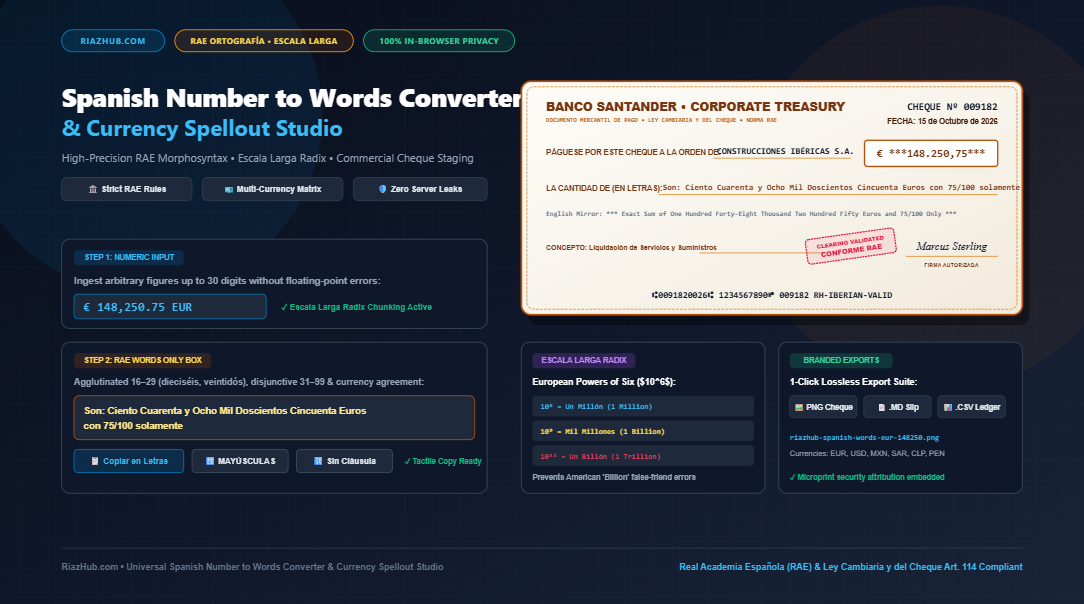
Need to convert numbers to authentic Spanish words right now? Launch the Spanish Number to Words Converter & Currency Spellout Studio on RiazHub.com to stage high-DPI bank checks, inspect Escala Larga designations, and generate instant legal payment vouchers with zero server transmission.
1. The Legal Doctrine of Words over Numbers: Why Spellout Precision Is Paramount
In modern international finance, digital banking, and treasury management, numerical amounts are virtually always represented in two distinct forms: Hindu-Arabic numerals (e.g., €148,250.75) and written natural language words. While digits facilitate rapid calculation and computational ingestion, they possess an inherent vulnerability to alteration, ink smudging, optical character recognition (OCR) transcription errors, and fraudulent modification.
To safeguard commercial transactions, negotiable instruments law across both Common Law and Civil Law jurisdictions maintains an absolute statutory rule: in the event of any discrepancy between the numeric sum and the spelled-out words, the written words legally govern.
Under Article 114 of the Spanish Ley 19/1985 Cambiaria y del Cheque, as well as analogous Latin American commercial clearing codes and Section 3-114 of the Uniform Commercial Code (UCC § 3-114), words triumph over numbers without exception:
— Ley Cambiaria y del Cheque (Principio de Primacía Absoluta de las Letras)
Consequently, corporate accountants, legal counsels, and export treasurers who issue commercial paper cannot afford spelling ambiguities, incorrect gender inflection, or missing fractional clauses. Utilizing a deterministic computational tool like the Spanish Number to Words Converter on RiazHub guarantees that every draft adheres strictly to statutory standards.
2. Morphosyntactic Rules of the Real Academia Española (RAE Ortografía 2010)
The Spanish grammatical system for numerals is governed by specific orthographic rules codified in the Real Academia Española (RAE) and the Association of Academies of the Spanish Language (ASALE) Ortografía de la lengua española (2010). Converting numeric values into authentic Spanish is far more complex than simple token concatenation:
(a) Agglutination of Compound Numerals (16 to 29)
Unlike older historical Spanish orthography that separated compound numbers with conjunctions (e.g., archaic diez y seis), modern RAE standards mandate that numbers from 16 through 29 are written as a single agglutinated word with strict graphic accents (tildes) required by standard phonological stress rules:
16: dieciséis (acento agudo on the final syllable)21: veintiuno (or veintiún before a masculine noun)22: veintidós (acute accent on the ending)23: veintitrés (acute accent on the ending)24: veinticuatro25: veinticinco26: veintiséis (acute accent on the ending)
(b) Disjunctive Conjunction from 31 Onwards
Beginning at 31, compound numbers are written separately with the coordinating conjunction “y”:
31: treinta y uno45: cuarenta y cinco99: noventa y nueve
Critically, hundreds are linked directly to tens without “y”: for example, 148 is written ciento cuarenta y ocho, not *ciento y cuarenta y ocho.
(c) The Apocope Rule (Regla del Apócope)
The numeral uno suffers apocope (shortening) to un when placed immediately before a masculine noun or before nouns representing higher orders of magnitude:
1 Euro→ un euro (never *uno euro)1,000,000→ un millón (never *uno millón)21 Pesos→ veintiún pesos
Similarly, ciento undergoes apocope to cien when preceding a noun or a number larger than itself (e.g., cien euros, cien mil), but retains the full form ciento before smaller numbers (e.g., ciento cinco).
(d) Gender Agreement in Hundreds (Concordancia de Género)
The hundreds from 200 through 900 inflect for grammatical gender to match the currency or noun:
| Numeral | Masculine Agreement (Euros, Dólares, Pesos) | Feminine Agreement (Halalas, Libras, Unidades) |
|---|---|---|
200 |
doscientos euros | doscientas libras |
300 |
trescientos dólares | trescientas coronas |
500 |
quinientos pesos | quinientas halalas |
700 |
setecientos soles | setecientas pesetas |
900 |
novecientos riyales | novecientas acciones |
3. Escala Larga vs. Escala Corta: Preventing the “Billion” False Friend in Financial Contracts
One of the most perilous traps in international commerce is the linguistic false-friend between the Anglo-American Short Scale (Escala Corta) and the traditional European Long Scale (Escala Larga), also known as the Chuquet-Pellos mathematical system.
In English (Short Scale), orders of magnitude advance by powers of three ($10^3$):
One Billion = $10^9$ ($1,000,000,000$).
In authentic Spanish (Escala Larga), major denomination milestones advance by powers of six ($10^6$):
Un Billón = $10^{12}$ ($1,000,000,000,000$ — a million millions).
Therefore, translating an American corporate contract for $5 Billion directly as “5 billones de dólares” accidentally multiplies the legal obligation by a factor of one thousand (representing $5,000,000,000,000 instead of $5,000,000,000). The correct Spanish representation for $10^9$ is mil millones (or un millardo).
The RiazHub Spanish Number to Words Converter & Currency Spellout Studio automatically executes native BigInt radix transformations according to the true European Escala Larga up to $10^{30}$:
| Power of Ten | Spanish Radix (Escala Larga) | English Short Scale Mirror | Numerical Value |
|---|---|---|---|
| $10^6$ | Un Millón | One Million | 1,000,000 |
| $10^9$ | Mil Millones (o un millardo) | One Billion | 1,000,000,000 |
| $10^{12}$ | Un Billón | One Trillion | 1,000,000,000,000 |
| $10^{15}$ | Mil Billones | One Quadrillion | 1,000,000,000,000,000 |
| $10^{18}$ | Un Trillón | One Quintillion | 1,000,000,000,000,000,000 |
| $10^{24}$ | Un Cuatrillón | One Septillion | 1024 |
4. Anatomy of a Legally Sealed Commercial Bank Check in Spanish
When issuing a commercial bank draft (cheque bancario), promissory note (pagaré), or corporate payment voucher (comprobante de egreso), specific structural elements are required to thwart fraudulent alteration:
- Statutory Delimiter Clauses: Beginning the legal line with
Son:and concluding withsolamente(or enclosing the phrase with protective asterisks:*** Son: ... solamente ***) ensures that third parties cannot prepend or append additional numeral words. - Fractional Subunit Clearing Standard: In European and Latin American banking, cents are customarily rendered in standard clearing fractional format:
con 75/100. Alternatively, full verbalization (e.g.,con setenta y cinco céntimos) is supported for formal notarized contracts. - Numeric Asterisk Framing: Numerical boxes are stamped with bounding asterisks (e.g.,
€ ***148.250,75***) to prevent the insertion of leading or trailing digits. - Dual-Language English Mirroring: For cross-border letters of credit and international SWIFT transactions, rendering an accompanying English mirror line under UCC § 3-114 eliminates ambiguity between overseas clearinghouses.
The Currency Spellout Studio on RiazHub provides a live interactive 1600×720 canvas that renders these elements in real time, complete with security guilloche tinting, red clearance stamps, and bottom MICR routing lines.
5. Multi-Currency ISO 4217 Matrix Supported by the Studio
Different Spanish-speaking nations apply unique designations to their principal currency units and minor fractions:
- EUR (Euro – €): Spelled as Euros and Céntimos. Standard across Spain and the Eurozone.
- USD (Dólar Estadounidense – $): Spelled as Dólares and Centavos. Widely utilized in Ecuador, El Salvador, Panama, and international trade.
- MXN (Peso Mexicano – $ M.N.): Spelled as Pesos M.N. (Moneda Nacional) with Centavos. Adheres to Banco de México standards.
- COP (Peso Colombiano – $): Spelled as Pesos Colombianos.
- ARS (Peso Argentino – $): Spelled as Pesos Argentinos and Centavos.
- CLP (Peso Chileno – $): Standard 0-decimal currency spelled as Pesos Chilenos.
- PEN (Sol Peruano – S/): Spelled as Soles and Céntimos according to Banco Central de Reserva del Perú rules.
- SAR (Riyal Saudí – ر.س): Spelled as Riyales Saudíes and Halalas for Middle Eastern trade settlements.
6. 100% In-Browser Privacy: Why Enterprise Treasurers Require Zero Server Transmission
In corporate payroll processing, high-value supplier settlement, and executive bonus disbursements, financial figures represent highly confidential business intelligence. Transmitting figures, beneficiary names, and check serial numbers across remote APIs exposes enterprises to data leakage, man-in-the-middle interception, and compliance violations under GDPR and CCPA.
The Spanish Number to Words Converter & Currency Spellout Studio executes 100% inside the client’s web browser using native ECMAScript BigInt, the HTML5 Canvas 2D API, and local Blob generators. Not a single digit or payee name is ever transmitted across an external network, providing total data sovereignty.
📁 Ready to Export Branded Financial Vouchers?
You can export high-resolution PNG bank check drafts, printable PDF accounting vouchers, formatted Markdown slips, or audit CSV registers with automatic riazhub-spanish-words-* file naming and microprint certification.
7. Frequently Asked Questions (FAQ)
Is 1,000,000,000 considered “Un Billón” in Spanish?
No. In Spanish, $1,000,000,000$ ($10^9$) is strictly mil millones (or un millardo). The term un billón is reserved for $10^{12}$ ($1,000,000,000,000$), representing a million millions under the European Long Scale.
Why do numbers like 16, 22, and 26 have accent marks (tildes)?
Under RAE accentuation rules, compound words like dieciséis, veintidós, veintitrés, and veintiséis are sharp words (palabras agudas) ending in -s or vowels. Because they consist of multiple syllables stressed on the final vowel, a written tilde is grammatically mandatory.
How does the studio handle numbers with decimals?
The studio offers two standardized modes: Fraccionario Bancario (e.g., con 75/100), which is standard on commercial checks and promissory notes, or Subunidades en Letras (e.g., con setenta y cinco céntimos), which spells out the decimal subunit words completely.
Can I print or download a realistic check graphic?
Yes. The studio features a high-DPI HTML5 Canvas check generator that produces lossless PNG downloads with genuine security guilloche patterns, MICR clearing lines, red authorization stamps, and site metadata in the file name. You can also print directly to PDF.
8. Conclusion
Accurately rendering financial amounts into Spanish words is both a linguistic science and a legal necessity. Whether you are drafting cross-border commercial invoices in Madrid, settling treasury contracts in Mexico City, or staging promissory notes in Buenos Aires, adhering to RAE morphosyntax, Escala Larga tiers, and Ley Cambiaria standards guarantees legal enforceability and fraud protection.
Access the full suite directly in your browser: visit the Spanish Number to Words Converter & Currency Spellout Studio on RiazHub to convert figures, preview check drafts, and export certified accounting documentation today.
Universal Spanish Number to Words Converter & Currency Spellout Studio
Transform numeric figures into orthographically verified Spanish words (Real Academia Española), stage commercial bank drafts (Escala Larga $10^6 - 10^{30}$), render anti-fraud cheque canvases, and generate verified accounting vouchers with zero external server transmission.