
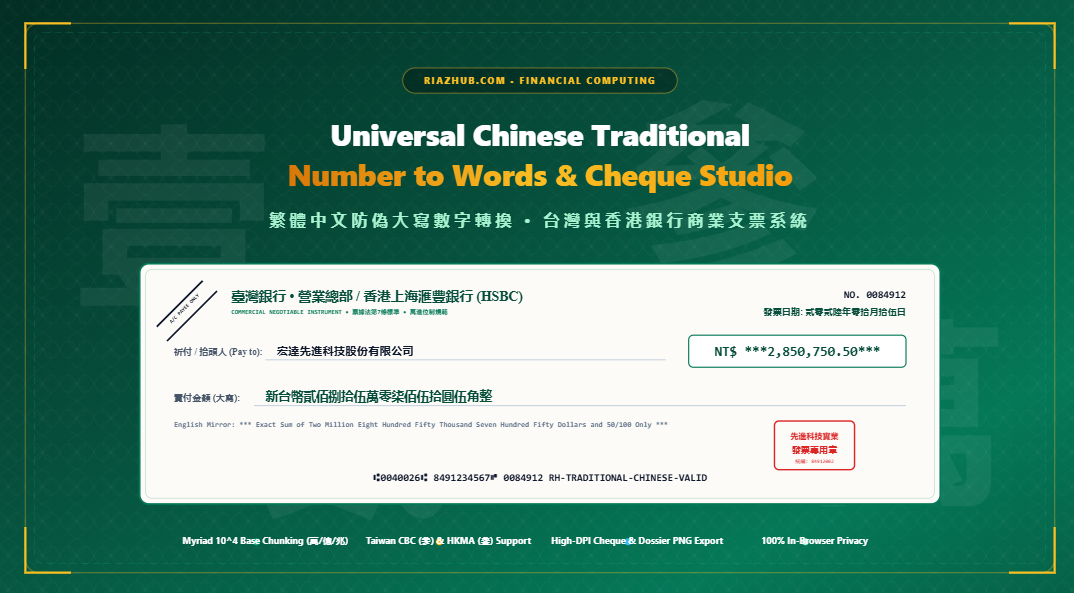
Mastering Traditional Chinese Financial Numerals: The Definitive Guide to Daxie (繁體大寫), Commercial Cheques & Taiwan/HK Banking Law
Whether issuing an eight-figure corporate settlement in Taipei or executing a cross-border draft via HSBC in Hong Kong, an erroneous stroke or improper zero placement can delay transactions, prompt bank clearing rejections, or invite legal disputes. To automate this complex morphosyntactic conversion with zero cloud leakage, corporate controllers rely on the Universal Chinese Traditional Number to Words Converter & Currency Spellout Studio on RiazHub.
⚡ Instant Client-Side Conversion Engine
Need to draft a CBC or HKMA-compliant crossed cheque, commercial payment voucher, or formal Daxie spellout immediately? Access our browser-based utility:
1. The Historical Genesis & Anti-Fraud Architecture of Daxie (大寫)
The everyday lowercase Chinese numerals (小寫: 一, 二, 三, 四, 五, 六, 七, 八, 九, 十) possess an inherent vulnerability: simplicity of stroke structure. In pre-modern banking and grain bookkeeping, an unscrupulous ledger clerk could easily alter records:
- A single horizontal stroke 「一」 (1) could be converted into 「二」 (2) with a second stroke, or into 「三」 (3) with a third.
- A single vertical stroke could transform 「一」 into 「十」 (10).
- Subsequent characters like 「千」 (1,000) could be modified from 「十」 with a single sweep.
To permanently eradicate tampering on negotiable debt contracts, the imperial administration of the Ming Dynasty (codified during the reign of Emperor Hongwu following major treasury fraud cases) established the mandatory use of complex homophonic phonetic characters known as Daxie (大寫). Characters such as 「壹、貳、參/叄、肆、伍、陸、柒、捌、玖、拾、佰、仟」 feature dense, interlocking radicals that make unauthorized stroke additions physically impossible without completely distorting the character’s balance.
| Arabic | Casual Xiaoxie (小寫) | Financial Capital Daxie (防偽大寫) | Stroke Anti-Tamper Mechanism |
|---|---|---|---|
| 0 | 〇 / 零 | 零 | Rain radical (雨) + phonetic bridge; prevents alteration. |
| 1 | 一 | 壹 | 12 strokes; completely encloses the base numeral. |
| 2 | 二 | 貳 | Shell radical (貝) denotes treasure/wealth; 12 strokes. |
| 3 | 三 | 參 (TW) / 叄 (HK) | Complex radical prevents adding strokes to mimic 2 or 10. |
| 4 | 四 | 肆 | 13 strokes; eliminates modification into other figures. |
| 5 | 五 | 伍 | Person radical (亻) coupled with five; dense balance. |
| 6 | 六 | 陸 | Mound/land radical (阝); 11 strokes. |
| 7 | 七 | 柒 | Water radical (氵) + tree (木); eliminates ambiguity with 10. |
| 8 | 八 | 捌 | Hand radical (扌) + distinct phonetic base; 10 strokes. |
| 9 | 九 | 玖 | Jade radical (王); prevents alteration into丸 or other forms. |
| 10 | 十 | 拾 | Hand radical (扌); prevents adding strokes to mimic 千 (thousand). |
| 100 | 百 | 佰 | Person radical (亻) + hundred; stops modification into 白. |
| 1,000 | 千 | 仟 | Person radical (亻) + thousand; stops modification into 于. |
| 10,000 | 萬 | 萬 | Foundational myriad base-10,000 radix; 13 strokes. |
When you use the Chinese Traditional Number to Words Converter, every numeral is verified against this anti-fraud character matrix according to official Taiwan and Hong Kong clearing standards.
2. The Myriad Base-10,000 Positional Radix System (萬進位制)
A fundamental disconnect between Western financial math and Traditional Sinophone accounting lies in radix chunking:
- Western Short Scale (1,000 Base): Figures group by thousands: Thousand ($10^3$), Million ($10^6$), Billion ($10^9$), Trillion ($10^{12}$).
- Traditional Chinese Myriad Scale (10,000 Base): Figures group in cycles of four zeros: 萬 ($10^4$), 億 ($10^8$), 兆 ($10^{12}$), 京 ($10^{16}$).
For instance, an amount written in English as $2,850,750.50 represents Two Million, Eight Hundred Fifty Thousand, Seven Hundred Fifty. In Traditional Chinese myriad math, the number is partitioned as:
= 貳佰捌拾伍萬 + 零柒佰伍拾圓 + 伍角整
Converting across the boundaries of 億 ($10^8$) and 萬 ($10^4$) without generating duplicate zeros or omitting mandatory bridging syllables requires strict algorithmic parsing. The RiazHub Traditional Chinese Spellout Studio implements native ES6+ BigInt chunking, accurately supporting astronomical figures up to 30 digits without the floating-point inaccuracies inherent in ordinary calculators.
3. Regional Divergence: Taiwan CBC Standards vs. Hong Kong HKMA Guidelines
Although both jurisdictions share classical Traditional Chinese orthography, decades of regional legal codification have produced critical variations:
A. The Character for “Three” (3): 參 vs. 叄
Under the standards of the Central Bank of the Republic of China (Taiwan CBC) and the Ministry of Finance’s Unified Invoice Regulations (統一發票使用辦法), the character 「參」 is universally mandated. Conversely, commercial banks under the Hong Kong Monetary Authority (HKMA), such as HSBC, Standard Chartered, and Bank of China (Hong Kong), predominantly utilize and recognize 「叄」 on commercial cheques.
B. Major Currency Units and Subunits: 圓/角/分 vs. 圓/毫/仙
In Taiwan commercial practice, the major unit of the New Taiwan Dollar is formal 「圓」 (or casual 「元」), while decimals are denominated in 「角」 (tenths) and 「分」 (hundredths).
In Hong Kong banking, the Hong Kong Dollar uses 「圓」, while fractional subunits are historically denoted as 「毫」 (0.1 HKD) and 「仙」 (0.01 HKD, derived from the English word Cent).
C. Terminal Closure Word: 整 vs. 正
To prevent fraudulent additions to the end of a written check (e.g., adding extra decimals after the principal sum), negotiable instruments must terminate with a mandatory closure character:
- Taiwan CBC Standard: 「整」 (Zhěng) or 「正」.
- Hong Kong Standard: 「正」 (Zhèng) is preferred by the Hong Kong Association of Banks (HKAB).
With the Traditional Chinese Number to Words Converter, corporate users can toggle between Taiwan CBC Mode and Hong Kong HKMA Mode with a single click, instantly reconfiguring radicals, currency markers, and closure terminology.
4. The Legal Primacy of Traditional Words: Article 7 of the Negotiable Instruments Law
In commercial jurisprudence across both Taiwan (票據法第7條) and Hong Kong (Bills of Exchange Ordinance, Cap. 19, Section 9), there exists an unambiguous statutory mandate:
“Where the sum payable by a negotiable instrument is expressed in both words and figures, and there is a discrepancy between the two, the sum denoted by the words shall govern.”
This principle known as Statutory Word Supremacy (文字絕對優先原則) means that if an accounting clerk writes NT$ 1,500,000 in the numeric figure box, but inadvertently scripts 「新台幣壹佰伍拾伍萬圓整」 (1,550,000) on the legal amount line, the banking clearing house will honor the written Chinese words: 1,550,000.
This legal doctrine makes manual check writing a high-risk liability for corporate treasurers. Pre-validating figures through the RiazHub Cheque Staging Studio eliminates transcription discrepancies before ink touches the negotiable draft.
5. Check Date Anti-Fraud Rules (發票日期大寫規範)
Writing the amount correctly is only half the battle; commercial clearing guidelines strictly regulate the Value Date line (發票日期) on bank drafts. To prevent date alterations (which could prematurely negotiate post-dated checks or extend stale-dated drafts), digits must adhere to rigid anti-fraud rules:
- Individual Year Digits: The year must not be written as an aggregate number, but digit by digit. For example, 2026 is rendered as 「貳零貳陸年」.
- Zero Prefix on Months 1, 2, and 10: January must be written as 「零壹月」, February as 「零貳月」, and October as 「零拾月」 (or 「零壹拾月」). This prevents a fraudster from prepending a stroke to turn January (壹月) into November (拾壹月).
- Zero Prefix on Days 1 to 9, 10, 20, and 30: Days 1 through 9 must be prefixed with 「零」 (e.g., 「零壹日」). Days 10, 20, and 30 must be written as 「零拾日」, 「零貳拾日」, and 「零參拾日」.
6. Crossed Cheques (劃線支票) & Security Features
Drawing two parallel diagonal lines across the upper-left corner of a commercial cheque creates a Crossed Cheque (劃線支票), commonly annotated with “A/C PAYEE ONLY” (只准存入受款人帳戶).
Under banking clearing rules, a crossed cheque cannot be cashed over the counter. It can only be collected by an authorized financial institution and credited directly to the named beneficiary’s verified corporate account. The visualizer inside the Chinese Traditional Number to Words Studio renders these crossed lines alongside authentic security guilloche tints, protective asterisks, MICR clearing bands, and red financial chops (發票專用章).
🔒 100% In-Browser Privacy Guarantee
Corporate payroll sums, commercial invoice balances, and beneficiary names should never be transmitted to unknown cloud APIs. Our converter operates entirely client-side using native JavaScript and HTML5 Canvas. Your financial data never leaves your device.
Frequently Asked Questions (FAQ)
While 「元」 is commonly accepted on general business receipts and casual invoices, commercial clearing houses in Taiwan and Hong Kong strongly advise using the formal capital 「圓」 for negotiable instruments to ensure flawless automated optical character recognition (OCR) and eliminate ambiguity.
Traditional zero normalization dictates that consecutive zeros within a 4-digit myriad block are collapsed into a single 「零」. For example, NT$ 10,005 is correctly written as 「新台幣壹萬零伍圓整」, not 「壹萬零零零伍圓整」. The RiazHub Converter automatically normalizes intermediate zeros.
Yes. By selecting the NONE - 純數字繁體漢字 option in the currency selector, the studio converts pure integers and decimal figures into formal Daxie or casual Xiaoxie without appending currency prefixes, subunits, or closure characters—ideal for legal deeds, contractual clauses, and inventory manifests.
The studio provides direct 1-click export buttons for lossless high-resolution PNG cheque graphics, formatted Markdown (.md) accounting vouchers, check register CSV logs, high-DPI certification dossier cards, and print-ready PDF stylesheets with automatic RiazHub.com compliance branding.
Universal Chinese Traditional Number to Words Converter & Cheque Studio
High-precision financial Daxie (繁體大寫) and casual Xiaoxie (小寫) conversion, myriad base-10,000 radix grouping, interactive anti-fraud bank cheques, accounting vouchers, and branded legal certificates.
商業支票付款折讓與統一憑證核驗單
| 支票憑證號碼 (Cheque No.) | -- | 發票日期 (Issue Date) | -- |
|---|---|---|---|
| 付款銀行 (Bank Name) | -- | 抬頭人 (Payee Name) | -- |
| 幣別代碼 (Currency) | -- | 數碼金額 (Arabic Amount) | -- |
| 繁體大寫法定金額 (Daxie) | -- | ||
| 英文金額鏡像 (English) | -- | ||
| 用途摘要 (Description) | 貨款結算與專業技術服務報酬 • 依票據法第7條規定立據 | ||
⚖️ 票據法第7條與文字絕對優先原則 (Statutory Word Supremacy)
根據中華民國《票據法》第7條及香港《票據條例》第9條,票據上所記載之金額,若「文字」與「號碼」不符時,以文字(繁體大寫金額)為準。若文字有數處記載且不符時,以最低金額為準。因此,大寫漢字的精確度與防偽性具有最高法定效力。
📅 支票發票日期大寫防偽規範 (Anti-Fraud Date Rules)
為防止有心人士加筆篡改日期,銀行公會規範發票日期填寫標準:
- 年份 (Year): 數字必須分開逐一寫出大寫,如 2026年 應寫作「貳零貳陸年」(或民國115年寫作「壹佰壹拾伍年」)。
- 月份 (Month): 壹月、貳月及拾月前必須加「零」,寫作「零壹月」、「零貳月」、「零拾月」;拾壹月及拾貳月應寫作「壹拾壹月」、「壹拾貳月」。
- 日期 (Day): 壹日至玖日前必須加「零」(如「零壹日」);拾日、貳拾日、參拾日必須加「零」(如「零拾日」、「零貳拾日」),防止前添「壹」或「貳」。
🔒 劃線支票 (Crossed Cheque) 法律效力
支票正面左上角劃平行雙斜線(Crossed Cheque),並註明「A/C PAYEE ONLY」(只准存入受款人帳戶)者,付款金融機構僅得由受款人之帳戶代為存入兌現,絕對禁止在銀行櫃台直接兌領現鈔,杜絕冒領與遺失風險。
📚 Traditional Chinese Financial Linguistics & Metrology Knowledge Base
數字「3」的大寫: 台灣票據實務與公文字體標準主要使用「參」;香港金融界與銀行支票清算標準則極普遍採用「叄」。
幣別角/分單位: 台灣法定貨幣為「新台幣」,輔幣單位為「角」與「分」;香港法定貨幣為「港幣」,輔幣在日常商業與支票上通常表述為「毫」(一毫為一角)與「仙」(一仙為一分,源自 Cent)。
結尾封口字: 台灣習慣使用「整」或「正」;香港銀行公會指引多偏好「正」字,兩者均具備防止在尾端添寫金額之法定效力。