
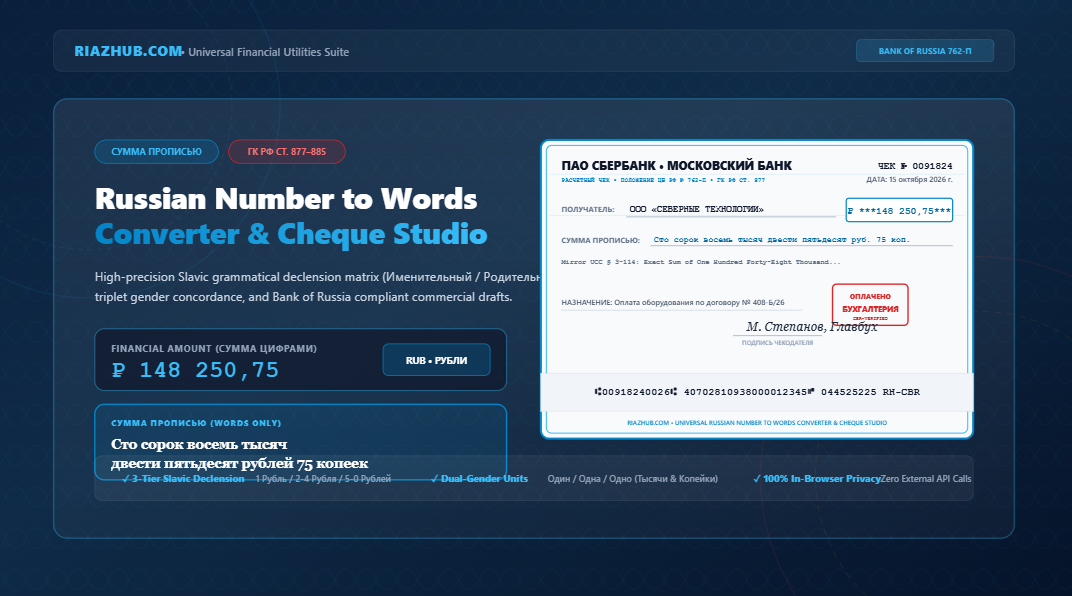
Mastering Russian Number to Words: The Complete Guide to Slavic Currency Spellouts, Bank of Russia Cheques & Legal Accounting Standards
However, Russian financial orthography poses formidable challenges even for native speakers and senior accountants. Unlike English, Spanish, or German, where pluralization follows relatively uniform rules, the Russian linguistic engine requires dynamic triple-tier Slavic case declensions (Nominative Singular, Genitive Singular, and Genitive Plural), strict gender concordance (masculine, feminine, and neuter agreements), and specialized legal formatting protocols dictated by Central Bank regulations.
To eliminate discrepancies and ensure compliance, financial professionals rely on the browser-based Russian Number to Words Converter & Currency Spellout Studio, an in-browser computational suite engineered specifically to navigate the complexities of Russian financial linguistics and commercial banking law.
⚡ Key Takeaways at a Glance:
- The Slavic Case Rule: Russian numerals decline based on a modulo 10 and modulo 100 algorithmic test, creating three distinct grammatical forms for currency nouns (e.g., рубль, рубля, рублей).
- Gender Concordance: Numbers ending in “1” and “2” change their form according to the grammatical gender of the unit: masculine (один рубль, два рубля), feminine (одна тысяча, две тысячи, одна копейка), and neuter (одно евро).
- Legal Word Supremacy: Under Article 877 of the Civil Code of the Russian Federation (ГК РФ) and Central Bank Regulation No. 762-P, when a conflict exists between figures and written words on a financial instrument, the amount written in legal words legally prevails.
- Instant In-Browser Validation: You can test any transaction amount, generate Bank of Russia drafts, and copy verified phrases in seconds using the Russian Currency Spellout Studio at RiazHub.com.
1. The Slavic Computational Linguistics Matrix: How Russian Number Declension Works
Russian numerical morphology treats quantities through a sophisticated declension system. Every positive integer $n$ belongs to one of three grammatical categories determined by its final digits. To compute the correct noun ending for major currency units (rubles, dollars, tenge) and fractional subunits (kopeks, cents), Slavic computational linguists evaluate two simple modulo operations:
Let
rem100 = n % 100andrem10 = n % 10.
| Linguistic Condition | Grammatical Case | Masculine Example (Рубль) | Feminine Example (Тысяча) | Subunit Example (Копейка) |
|---|---|---|---|---|
| rem10 == 1 and rem100 != 11 | Nominative Singular (Именительный падеж ед.ч.) | 1 один рубль 101 сто один рубль |
1 одна тысяча 51 пятьдесят одна тысяча |
1 одна копейка 21 двадцать одна копейка |
| rem10 in [2, 3, 4] and not (12 ≤ rem100 ≤ 14) | Genitive Singular (Родительный падеж ед.ч.) | 2 два рубля 104 сто четыре рубля |
2 две тысячи 54 пятьдесят четыре тысячи |
2 две копейки 33 тридцать три копейки |
| rem10 in [5, 6, 7, 8, 9, 0] OR 11 ≤ rem100 ≤ 19 | Genitive Plural (Родительный падеж мн.ч.) | 5 пять рублей 11 одиннадцать рублей |
5 пять тысяч 14 четырнадцать тысяч |
5 пять копеек 17 семнадцать копеек |
Notice the critical linguistic exception: the teen numbers from 11 through 19 (одиннадцать, двенадцать… девятнадцать) always trigger the Genitive Plural form (рублей, тысяч, копеек), regardless of whether their final digit is 1, 2, 3, or 4. Attempting to write «11 рубля» or «12 копейки» constitutes a severe grammatical blunder that invalidates banking paperwork.
Whenever you need to quickly verify high-value transactions with nested thousands or millions, running your numbers through the Universal Russian Number to Words Converter ensures algorithmic adherence to all Slavic declension matrices without manual guesswork.
2. Grammatical Gender Agreement: Units 1 and 2
A second layer of complexity is gender concordance. In Russian, the numerals 1 and 2 must agree with the grammatical gender of the noun they modify:
- Masculine Nouns (рубль, доллар, миллион, миллиард):
Use один and два.
Example: «Один рубль», «Два миллиона рублей». - Feminine Nouns (тысяча, копейка, халала):
Use одна and две.
Example: «Одна тысяча», «Две тысячи», «Одна копейка», «Две копейки». - Neuter Nouns (евро):
Use одно and два.
Example: «Одно евро», «Два евро».
This gender interplay creates compound phrasing where adjacent words exhibit different gender endings. For instance, in the amount ₽ 141 002,00, the thousands triplet modifies the feminine noun тысяча (yielding «сто сорок одна тысяча»), whereas the units modify the masculine noun рубль (yielding «два рубля»). The complete phrase is:
«Сто сорок одна тысяча два рубля 00 копеек»
3. Central Bank of Russia Regulations (Положение ЦБ РФ № 762-П) & Statutory Word Supremacy
Under the regulatory framework governing commercial payments in the Russian Federation specifically Regulation of the Bank of Russia No. 762-P «On the Rules of Transfer of Funds» (Положение Банка России № 762-П) and Articles 877–885 of the Civil Code of the Russian Federation (ГК РФ) commercial cheques and payment orders are classified as negotiable instruments with strict formatting rules:
- First Letter Capitalization: The written words must begin strictly with a capitalized initial letter (С заглавной буквы) without any leading indentation or space. This ensures no fraudulent text can be inserted ahead of the declared figure.
- Subunit Designation: The main currency unit must be written in full words (рублей), while the fractional subunit (kopeks) is typically designated as two numerical digits followed by the inflected word копеек (e.g., «75 копеек») or as a fractional expression (75/100).
- Safety Fill Lines & Protective Symbols: Any remaining horizontal space on the payment cheque’s amount line must be closed off with a continuous strike-through or double security line to prevent post-authorization alterations.
- Statutory Supremacy of Written Words: In the event of a discrepancy between the numeric box and the written words line, Russian law and international banking treaties dictate that the written text is legally binding and supersedes any conflicting figures.
You can preview fully staged, Bank of Russia compliant commercial check drafts complete with security Guilloche tints, payee endorsements, and clearing bands directly within the Russian Number to Words Converter & Currency Spellout Studio.
4. Multi-Currency Support Across the CIS, GCC, and International Trade
Modern enterprise accounting frequently involves multi-currency settlement. Russian financial documents must accurately verbalize foreign currencies in accordance with Russian linguistic standards:
| Currency (ISO Code) | Major Unit Declensions (1 / 2–4 / 5–0) | Subunit Declensions (1 / 2–4 / 5–0) | Standard Sample Spellout (148 250,75) |
|---|---|---|---|
| RUB (₽) — Российский рубль | рубль / рубля / рублей | копейка / копейки / копеек | Сто сорок восемь тысяч двести пятьдесят рублей 75 копеек |
| USD ($) — Доллар США | доллар США / доллара США / долларов США | цент / цента / центов | Сто сорок восемь тысяч двести пятьдесят долларов США 75 центов |
| EUR (€) — Евро | евро / евро / евро (несклоняемое) | цент / цента / центов | Сто сорок восемь тысяч двести пятьдесят евро 75 центов |
| KZT (₸) — Казахстанский тенге | тенге / тенге / тенге (несклоняемое) | тиын / тиына / тиынов | Сто сорок восемь тысяч двести пятьдесят тенге 75 тиынов |
| BYN (Br) — Белорусский рубль | белорусский рубль / белорусских рубля / белорусских рублей | копейка / копейки / копеек | Сто сорок восемь тысяч двести пятьдесят белорусских рублей 75 копеек |
| SAR (ر.س) — Саудовский риял | саудовский риял / саудовских рияла / саудовских риялов | халала / халалы / халал | Сто сорок восемь тысяч двести пятьдесят саудовских риялов 75 халал |
| AED (د.إ) — Дирхам ОАЭ | дирхам ОАЭ / дирхама ОАЭ / дирхамов ОАЭ | филс / филса / филсов | Сто сорок восемь тысяч двести пятьдесят дирхамов ОАЭ 75 филсов |
For cross-border escrow accounts and bilingual commercial invoices, the Russian Currency Spellout Studio simultaneously generates a parallel English translation mirror conforming to Uniform Commercial Code (UCC § 3-114) standards, providing instant dual-language parity.
5. Commercial Accounting Vouchers (КО-2) & Expense Slips
Russian accounting departments use the Cash Expenditure Order (Расходный кассовый ордер, типовая форма КО-2) whenever cash is disbursed from the corporate treasury. The regulations governing primary accounting documentation (Федеральный закон № 402-ФЗ «О бухгалтерском учете») mandate that the total sum disbursed must be inscribed in words to prevent fraud.
Typical entry requirements include:
- Corresponding Accounts: Clearly designated Debit (e.g., Счет 60.01 «Расчеты с поставщиками») and Credit (Счет 50 «Касса» or Счет 51 «Расчетные счета»).
- VAT Allocation: Explicit identification of whether the sum includes Value Added Tax («В том числе НДС 20%») or is VAT-exempt («НДС не облагается»).
- Signatures: Dual sign-off by the Organization Director and Chief Accountant (Главный бухгалтер).
Using the built-in Cash Voucher staging tab on the Russian Number to Words Studio at RiazHub, accountants can view an authentic КО-2 preview with automatic 20% VAT calculations and export ready-to-print Markdown documentation or accounting CSV registers with a single click.
6. 100% Client-Side Privacy: Why In-Browser Processing Matters
In an era of stringent corporate confidentiality laws and GDPR/Russian Federal Law No. 152-FZ on Personal Data Protection, transmitting payroll figures, supplier bank accounts, or high-stake invoice totals to external third-party API servers presents serious cybersecurity and regulatory vulnerabilities.
The Russian Number to Words Converter & Currency Spellout Studio operates 100% client-side inside your browser sandbox. Utilizing native JavaScript BigInt arithmetic, offline HTML5 Canvas drafting, and localized formatting engines:
- Zero private bank accounts, contractor names, or payment values leave your device.
- No external telemetry, cloud tracking, or server databases store your financial documentation.
- You can safely draft multi-million ruble corporate disbursements even in offline or air-gapped corporate environments.
7. Frequently Asked Questions (FAQ)
How do I write zero kopeks in Russian formal documents?
In standard Russian banking practice, zero fractional units are written numerically with the word копеек: «00 копеек». For example: «Сто рублей 00 копеек». In certain civil contracts, writing «ровно» (e.g., «Сто рублей ровно») is also legally acceptable, though banking drafts prefer the explicit «00 копеек» format.
Why is thousand (тысяча) declined differently from million (миллион)?
In Slavic linguistics, тысяча is a grammatically feminine noun, whereas миллион and миллиард are grammatically masculine. Therefore, when specifying units 1 and 2, thousands require feminine concordance (одна тысяча, две тысячи), while millions require masculine concordance (один миллион, два миллиона).
What is the maximum number supported by the converter?
Because the engine utilizes native JavaScript BigInt mathematics rather than standard 64-bit floating-point numbers, the Russian Number to Words Converter can process numbers with up to 30 digits without precision loss spanning trillions, quadrillions, and quintillions.
Conclusion: Seamless Accuracy for Russian Financial Documentation
Mastering Russian financial grammar is an essential prerequisite for risk-free business operations throughout the Slavic linguistic sphere. By integrating automated morphological rules, CBR Regulation 762-P standards, and zero-leakage client-side privacy, you ensure every settlement cheque, invoice total, and accounting voucher is flawless.
Ready to convert numbers and generate certified commercial drafts? Visit the Russian Number to Words Converter & Currency Spellout Studio on RiazHub.com and streamline your financial paperwork today.
Universal Russian Number to Words Converter & Currency Spellout Studio
Convert financial figures into grammatically accurate Russian words (сумма прописью) with rigorous Slavic case declensions (Именительный / Родительный), dynamic gender concordance, Bank of Russia compliant cheque drafting, and legal accounting vouchers.
⚙️ Slavic Grammar & Drafting Rules
| Корреспондирующий счет | Статья затрат | Сумма цифрами | Код целевого назначения |
|---|---|---|---|
| Дебет 60.01 / Кредит 51 | Оплата за оборудование | 148 250,75 ₽ | CBR-762P-EXP-01 |
Основание: Договор поставки промышленного оборудования б/н
Сумма прописью: Сто сорок восемь тысяч...
В том числе НДС (20%): 24 708,46 ₽
(подпись / расшифровка)
(подпись / расшифровка)
| Числовое окончание | Грамматический падеж | Пример для рублей (Муж. род) | Пример для тысяч (Жен. род) | Пример для копеек (Жен. род) |
|---|---|---|---|---|
| Оканчивается на 1 (кроме 11) |
Именительный падеж ед.ч. | 1 один рубль | 1 одна тысяча | 1 одна копейка |
| Оканчивается на 2, 3, 4 (кроме 12-14) |
Родительный падеж ед.ч. | 2 два рубля | 2 две тысячи | 2 две копейки |
| Оканчивается на 5–9, 0 и 11–19 |
Родительный падеж мн.ч. | 5 пять рублей | 5 пять тысяч | 5 пять копеек |
- Rule 1 (Nominative Singular): When the last digit is 1 (except 11) → рубль, доллар, тысяча, копейка.
- Rule 2 (Genitive Singular): When the last digit is 2, 3, or 4 (except 12, 13, 14) → рубля, доллара, тысячи, копейки.
- Rule 3 (Genitive Plural): For numbers ending in 0, 5–9, and the teens 11–19 → рублей, долларов, тысяч, копеек.
- The amount in words must always begin with an uppercase letter without indentation or leading space.
- The currency major unit is written in full (рублей), while the fractional subunit (kopeks) is typically designated as two digits followed by the word копеек (e.g., 75 копеек).
- Any unused horizontal space on the cheque amount line must be struck through with a double horizontal security line to prevent fraudulent subsequent alterations.