
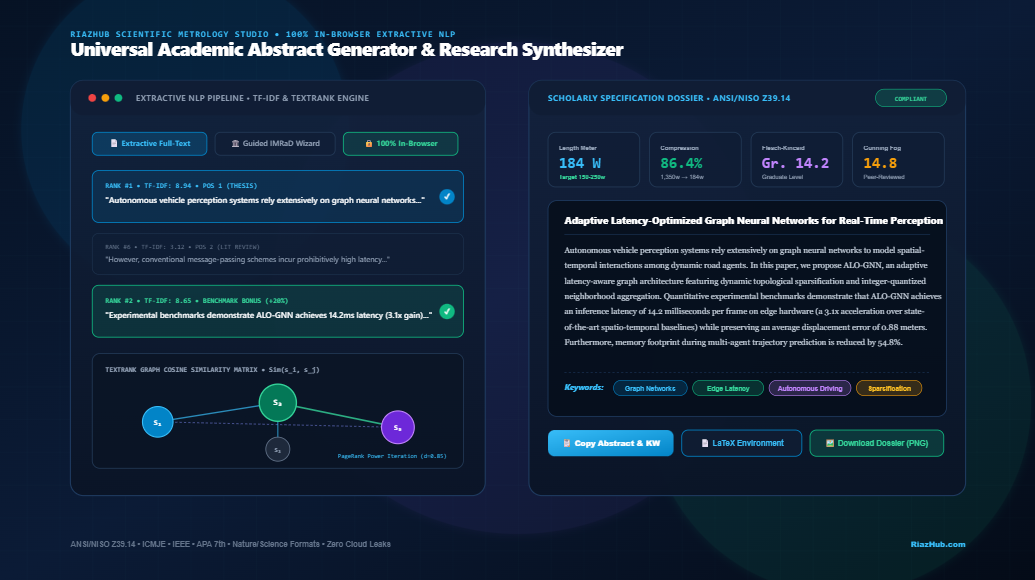
In modern scholarly publishing, the abstract is the single most critical paragraph of your entire manuscript. It determines whether journal editors send your paper for peer review, whether indexing crawlers surface your research, and whether fellow scientists cite your discoveries. Discover how to synthesize publication-ready abstracts using pure client-side extractive NLP, mathematical vector space modeling, and structured IMRaD frameworks without hallucinations or third-party server leaks.
1. The Crisis of Generative AI Hallucinations in Scientific Publishing
With the emergence of large generative neural networks, thousands of researchers have attempted to automate abstract drafting using general-purpose commercial language models. However, academic publishing metrologists and peer-review boards have uncovered an alarming frequency of generative hallucinations.
Because generative LLMs predict output probabilistically rather than evaluating factual mathematical ground truth, they frequently fabricate non-existent p-values, invert drug trial hazard ratios, alter algorithmic complexity classes, and invent fictional co-author citations. In scholarly publishing, a single hallucinated statistical metric can disqualify a manuscript from peer review, spark retractions, or permanently taint an investigator’s credibility.
This critical vulnerability necessitated a return to mathematically verifiable Extractive Natural Language Processing (NLP). Instead of generating speculative phrases from scratch, extractive algorithms evaluate the authentic, verbatim sentences written by the author, ranking them through vector space frequencies and graph centrality matrices to extract the most thematically significant findings without altering a single word.
Why Verbatim Extractive Summarization Protects Authors
Unlike generative neural networks that reconstruct sentences using token probability distributions, the Academic Abstract Generator & Scholarly Studio extracts original, peer-checked experimental claims directly from your manuscript draft. Every percentage, standard deviation, and methodology statement remains 100% faithful to your raw empirical data.
2. Extractive vs. Abstractive Summarization: A Computational Comparison
Understanding the distinction between extractive and abstractive NLP models is foundational to academic integrity and scholarly metrology:
| Metric / Characteristic | Extractive NLP (Vector Space / Graph) | Abstractive LLM (Generative Neural) |
|---|---|---|
| Factual Fidelity | 100% Verbatim — Extracts author’s exact sentences | Probabilistic — Prone to hallucinations & data drift |
| Numerical Accuracy | Absolute — Quantitative metrics remain intact | Unreliable — Frequently transposes numbers & p-values |
| Intellectual Property Privacy | 100% In-Browser — Zero cloud transmissions | Server-Side — Drafts logged on corporate API servers |
| ANSI/NISO Z39.14 Adherence | Strict — Objective reflection of manuscript scope | Variable — Often introduces subjective conversational filler |
| Execution Latency | < 50 Milliseconds client-side execution | 3 to 15 seconds dependent on cloud queue |
3. The Mathematical NLP Pipeline: TF-IDF & TextRank Graph Centrality
The client-side engine running within the Universal Academic Abstract Generator implements a multi-stage computational linguistics pipeline:
A. Abbreviation & Decimal-Protected Sentence Tokenization
Standard sentence tokenizers naively split text on periods, corrupting academic literature containing Latin abbreviations (e.g., et al., i.e., e.g.), scientific figure labels (Fig. 3A, Tab. 1), or decimal values (3.1415, p < 0.05). Our tokenizer temporarily shields protected tokens with unique semantic placeholders before executing terminal boundary segmentations:
// Shielding Abbreviations & Floating-Point Decimals
sanitized = text.replace(/(\d+)\.(\d+)/g, '$1___DECIMAL___$2');
ABBREVIATIONS.forEach((abbr, idx) => {
    const regex = new RegExp('\\b' + abbr.replace(/\./g, '\\.'), 'gi');
    sanitized = sanitized.replace(regex, '___ABBR_' + idx + '___');
});
B. Term Frequency-Inverse Document Frequency (TF-IDF) Scoring
Each sentence $s$ in the manuscript $S = \{s_1, s_2, \dots, s_N\}$ is tokenized, stripped of scholarly stopwords, and evaluated across term frequencies:
$$\text{TF}(t, s) = \frac{\text{Count of term } t \text{ in sentence } s}{\text{Total tokens in sentence } s}$$
$$\text{IDF}(t) = \ln\left(\frac{1 + |S|}{1 + |\{s \in S : t \in s\}|}\right) + 1$$
C. TextRank Graph Cosine Similarity Matrix Formulation
Inspired by Google’s PageRank algorithm, TextRank constructs an undirected, weighted graph where every sentence serves as a node, and edges quantify lexical semantic overlap:
$$\text{Sim}(s_i, s_j) = \frac{|\text{Tokens}(s_i) \cap \text{Tokens}(s_j)|}{\ln(|\text{Tokens}(s_i)|) + \ln(|\text{Tokens}(s_j)|)}$$
Power iteration over 10 cycles with damping factor $d = 0.85$ converges node centrality scores, revealing which sentences share the highest structural inter-connectivity with the broader manuscript.
D. Scholarly Position Factor & Empirical Quantitative Multipliers
Academic papers possess conventional rhetorical structures. The opening 20% of a manuscript (Introduction) contains primary thesis objectives, while the final 20% (Discussion/Conclusion) houses takeaway implications. The algorithm applies a +30% position boost to introductory thesis statements, a +20% boost to concluding summaries, and an additional +20% quantitative bonus to sentences verifying empirical benchmark statistics (e.g., percentages, hazard ratios, confidence intervals).
4. The Structured IMRaD Framework: ANSI/NISO Z39.14 Standard
The universal four-pillar framework mandated by the International Committee of Medical Journal Editors (ICMJE), IEEE, and Elsevier is IMRaD:
- Introduction & Background: What was the context, the unaddressed gap in existing scholarship, and the specific investigative objective? (Target: 20% of abstract word count).
- Methods & Protocol: What experimental methodology, materials, computational models, clinical trial design, or statistical regressions were deployed? (Target: 25% of abstract word count).
- Results & Quantitative Findings: What were the specific measurements, percentage enhancements, effect sizes, and statistical significances ($p$-values)? (Target: 35% of abstract word count).
- Discussion & Implications: How do these findings contextualize within established literature, and what are the underlying mechanisms? (Target: 10% of abstract word count).
- Conclusion & Broader Impact: What is the definitive takeaway and translational scholarly contribution? (Target: 10% of abstract word count).
When using the guided IMRaD mode in the RiazHub Abstract Generator, authors can toggle automated transitional conjunctives (e.g., “Specifically,” “The experimental findings reveal,” “Consequently,”) to seamlessly fuse these five modules into a unified, publication-ready academic block.
5. Linguistic Quality & Readability Telemetry Metrology HUD
Submitting an abstract with an improper reading complexity score or excessive syntactic passivity leads to swift desk rejections. The metrology radar in the tool audits five vital metrics in real time:
| Telemetry Metric | Mathematical Formulation | Optimal Academic Target Range |
|---|---|---|
| Flesch Reading Ease (FRE) | $$206.835 – 1.015\left(\frac{W}{S}\right) – 84.6\left(\frac{\text{Syll}}{W}\right)$$ | 30.0 – 50.0 (Academic / Graduate Level) |
| Gunning Fog Index (FOG) | $$0.4 \left[\left(\frac{W}{S}\right) + 100\left(\frac{\text{Complex Words}}{W}\right)\right]$$ | 13.0 – 16.0 (Rigorous Scientific Discourse) |
| Flesch-Kincaid Grade | $$0.39\left(\frac{W}{S}\right) + 11.8\left(\frac{\text{Syll}}{W}\right) – 15.59$$ | Grade 12.0 – 15.0 (Post-Secondary / Scholar) |
| Lexical Diversity (TTR) | $$\text{TTR} = \frac{\text{Unique Tokens}}{\text{Total Tokens}}$$ | 0.55 – 0.75 (Rich, Non-Redundant Vocabulary) |
| Passive Voice Proportion | $$\% = \frac{\text{Passive Sentences}}{\text{Total Sentences}} \times 100$$ | < 25% (APA 7th & Nature Active Preference) |
6. Keyword Optimization Strategy for Google Scholar & PubMed
An abstract does not exist in isolation; it functions as a search discovery engine for your paper. Many researchers make the critical mistake of selecting keywords that repeat words already in their paper title. Because indexing databases (Google Scholar, Scopus, PubMed, IEEE Xplore) automatically index all title terms with maximum weight, repeating title words in your keyword field waste valuable indexable surface area.
The keyword extractor inside the Academic Abstract Generator Tool identifies top multi-word keyphrases using composite TF-IDF frequencies. Authors can click any tag in the interactive cloud to dynamically insert or remove terms from the abstract footer.
7. Target Word Clamps Across Major Scientific Journals
Every scholarly publisher enforces rigid word clamps. Exceeding a word ceiling by even a single term can cause the journal submission portal to reject the manuscript upload:
- Nature & Science Letters: Strictly < 150 words. Unstructured, descriptive paragraph.
- IEEE Transactions & ACM: 150 to 250 words. Single, dense technical paragraph highlighting quantitative gains.
- APA 7th Edition (Psychology & Social Sciences): 150 to 250 words. Structured or single-block descriptive summary.
- The Lancet, JAMA & BMJ (ICMJE Standard): 250 to 300 words. Explicitly structured under Background, Methods, Findings, and Interpretation headings.
8. Step-by-Step Workflow Tutorial
- Enter Manuscript Title: Type or paste your research paper title. The character count and header synchronizer update dynamically across the specification dossier.
- Select Synthesis Paradigm: Choose Extractive Full-Text if you have an existing manuscript or thesis draft (up to 50,000 words), or select Guided IMRaD Wizard to build a structured abstract from scratch.
- Adjust Compression Slider: In Extractive mode, choose your target sentence count (3 to 10 sentences) or click a discipline preset chip (e.g., APA 7th, IEEE Technical, Nature Descriptive).
- Click “Generate Academic Abstract”: The browser engine tokenizes the manuscript, performs TF-IDF matrix factorization, calculates TextRank graph cosine similarities, and presents the synthesized abstract in milliseconds.
- Audit Readability & Thematic Cloud: Switch to the Readability & Style tab to check Flesch Reading Ease, Fog Index, and ANSI/NISO Z39.14 compliance checklist. Click tags in the Keyword Cloud to customize your indexable terms.
- Export in 1 Click: Copy formatted text with keywords, generate LaTeX code (
\begin{abstract}...\end{abstract}), copy Markdown, or trigger a clean print brief for submission archiving. - Render 1200×630 Specification Dossier: Navigate to the Dossier Card Studio, select a scholarly palette (Cyber Azure, Scholarly Emerald, Deep Obsidian, or Academic Crimson), and download a high-DPI PNG card for academic social media or conference presentations.
9. 100% In-Browser Privacy Guarantee for Unpublished Manuscripts
Unpublished scientific manuscripts, proprietary pharmaceutical trials, patent applications, and thesis drafts contain vulnerable intellectual property. Transmitting raw manuscripts to third-party generative cloud APIs exposes proprietary data to server caching, training data ingestion, and corporate leaks.
The Universal Academic Abstract Generator executes 100% client-side inside your browser sandbox. All tokenization, vector scoring, graph calculations, and canvas rendering utilize native Web APIs (ECMAScript 6+, Canvas 2D, Blob, Clipboard API). No server requests are initiated, guaranteeing total data sovereignty and IP security.
10. Frequently Asked Questions (FAQ)
▼
▼
▼
▼
\begin{abstract}...\end{abstract} block along with an indented \noindent \textbf{Keywords:} tag ready to paste directly into your TeX document.Universal Academic Abstract Generator & Scholarly Studio
Synthesize publication-ready academic abstracts using high-precision extractive TF-IDF & TextRank NLP, compose structured IMRaD frameworks, extract domain keyphrases, and audit journal readability metrics entirely in your browser.
Inspection breakdown of sentences evaluated by the mathematical TF-IDF & TextRank engine. The highest thematic density sentences are extracted to compose the abstract.
| Rank | Sentence Excerpt | Position | Thematic Score |
|---|---|---|---|
| No data available. Generate an abstract from full text to view sentence ranking matrix. | |||
TF-IDF & co-occurrence keyphrases. Click any keyword card to toggle inclusion in the abstract footer.
Readability Telemetry
ANSI/NISO Z39.14 Audit Checklist
Journal Target Limits Reference Table
| Journal / Publisher | Target Limit | Structure Requirement |
|---|---|---|
| Nature / Science | < 150 words | Unstructured descriptive |
| IEEE Transactions / ACM | 150–250 words | Single paragraph technical |
| APA 7th Edition (Psych/Social) | 150–250 words | Structured or single block |
| The Lancet / JAMA (ICMJE) | 250–300 words | Structured IMRaD headings |