
Universal AI Educational Content Generator, Lesson Plan Builder and Study Assessment Studio: The Complete Guide to In-Browser Pedagogical Synthesis
Transform any subject, curriculum syllabus, or raw textbook excerpt into a complete educational toolkit in seconds. Access the free, zero-latency tool directly at RiazHub AI Educational Content Generator and Lesson Plan Builder Studio.
The Instructional Design Challenge: Teaching vs. Lesson Preparation
Educators across K-12 classrooms, university lecture halls, corporate training departments, and homeschooling environments face a persistent challenge: the heavy time investment required to create high-quality curriculum materials. Preparing an effective, standards-aligned learning unit demands multiple hours of administrative effort:
- Drafting scaffolded curriculum learning objectives aligned with Bloom’s Taxonomy.
- Translating dense subject matter into student-friendly, plain-English explanations.
- Developing concrete, sensory analogies (Dual Coding Theory) that connect abstract formulas to familiar everyday experiences.
- Writing multiple-choice quiz questions with realistic distractor options and detailed answer explanations.
- Building spaced-repetition flashcard decks for Anki or Quizlet to promote active recall.
- Formatting clean, printable student worksheets, exit tickets, and vocabulary glossaries.
When instructors turn to cloud-based AI chatbots to assist with this process, they often face critical limitations: generic questions, unpredictable formatting, complex prompt engineering, and serious student data privacy risks. Unpublished exams, proprietary school curricula, and student notes are frequently transmitted across third-party cloud servers for model training.
To address this challenge directly, RiazHub created the Universal AI Educational Content Generator, Lesson Plan Builder and Study Assessment Studio: a high-speed, private educational synthesis utility operating 100% within your web browser with zero server calls and zero data leaks.
Core Architecture: The Multi-Asset Educational Matrix
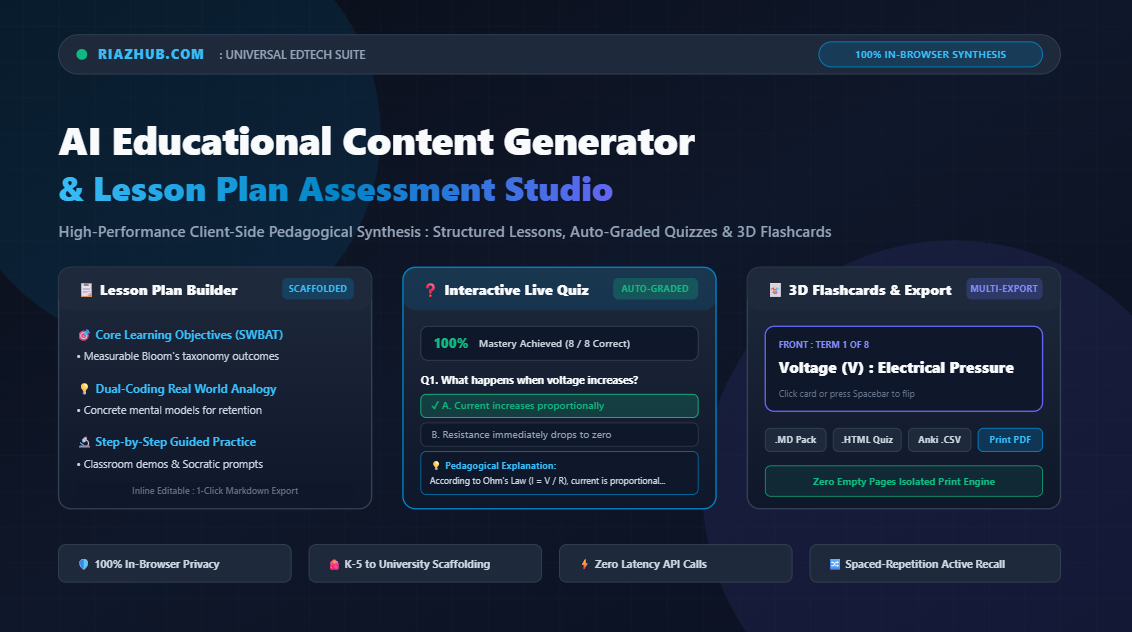
Instead of generating unstructured blocks of generic text, the studio produces a coordinated Multi-Asset Educational Matrix across four dedicated workspaces:
1. Structured Teacher Lesson Plan
Includes measurable SWBAT (Students Will Be Able To) objectives, plain-English conceptual overviews, dual-coding analogies, step-by-step guided practice, Socratic discussion prompts, and formative exit tickets.
2. Interactive Student Quiz Sandbox
Generates 5, 8, or 10 multiple-choice questions scaffolded across Bloom’s Taxonomy. Students can test their knowledge directly inside the browser with instant auto-grading, color-coded feedback, and pedagogical answer explanations.
3. 3D Spaced-Repetition Flashcards
An interactive flip-card study deck equipped with 3D card physics, keyboard shortcuts, shuffle options, progress tracking, and full deck review tables for rapid retrieval practice.
4. Key Vocabulary Glossary
A structured 2-column reference table defining core terms, formulas, and operational significance, complete with live search filtering and instant copy controls.
Experience this complete educational synthesis in action on the RiazHub Educational Content Generator Studio.
Cognitive Science Foundations: Evidence-Based Learning Principles
The synthesis engine is built upon foundational cognitive psychology research to maximize student retention and comprehension:
1. Active Recall and Retrieval Practice
Decades of experimental research demonstrate that actively reconstructing knowledge from memory produces substantially higher retention than passive review methods like re-reading or highlighting text. The AI Educational Content Generator integrates active retrieval directly into every study pack by pairing conceptual explanations with self-testing quizzes and interactive flashcards.
2. Dual Coding Theory (Allan Paivio’s Mental Models)
The human brain processes verbal information and visual or analogous mental models through separate, parallel cognitive channels. When abstract scientific laws, mathematical equations, or economic principles are paired with concrete physical models (such as water flowing through pressurized pipes, kitchen cooking pipelines, or balancing scales), both cognitive channels activate simultaneously. This dual activation accelerates conceptual understanding and improves long-term memory transfer across all learner age groups.
3. Bloom’s Revised Taxonomy Calibration
The studio dynamically calibrates instructional depth and question complexity according to your selected grade level:
| Grade Level Tier | Bloom’s Focus | Pedagogical Characteristics |
|---|---|---|
| Elementary (K-5) | Remember & Understand | Visual analogies, accessible vocabulary, shorter sentences, and sensory observations. |
| Middle School (6-8) | Understand & Apply | Relatable everyday systems, structured cause-and-effect explanations, and guided inquiries. |
| High School (9-12) | Apply & Analyze | Analytical modeling, quantitative relationships, system troubleshooting, and trade-off evaluation. |
| University & Professional | Analyze & Evaluate | Academic nomenclature, theoretical boundary conditions, edge cases, and architectural design choices. |
100% In-Browser Privacy: Complete Data Protection for Classrooms
Educational institutions operate under strict privacy standards (including FERPA, COPPA, and GDPR). Transmitting student inquiries, proprietary lesson outlines, or unpublished examination questions across third-party AI APIs introduces serious compliance liabilities.
The RiazHub Lesson Plan Builder Studio executes 100% inside your client browser using vanilla JavaScript (ES6+), DOM APIs, Blob file compiling, and native LocalStorage. At no point are your custom study notes, test questions, or syllabus materials sent to external servers. Your curriculum remains entirely private and secure on your local device.
Step-by-Step Guide: How to Generate Curriculum Assets in Seconds
- Step 1: Enter Topic & Subject Area:
Open the AI Educational Content Generator Studio. Enter your lesson title (for example, “Electrical Circuits and Ohm’s Law: Voltage, Current, and Resistance”) and choose your subject domain. - Step 2: Choose Grade Level & Question Count:
Select the target comprehension level (K-5, 6-8, 9-12, or University) and specify whether you want 5, 8, or 10 assessment questions. - Step 3 (Optional): Paste Reference Notes:
Paste your custom lecture notes, textbook excerpt, or syllabus outline. The engine will extract key terms and ground all generated questions and flashcards directly in your material. - Step 4: Click Generate:
Press the primary “Generate Complete Study & Lesson Pack” button. In under 300 milliseconds, the full curriculum matrix is synthesized. - Step 5: Review, Edit & Export:
Review the lesson plan, test-drive the live quiz in the interactive sandbox, practice with the 3D flashcards, and use the 1-click exporter toolbar to download formatted files.
1-Click Multi-Format Export Options
The RiazHub Study Assessment Studio provides direct export into every major study and teaching format:
💾 Complete Markdown Pack (.md)
Downloads a formatted Markdown file containing the complete lesson plan, objectives, quiz, answer key with explanations, flashcard tables, and glossary. Ideal for Obsidian, Notion, GitHub, and Canvas LMS.
🌐 Standalone Interactive HTML Quiz (.html)
Compiles an independent, self-contained HTML5 webpage with built-in JavaScript auto-grading. Teachers can share this file directly with students for offline, self-paced quiz practice.
🃏 Anki & Quizlet Flashcard CSV (.csv)
Generates an escaped CSV file ready for immediate 1-click import into Anki, Quizlet, Brainscape, and RemNote.
🖨️ Printable Student Worksheet (PDF)
Uses an isolated print engine to generate clean paper worksheets with student name and date blanks, multiple-choice questions, and reflection boxes with zero extra blank pages.
Frequently Asked Questions
Does this generator require an API key or paid subscription?
No. The utility operates completely via client-side JavaScript execution inside your web browser. You do not need an API key, payment card, or account registration.
Can I edit the generated lesson plan before exporting?
Yes. Every section in the Lesson Plan tab supports direct inline editing. Click on learning objectives, concept explanations, or discussion prompts to modify text before saving or printing.
Are custom reference notes stored on external servers?
No. All text parsing, question formulation, and file compilation occur strictly inside your device’s memory and browser local storage. No data is ever transmitted externally.
Does the tool work on mobile devices and tablets?
Yes. The studio layout, 3D flashcard controls, and exported standalone HTML quizzes are responsive and touch-friendly on smartphones, iPads, Chromebooks, and desktop computers.
Ready to Generate Your Lesson Plan & Study Pack?
Create structured lesson plans, test-drive interactive multiple-choice quizzes with instant auto-grading, and practice with 3D flashcards 100% locally in your browser.
✓ Zero Cloud Dependencies
✓ Multi-Format Exporters
Universal AI Educational Content Generator, Lesson Plan Builder and Study Assessment Studio
Transform any topic or study notes into a complete educational toolkit in seconds. Generate structured lesson plans, student-friendly concept guides, auto-graded interactive quizzes, and spaced-repetition flashcards directly inside your browser.
Electrical Circuits and Ohm's Law: Voltage, Current, and Resistance
- Define voltage (V), current (I), and resistance (R) using precise scientific terminology and standard SI units.
- Explain the cause-and-effect relationship between potential difference and charge flow using the hydraulic pipe analogy.
- Apply Ohm's Law (V = I * R) to calculate unknown circuit parameters and predict system behavior when resistance changes.
- Evaluate safety implications of circuit overloads and understand why resistors protect delicate electronics.
Ohm's Law is the bedrock rule governing direct-current electrical circuits. It states that the electrical current flowing through a conductor between two points is directly proportional to the voltage across the two points, and inversely proportional to the resistance of the conductor.
In mathematical notation, this is written as V = I * R, where Voltage (V) represents electrical potential energy, Current (I) represents the physical rate of electron movement, and Resistance (R) represents the material's opposition to that movement. When voltage is raised in a stable circuit, current increases proportionally. If resistance is introduced, current drops proportionally.
The Municipal Water Pipe Analogy: Think of an electric circuit like water flowing through a plumbing system. Voltage is the water pressure produced by a pump or water tower pushing water through the pipes. Current is the actual volume of water streaming through the pipe each second. Resistance is a narrow valve, gravel filter, or constriction in the pipe that slows down the flow. If you open the valve wide (low resistance), water rushes through with high volume. If you pinch the pipe tight (high resistance), only a trickle of water can pass, even if the pump pressure remains strong.
- Step 1 (Observation): Connect a 9-volt battery to a small LED light with a 330-ohm resistor. Note the steady, safe light output.
- Step 2 (Calculation Practice): Use V = I * R to compute the current: I = V / R = 9V / 330 ohms = 0.027 Amps (27 milliamperes).
- Step 3 (Hypothesis & Test): Ask students what happens if we double the resistance to 680 ohms. Compute the new current (13.2 mA) and verify that the LED glows dimmer because fewer electrons pass per second.
- Why do smartphone charging cables feel warm when fast-charging? Relate this to resistance and electron collisions.
- What would happen to the current if a wire's resistance dropped close to zero while connected across a high-voltage battery? Explain why this creates a dangerous short circuit.
- In power transmission across long distances, utility companies step voltage up to hundreds of thousands of volts. Using Ohm's Law and power relationships, why does higher voltage reduce energy loss in wires?
Prompt: In 2 sentences, explain what happens to the electric current in a household appliance if the electrical resistance inside the heating coil doubles while the wall outlet voltage remains 120V.
Sample Exemplary Answer: According to Ohm's Law (I = V / R), current is inversely proportional to resistance. If resistance doubles while voltage remains constant at 120V, the current flowing through the coil will be cut in half.
Interactive Student Assessment Quiz
Test-drive the generated assessment right inside your browser. Select answers and submit for instant scoring and explanations.
Spaced-Repetition Interactive Flashcard Deck
Practice active recall with tactile 3D flip cards. Use mouse clicks, on-screen controls, or keyboard arrow/spacebar navigation.
Full Flashcard Deck Review (All Cards)
Curriculum Vocabulary & Concept Glossary
Comprehensive definitions and core formulas extracted directly from the lesson material.
| Term / Concept | Pedagogical Definition & Significance | Action |
|---|
Pedagogical Design & Cognitive Science Foundations
Decades of empirical cognitive research demonstrate that active retrieval (answering questions, testing memory with flashcards, and completing low-stakes quizzes) produces significantly higher long-term conceptual retention than passive review techniques like re-reading or highlighting textbooks.
When learners deliberately reconstruct knowledge from memory, neural connections are strengthened, and cognitive pathways become more resistant to decay. This studio integrates instant-feedback multiple-choice assessments and spaced-repetition flashcards directly alongside every lesson plan to convert passive reading into active mastery.
Dual Coding Theory posits that the human mind processes verbal information and non-verbal/visual representations through separate yet interconnected channels. When abstract theoretical rules (such as voltage, current, and electrical resistance) are paired with concrete, sensory mental models (such as water flowing through a pressurized pipe network), both cognitive channels are activated simultaneously.
This dual activation dramatically lowers cognitive load, accelerates schema formation in working memory, and enables students of all grade levels to transfer their understanding to novel problem-solving tasks with greater confidence.
Unlike third-party AI platforms that transmit your custom prompts, unpublished classroom exams, proprietary curriculum standards, or student study notes across external servers, this studio operates entirely inside your local web browser using client-side JavaScript execution.
Every concept decomposition, quiz distractor synthesis, flashcard generation, scoring calculation, and document export is performed deterministically on your local machine. No tracking cookies, no classroom data leaks, no external API keys, and no server logging.