
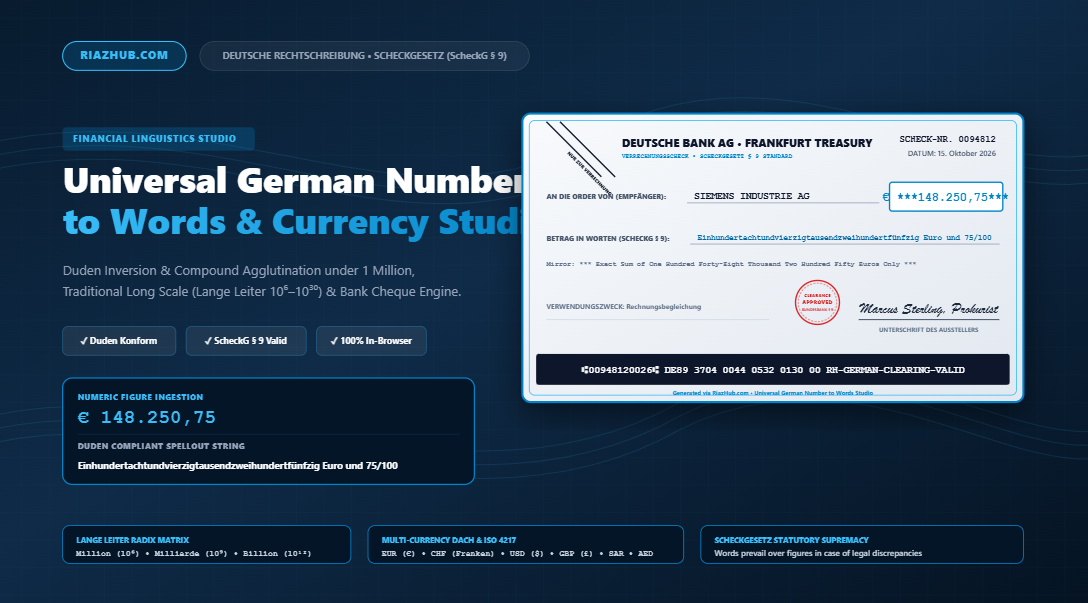
Mastering German Number to Words: Duden Rules, Lange Leiter & Scheckgesetz (ScheckG § 9) Explained
Converting numerical amounts into written words is one of the most critical legal requirements in European finance, commercial contracts, corporate payroll, and negotiable banking instruments. While in English writing numbers out is straightforward (e.g., “One hundred forty-eight thousand two hundred fifty”), the German language imposes a unique set of rigorous morphosyntactic, orthographic, and statutory banking rules.
Whether you are balancing corporate invoices, issuing commercial drafts, or verifying check amounts according to the German Check Act (Scheckgesetz – ScheckG § 9), understanding standard rules established by the Council for German Orthography (Rat für deutsche Rechtschreibung) and the Duden is indispensable.
To automate this complex linguistic translation with zero risk of floating-point inaccuracies or sensitive data leakage, professionals rely on the
Universal German Number to Words Converter & Currency Spellout Studio hosted on RiazHub.com. In this in-depth guide, we explore the grammatical foundations, traditional radix scales, and commercial banking laws that govern German currency spellout.
1. Duden Rules for German Number Words: Agglutination & Inversion
German is famous for compounding, and numerals are no exception. The official Duden dictionary sets strict rules on when numbers must be concatenated into a single compound word and when they must be written separately:
A. Single-Word Compound Agglutination Below 1,000,000
All cardinal numbers under one million (1.000.000) are written as a single continuous lowercase compound word without spaces in running text. Even large numbers like 148,250 must be written without spaces:
Breaking this word into separate components (e.g., writing “ein hundert acht und vierzig tausend”) is orthographically incorrect under standard German grammar.
B. Units-Before-Tens Inversion Syntax (Einer vor Zehner)
Unlike English, French, or Spanish where the tens place precedes the units place (e.g., twenty-one, vingt-et-un) German reverses this order for all two-digit numbers ending between 21 and 99. The units digit is stated first, followed by the conjunction „und“, followed by the tens digit:
- 21: einundzwanzig (literally: “one-and-twenty”)
- 35: fünfunddreißig (literally: “five-and-thirty”)
- 78: achtundsiebzig (literally: “eight-and-seventy”)
- 99: neunundneunzig (literally: “nine-and-ninety”)
Notice that the single unit “eins” drops its terminal “-s” when combined with “und” (e.g., einundzwanzig, not einsundzwanzig).
C. Capitalization & Separation Above One Million
Starting at 1,000,000, the grammatical categorization changes completely. Numerals representing millions, billions, and beyond are grammatically classified as feminine nouns (Substantive). Consequently, they are capitalized, pluralized, and written as separate words:
- 1.000.000 = eine Million (singular)
- 2.000.000 = zwei Millionen (plural)
- 2.148.250 = zwei Millionen einhundertachtundvierzigtausendzweihundertfünfzig
2. The Traditional Long Scale (Die Lange Leiter) vs. The Short Scale
One of the most dangerous traps in international banking between Germany and English-speaking nations is the confusion between the Traditional European Long Scale (Chuquet-Pellos System / Lange Leiter) and the American Short Scale.
In the DACH region (Germany, Austria, Switzerland), the magnitude tier shifts every factor of $10^6$ (one million), utilizing the intermediate suffix “-arde” for intermediate thousands:
| Power of 10 | German Long Scale Term | English Short Scale Term | Numerical Value |
|---|---|---|---|
| 10⁶ | eine Million | One Million | 1,000,000 |
| 10⁹ | eine Milliarde | One Billion | 1,000,000,000 |
| 10¹² | eine Billion | One Trillion | 1,000,000,000,000 |
| 10¹⁵ | eine Billiarde | One Quadrillion | 1,000,000,000,000,000 |
| 10¹⁸ | eine Trillion | One Quintillion | 1,000,000,000,000,000,000 |
Critical Financial Distinction: In German, 1,000,000,000 is “eine Milliarde”. A German “Billion” represents $10^{12}$—which is one thousand times larger than the American billion ($10^9$). Transcribing this incorrectly in corporate debt settlements or Treasury records can have catastrophic contractual consequences.
The online German Number to Words Converter on RiazHub calculates these tiers natively using JavaScript BigInt arithmetic up to $10^{30}$ (Quintillionen), guaranteeing zero floating-point rounding errors on multi-million corporate transactions.
3. Scheckgesetz (ScheckG § 9) & Statutory Word Supremacy
In Germanic commercial law, negotiable instruments and commercial bank cheques are governed by the German Check Act (Scheckgesetz), which mirrors Article 9 of the Geneva Uniform Law on Cheques (1931). Section 9 of the ScheckG states:
„Ist die Schecksumme in Buchstaben und in Ziffern ausgedrückt, so gilt bei Abweichungen die in Buchstaben ausgedrückte Summe.“
(If the cheque amount is stated in both words and figures, the amount stated in words legally prevails in case of discrepancies.)
This statutory principle known as Statutory Word Supremacy exists because numerical digits (such as adding an extra zero or changing a 3 into an 8) can easily be altered by fraudsters. A fully written agglutinated German word string cannot be casually altered without detection.
Standard Commercial Cheque Security Clauses
When issuing a German commercial cheque (Verrechnungsscheck), standard anti-alteration formatting requires:
- Delimiting Asterisks: Surrounding the numerical figure with protective symbols (e.g.,
€ ***148.250,75***). - The Crossed Marking (“Nur zur Verrechnung”): Two parallel diagonal lines in the upper-left corner ensuring that the cheque cannot be cashed over the bank counter; it can only be credited to a verified corporate bank account.
- Trailing Security Lines: Filling unused space on the written words line with dashes to prevent unauthorized appended characters.
4. Currency Subunit Concordance: EUR, CHF, USD & Fractions
Depending on the commercial jurisdiction and regional currency conventions across the DACH zone, fractional subunit transcription follows distinct accounting standards:
- Eurozone (EUR): Major currency is Euro; minor currency is Cent. In bank drafts, cents are written either fractional as
75/100 Euroor spelled out asfünfundsiebzig Cent. - Switzerland (CHF): Major unit is Schweizer Franken; minor unit is Rappen. Standard Swiss cheques write:
Schweizer Franken und 50/100orfünfzig Rappen. - International Currencies: Standard ISO 4217 representations include US-Dollar (Cents), Britisches Pfund (Pence), Saudi-Riyal (Halalas), and VAE-Dirham (Fils).
5. How to Use the German Number to Words Studio on RiazHub
Using the tool at RiazHub German Number to Words Converter is simple and immediate:
- Input Numeric Figure: Type any numerical amount into the Amount / Betrag field (e.g.,
148250.75). - Direct Word Copying: Immediately below the input, the dedicated German Words Box provides the clean spelled-out words with a 1-click
📋 Copy Wordsbutton. - Choose Currency & Fraction Format: Select between EUR, CHF, USD, GBP, SAR, AED, or Pure Cardinal numbers, and pick fraction style (
75/100vs.Fünfundsiebzig Cent). - Preview High-DPI Bank Draft: Click on the Bank Cheque Visualizer tab to inspect a realistic German commercial draft complete with drawee bank header, crossed cheque marking, and Bundesbank standard seal.
- Export Accounting Files: Download lossless PNG cheque graphics, Markdown voucher slips, CSV transaction logs, or 1200×630 social dossier cards—all automatically branded and formatted.
6. 100% Client-Side Privacy: Why Zero Cloud Transmission Matters
In corporate accounting and treasury management, commercial invoice figures, employee bonuses, and supplier bank details constitute sensitive financial data. Sending these numbers over unencrypted or external cloud APIs exposes organizations to GDPR violations and surveillance.
The German Number to Words Converter & Currency Spellout Studio executes 100% inside your web browser using native JavaScript. Zero figures, payee names, or banking credentials ever leave your computer.
Frequently Asked Questions (FAQ)
Universal German Number to Words Converter & Currency Spellout Studio
Convert financial amounts into grammatically precise German words conforming to Duden agglutination rules, simulate authentic crossed bank cheques (Verrechnungsscheck), inspect Lange Leiter radix scaling, and download branded accounting slips.
| Long Scale Magnitude | Exponent | German Radix Term | Extracted Chunk |
|---|
BUCHUNGSBELEG & ZAHLUNGSANWEISUNG
1. Duden Agglutination & Zusammenschreibung unter 1.000.000
Nach den amtlichen Rechtschreibregeln des Rats für deutsche Rechtschreibung und des Dudens werden alle Zahlen unter einer Million als ein einziges langes Wort ohne Leerzeichen zusammengeschrieben (z.B. einhundertachtundvierzigtausendzweihundertfünfzig).
2. Inversion: Einer vor Zehner mit Bindewort „und“
Im Deutschen werden die Einerstellen vor den Zehnerstellen ausgesprochen und geschrieben: 21 ist einundzwanzig, 45 ist fünfundvierzig. Dies unterscheidet das Deutsche syntaktisch von romanischen Sprachen und dem Englischen.
3. Substantivierung ab Million (Die Lange Leiter / Chuquet-Pellos)
Ab einer Million werden die Zahlwörter grammatikalisch als Substantive behandelt und getrennt großgeschrieben: eine Million, zwei Millionen, eine Milliarde ($10^9$), eine Billion ($10^{12}$). Im Englischen entspricht eine deutsche Milliarde dem englischen „billion“.
4. Scheckgesetz (ScheckG § 9) & Schutz vor Scheckbetrug
Gesetzlich gilt: Weicht der Betrag in Buchstaben von der Zahl ab, gilt zwingend die in Worten geschriebene Summe. Durch Begrenzungssterne (*** Betrag ***) und die Klausel „Nur zur Verrechnung“ wird verhindert, dass der Betrag manipuliert oder bar eingelöst werden kann.