
In modern digital workflows, text is rarely just plain ASCII characters. Every document, snippet of code, database query, translation string, and SEO meta tag contains an intricate web of spacing characters. While visible glyphs convey semantic meaning, the whitespace between them dictates readability, layout behavior, file sizes, and compiler syntax validation.
However, standard text editors and basic word counters frequently fail to capture the nuances of non-printing characters. They treat every space as an ordinary ASCII 0x20 character, completely overlooking non-breaking spaces ( ), zero-width format controls (ZWSP, BOM), typographic quad spaces, and tab indentation clusters. To solve this challenge, the Universal Space Counter & Whitespace Density Analyzer on RiazHub provides a real-time, privacy-first diagnostic workbench built to classify, inspect, and sanitize every whitespace token client-side.
1. The Critical Difference: Characters With Spaces vs. Characters Without Spaces
When preparing manuscripts, translation orders, grant proposals, or technical documentation, character count specifications are ubiquitous. Yet, few specifications cause as much confusion as the distinction between total character count with spaces versus character count without spaces.
Consider the following phrase:
"The quick brown fox jumps over the lazy dog."- Characters with spaces:
44characters - Characters without spaces:
36characters (excluding 8 standard single spaces) - Whitespace density:
18.18%
While an 8-character difference may seem trivial in a single sentence, it scales exponentially across larger documents. In a 50,000-word book manuscript, spaces easily account for 50,000 to 70,000 characters. Using the Space Counter & Whitespace Analyzer allows authors, editors, and students to monitor both figures simultaneously in real time.
Why This Metric Matters Across Key Industries:
- Academic Submissions & Grant Applications: Academic journals (such as Nature, IEEE, and Elsevier) and competitive fellowship grants enforce stringent character limits on abstracts and executive summaries. Overstepping these limits because spaces were counted inadvertently can result in automated submission rejections.
- Translation & Copywriting Billing: In European translation markets (notably Germany, France, and Italy), pricing is frequently calculated per Normzeile (standard line of 55 characters including spaces) or per 1,000 characters without spaces. Discrepancies in counting method directly impact project invoicing and commercial contracts.
- Telecommunications & SMS Campaign Limits: Under standard GSM 03.38 7-bit encoding, a single SMS is capped at 160 characters. If trailing spaces or unrecognized Unicode spaces are included, the message is segmented into multiple parts or forced into UTF-16 UCS-2 mode (reducing the limit to 70 characters per segment), immediately doubling delivery costs.
- SEO Meta Tag Optimization: Google search result snippets display approximately 60 characters for title tags and 155–160 characters for meta descriptions. Excessive spaces or wide Unicode spaces cause premature SERP truncation with ellipsis (
...).
2. Hidden Unicode Spaces & Invisible Character Anomalies
The Unicode Standard (ISO/IEC 10646) defines dozens of distinct whitespace and formatting characters. When text is copied from formatted PDF files, WYSIWYG editors (Google Docs, Microsoft Word), Notion, or team chat channels (Slack, Microsoft Teams), these non-standard spaces are frequently transferred into codebases and CMS fields without visual warning.
U+00A0) and Zero-Width Spaces (U+200B) render visually identical to ordinary spaces in standard browsers, but they trigger catastrophic syntax errors in Python, JavaScript, JSON, and SQL compilers.Exhaustive Unicode Whitespace Classification Reference
The RiazHub Space Counter incorporates an exhaustive client-side classification engine that categorizes character codes across the entire Unicode spectrum:
| Code Point | Character Name / Entity | Category & Behavior | Common Source / Risk Factor |
|---|---|---|---|
U+0020 (0x20) |
Standard ASCII Space | Western word separator | Standard spacebar keypress |
U+0009 (\t) |
Horizontal Tab | Columnar indentation | Tab key, TSV spreadsheets, code indentation |
U+00A0 |
Non-Breaking Space ( ) |
Line-wrap inhibitor | Copied HTML, rich text editors, typography layouts |
U+200B |
Zero-Width Space (ZWSP) | Invisible line break opportunity | Rich text editors, messaging apps, hidden watermarks |
U+200C / U+200D |
ZWNJ / ZWJ | Ligature joiner & non-joiner | Complex scripts (Persian, Arabic, Devanagari) |
U+FEFF |
Byte Order Mark (BOM) | Zero-width no-break space | UTF-8/UTF-16 file stream headers |
U+2002 / U+2003 |
En Space / Em Space | Fixed-width typographic spaces | Typesetting software, InDesign exports, digital ebooks |
U+2009 / U+200A |
Thin Space / Hair Space | Subtle typographic spacing | Punctuation formatting in French and German publishing |
U+3000 |
Ideographic CJK Space | Full-width East Asian space | Chinese, Japanese, and Korean IME inputs |
3. The Power of Visual Ghost Whitespace Mode
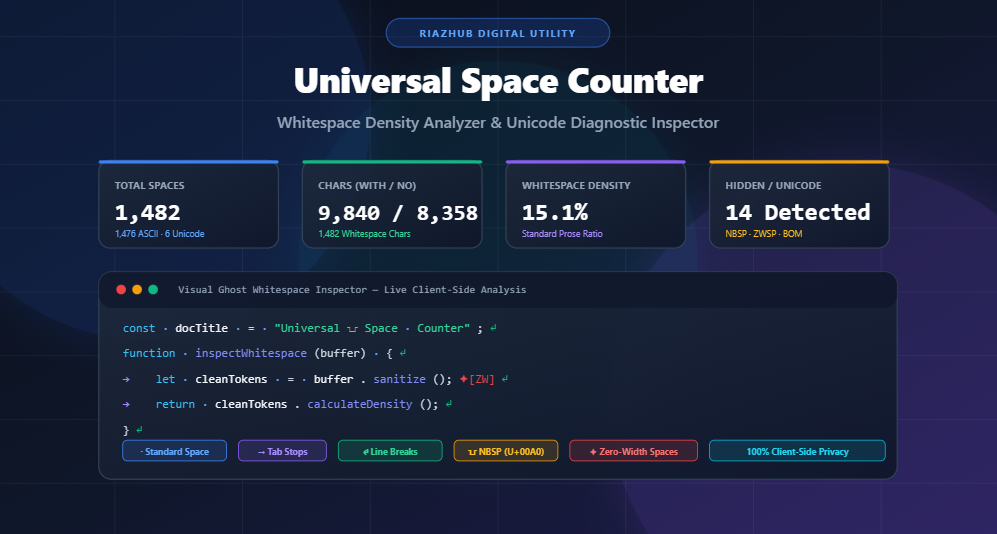
One of the standout features of the Universal Space Counter on RiazHub is its dedicated Visual Ghost Whitespace Mode. While the standard editor allows smooth typing and editing, Ghost Mode converts invisible whitespace tokens into distinct, color-coded visual glyph badges:
·(Blue Dot): Represents standard single ASCII spaces (U+0020).→(Purple Arrow): Highlights horizontal tab stops (\t).↵(Green Symbol): Pinpoints line breaks (\nand\r\n).⍽(Amber Box): Flags non-breaking spaces (U+00A0).✦[ZW](Pulsing Red Badge): Instantly exposes zero-width spaces, BOM markers, and soft hyphens.【 】(Pink Tag): Demarcates ideographic full-width CJK spaces (U+3000).
By switching to Ghost Mode, developers, data scientists, and proofreaders can visually locate trailing spaces, rogue tabs in Python scripts, and hidden characters in API payloads in a fraction of a second.
4. Whitespace Density Ratio: What It Tells You About Your Text
Whitespace density is the percentage of total document volume occupied by spacing, tabs, and line breaks:
Density (%) = (Total Whitespace Characters / Total Characters With Spaces) × 100%Analyzing whitespace density provides immediate insights into document formatting, readability, and structural efficiency:
- Below 10% (Dense Prose / Compact Data): Typical of unspaced strings, compressed payloads, acronym-dense technical data, or East Asian logographic scripts.
- 12% to 22% (Standard English Prose): The standard baseline for typical natural language articles, essays, and journalistic writing.
- 25% to 40% (Structured / Indented Code): Standard for clean programming code (Python, JavaScript, YAML, HTML) with regular indentation and line breaks.
- Above 45% (Sparse / Tabular Data): Indicates heavily indented tables, ASCII art, multiple consecutive empty lines, or excessive padding that may benefit from sanitization.
The Whitespace Density Analyzer visualizes this composition through a segmented live progress bar, breaking down standard spaces, tabs, newlines, and non-whitespace characters.
5. 1-Click Automated Whitespace Sanitization Toolkit
In addition to diagnostics, the utility includes an integrated suite of 1-click batch cleanup transformations. Instead of manually writing regex expressions or hunting down rogue spaces line by line, users can execute instant client-side cleanups:
- Collapse Multiple Spaces: Merges runs of two or more consecutive spaces into a single clean space.
- Remove Leading & Trailing Spaces: Strips extraneous edge whitespace from the beginning and end of every line.
- Convert Tabs to Spaces (4 or 2 Spaces): Standardizes indentation for Python PEP8 compliance and clean markdown rendering.
- Convert Spaces to Tabs: Reconstructs 4-space indentations into tab stops for tab-based coding styles.
- Normalize Unicode & NBSP Spaces: Converts all non-breaking spaces, En/Em spaces, and CJK spaces into standard ASCII
0x20spaces. - Remove Zero-Width & Hidden Characters: Safely purges invisible BOM markers, ZWSP tokens, and soft hyphens.
- Remove Blank Lines: Eliminates empty newlines and whitespace-only lines to condense log files and text exports.
- Strip All Whitespace Completely: Removes every space, tab, and newline for cryptographic hash testing and compact token verification.
6. Multi-Format Export & Privacy Architecture
Whether preparing audit reports or archiving cleaned documentation, the Universal Space Counter provides comprehensive export utilities:
- Copy Whitespace Summary: Generates a formatted plain-text diagnostic summary ready to paste into pull requests, tickets, or client reports.
- Download Sanitized Text (.txt): Exports cleaned text directly as a plain-text file.
- Export Structured JSON Report: Downloads full statistical metrics in JSON format for automated data pipelines.
- Export CSV Table: Generates an Excel-ready CSV spreadsheet breaking down all character metrics.
Conclusion: Upgrade Your Text Analysis Workflow Today
Whether you are an academic verifying essay lengths, a programmer debugging SQL syntax errors, a copywriter calculating localization rates, or an SEO specialist optimizing meta descriptions, whitespace precision is indispensable.
Eliminate invisible errors and streamline your text processing with the Universal Space Counter & Whitespace Density Analyzer on RiazHub. Bookmark the tool today for instant, secure, and comprehensive text diagnostics whenever you need them.
Universal Space Counter & Whitespace Analyzer
Count standard spaces, tabs, line breaks, non-breaking spaces, and hidden Unicode spaces with visual whitespace highlighting in real time.
Source Input & Stage
Whitespace Categorization
Exhaustive ClassificationQuick Whitespace Sanitization & Transformation Toolkit
Whitespace Standards, Typography & Coding Diagnostic Guide
Everything you need to know about character counting standards, hidden Unicode space anomalies, programming syntax gotchas, and client-side document privacy.
Understanding the distinction between character count with spaces and character count without spaces is critical across several industries:
- Academic & Grant Submissions: Academic publishers and grant organizations strictly specify whether character limits include or exclude whitespace. Inadvertently exceeding these bounds by including spaces can lead to automatic disqualification.
- Translation & Copywriting Billing: In international localization and technical translation (e.g., German, French, or Italian), billing is frequently priced per Standard Normzeile (55 characters including spaces) or per 1,000 characters without spaces.
- Telecom & SMS Limits: Standard GSM 03.38 character encoding limits a single SMS message to 160 characters. A trailing space or non-ASCII Unicode space can split your SMS into multi-part messages or trigger UTF-16 UCS-2 mode (reducing the limit to 70 characters per segment), doubling messaging fees.
When code or structured data is copied from PDF documentation, web tutorials, Notion, or Slack, invisible Unicode characters can slip in:
- Non-Breaking Spaces (
U+00A0): Web browsers render visually identical to standard space (0x20), but programming compilers (Python, JavaScript, Go, Rust) and SQL engines treatU+00A0as invalid tokens, causing cryptic syntax errors likeSyntaxError: invalid character in identifier. - Zero-Width Characters (
U+200B,U+FEFF): Zero-Width Spaces (ZWSP) and Byte Order Marks (BOM) have zero visual width. If embedded in database IDs, API keys, password fields, or regex search strings, they cause equality checks (a === b) to fail silently. - SEO Meta Tag Truncation: Search engines like Google count hidden Unicode whitespace towards title tag (60 characters) and meta description (160 characters) snippet limits, causing premature truncation in SERPs.
The table below summarizes standard and typographic whitespace codified under the Unicode Consortium standard:
| Unicode Code Point | Character Name | Category / Usage |
|---|---|---|
U+0020 (0x20) |
Standard ASCII Space | Standard word separator in Western text |
U+0009 (\t) |
Horizontal Tabulation | Code indentation and TSV columnar alignments |
U+00A0 |
Non-Breaking Space ( ) | Prevents automatic line breaks between words |
U+2000 – U+2003 |
En / Em / Quad Spaces | Fixed-width typographic spaces proportional to font size |
U+200B – U+200D |
Zero-Width Space / Joiners | Ligature formatting, invisible boundary markers |
U+3000 |
Ideographic Full-Width Space | CJK typography (Chinese, Japanese, Korean) glyph cell space |
U+FEFF |
Zero Width No-Break Space (BOM) | Byte Order Mark at the beginning of UTF streams |
Your data never leaves your computer.
This utility operates under a strict privacy-first architecture. All character counting, tokenization, regular expression parsing, visual ghost rendering, and export calculations take place strictly within your local web browser using native JavaScript (ES6+). Zero user input text, copied code, confidential documents, or metrics are ever sent to RiazHub servers or third-party tracking services.