
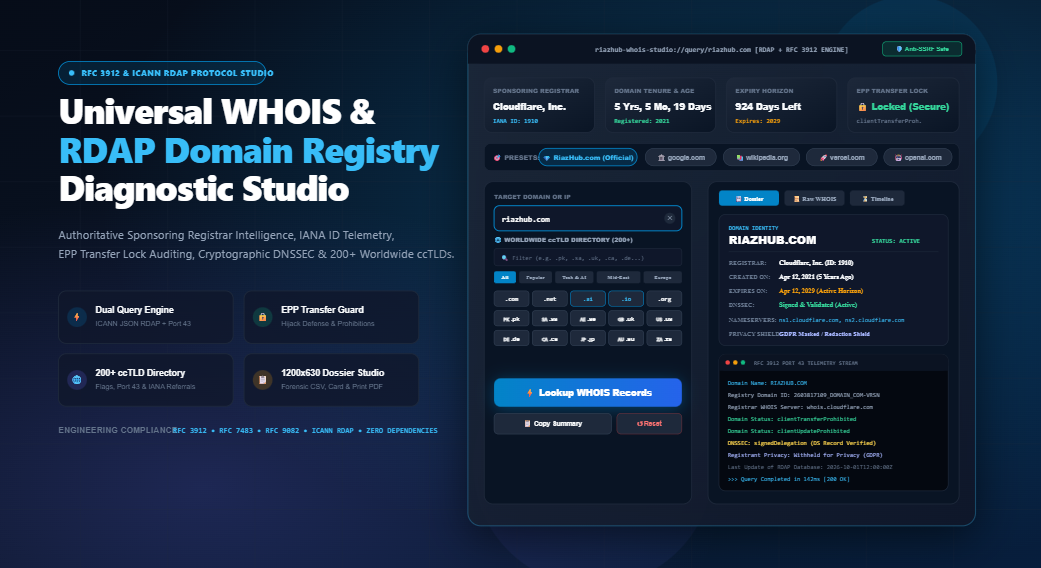
In modern cybersecurity intelligence, brand asset protection, domain portfolio management, and network diagnostics, understanding the exact registration posture of a domain name is paramount. Whether conducting threat triage against a malicious phishing domain, auditing an M&A corporate infrastructure transition, or verifying that a high-value enterprise asset is protected against unauthorized registry transfer hijacking, engineers require authoritative, real-time registry telemetry.
The Universal WHOIS & RDAP Domain Registry Lookup, Registrar Intelligence & DNS Ownership Diagnostic Studio on RiazHub delivers a forensic, zero-dependency diagnostic engine designed to bridge legacy RFC 3912 socket protocols with modern ICANN RESTful Registration Data Access Protocol (RDAP) architectures. This authoritative technical guide walks through domain registry engineering, protocol differences, Extensible Provisioning Protocol (EPP) status security, DNSSEC trust validation, and global ccTLD routing.
1. The Protocol Evolution: RFC 3912 WHOIS vs. Modern ICANN RDAP
For nearly four decades, the domain name ecosystem relied on the original WHOIS protocol defined in RFC 3912 (and its predecessor RFC 812). RFC 3912 was intentionally minimal: an application establishes a plain-text TCP connection over port 43 to an authoritative registry host, sends a single query string terminated by a carriage return and line feed (<domain>\r\n), reads the textual response until the server closes the connection, and attempts to parse the unstructured output.
While functional in the early days of ARPANET and the fledgling commercial internet, port 43 WHOIS suffered from severe structural limitations:
- No Structured Syntax Standard: Each registry and registrar formatted their plain-text output differently, requiring brittle regular expressions to parse dates, nameservers, and statuses.
- No Universal Internationalization: RFC 3912 lacks standard character encoding negotiation, causing character corruption for Internationalized Domain Names (IDNs) in Arabic, Cyrillic, Chinese, and Hindi.
- Zero Native Authentication or Access Controls: Port 43 does not support tiered access, making it difficult to balance public auditing with post-GDPR privacy mandates.
- Firewall Friction: Outbound TCP port 43 is frequently blocked by strict enterprise egress policies and cloud firewalls, rendering standard command-line tools inoperable.
To solve these fundamental problems, ICANN, the Internet Engineering Task Force (IETF), and global registries ratified the Registration Data Access Protocol (RDAP) under RFC 7480 through RFC 7484 and RFC 9082 / RFC 9083. RDAP transmits structured application/rdap+json over secure HTTPS (port 443), standardizes internationalized labels, supports cryptographically verifiable responses, and provides structured entity arrays for registrars, registrants, and abuse contacts.
| Architectural Feature | Legacy WHOIS (RFC 3912) | Modern ICANN RDAP (RFC 7483 / 9082) |
|---|---|---|
| Transport Protocol | Plaintext TCP Socket (Port 43) | Encrypted HTTPS / REST (Port 443) |
| Payload Format | Unstructured Freeform Text | Strictly Structured JSON Specification |
| Firewall Permeability | Frequently Blocked on Port 43 | Universal Web Standard Port 443 (Allowed Everywhere) |
| IDN & Internationalization | Unspecified (Often US-ASCII or UTF-8 Fallback) | Full Native Unicode & LDH (Letter-Digit-Hyphen) Support |
| Contact Redaction Model | Ad-hoc Text Masking | Standardized GDPR Entities & vCard (jCard) Arrays |
| Referral Routing | Manual Text Probing of “Registrar WHOIS Server” | Automatic IANA RDAP Bootstrap Discovery (RFC 7484) |
The RiazHub Universal WHOIS & RDAP Studio integrates both protocols simultaneously through a hybrid failover architecture. It queries authoritative RDAP endpoints first for structured JSON precision, and instantly falls back to direct RFC 3912 socket probing whenever an older registry or specialized country-code top-level domain (ccTLD) requires raw port 43 resolution.
2. Anatomy of Authoritative Registrar Intelligence
When evaluating domain ownership, distinguishing between the Registry Operator, the Sponsoring Registrar, and the Reseller is essential for security and legal analysis:
The master organization responsible for delegating top-level domains. For example, Verisign operates .com and .net, PIR operates .org, and PKNIC administers .pk.
An ICANN-accredited entity authorized to register names on behalf of end users (e.g., Cloudflare, MarkMonitor, Namecheap, GoDaddy). Each registrar holds a permanent IANA ID.
Authoritative direct-escalation channels (dedicated email and telephone numbers) mandated by ICANN for filing urgent trademark, DMCA, malware, or phishing takedowns.
Every accredited sponsoring registrar is assigned a unique numerical IANA Registrar ID. For instance, MarkMonitor holds IANA ID 292, Cloudflare holds IANA ID 1910, and GoDaddy holds IANA ID 146. Verifying the IANA ID prevents deceptive registrar naming attacks where rogue entities create confusingly similar commercial company names to impersonate legitimate registrars.
3. Domain Lifecycle Timestamps, Age Tenure & Expiry Horizons
Domain registrations pass through structured states defined by ICANN’s Expired Registration Recovery Policy (ERRP). The Universal WHOIS & RDAP Diagnostic Studio analyzes three pivotal timestamps to compute precise mathematical tenures:
- Creation Date (Registration Inception): The exact UTC timestamp when the domain was first provisioned at the central registry. Continuous domain tenure spanning decades (e.g.,
riazhub.com,google.com) is an authoritative signal for domain authority and brand longevity. Conversely, newly registered domains (less than 30 days old) carry a higher risk profile in security operations centers (SOCs) as prospective throwaway attack vectors. - Registry Expiry Date (Renewal Timeline): The moment the current registration period terminates. The tool calculates the active expiry horizon in days, warning administrators when critical infrastructure assets are approaching renewal deadlines.
- Updated Date (Last Modified Event): Indicates the last time nameservers, contact records, or EPP status locks were altered. A sudden updated timestamp on a mature domain often signals nameserver delegation changes, transfer attempts, or zone record propagation.
When investigating security anomalies, compare the Domain Age against the DNS Zone Update Date. If a domain was created 10 years ago but updated 48 hours ago to unfamiliar offshore nameservers, it could indicate domain hijacking, DNS hijacking, or a recently expired domain repurposed by a malicious actor.
4. Demystifying EPP Status Codes: Hijack Defense & Transfer Locks
The Extensible Provisioning Protocol (EPP) status codes (standardized under RFC 5730 through RFC 5734) specify the precise operational and security constraints applied to a domain at the registry and registrar levels. The RiazHub WHOIS Studio inspects these flags in real time to diagnose whether a domain is locked against illicit transfers:
| EPP Status Code | Authority Tier | Security Function & Practical Meaning |
|---|---|---|
clientTransferProhibited |
Registrar Tier | Prevents the domain from being transferred away to another registrar without the owner first unlocking it in their dashboard. Recommended for all active websites. |
clientUpdateProhibited |
Registrar Tier | Locks nameserver, contact, and glue record updates. Protects critical DNS infrastructure against unauthorized dashboard tampering. |
clientDeleteProhibited |
Registrar Tier | Disallows accidental deletion requests from the registrar interface. |
serverTransferProhibited |
Registry Tier | An authoritative lock placed by the central registry operator (e.g. Verisign). Higher priority than client locks; cannot be removed by the registrar alone. |
serverHold |
Registry Tier | The domain’s DNS is halted at the registry root. The domain ceases to resolve globally, frequently triggered by non-payment, court orders, or abuse suspensions. |
redemptionPeriod |
Registry Tier | The domain expired and was deleted by the registrar. It enters a 30-day grace period where only the original owner can restore it, typically for a recovery fee. |
pendingDelete |
Registry Tier | The domain is queued for permanent release back into the public pool (usually within 5 days). It cannot be renewed during this window. |
5. Cryptographic DNSSEC Audit: Verifying Delegation Authenticity
The Domain Name System Security Extensions (DNSSEC) provide cryptographic authentication of DNS data to prevent DNS spoofing, cache poisoning, and man-in-the-middle manipulation. When DNSSEC is enabled on a domain:
- The authoritative nameservers generate Resource Record Signatures (RRSIG) for every record set using a Zone Signing Key (ZSK).
- The ZSK is authenticated by a Key Signing Key (KSK).
- A cryptographic hash of the KSK is submitted to the parent registry as a Delegation Signer (DS) record.
In the Universal WHOIS & RDAP Studio, the DNSSEC diagnostic engine verifies whether the authoritative registry reflects signedDelegation (Active) or Unsigned. If an organization serves sensitive financial, corporate, or customer transactions, maintaining an active DNSSEC cryptographic chain of trust is an essential security baseline.
6. Navigating Worldwide ccTLDs: 200+ Countries & Port 43 Referral Routing
While generic top-level domains (gTLDs like .com, .net, .org) follow centralized ICANN policies, Country-Code Top-Level Domains (ccTLDs) represent sovereign nations and territories governed by individual local registry policies.
The WHOIS Lookup Studio features an interactive directory deck covering over 200 worldwide ccTLDs across every region:
- Middle East & Central Asia: 🇵🇰
.pk(Pakistan), 🇸🇦.sa(Saudi Arabia), 🇦🇪.ae(UAE), 🇶🇦.qa(Qatar), 🇰🇼.kw(Kuwait), 🇴🇲.om(Oman), 🇧🇭.bh(Bahrain), 🇪🇬.eg(Egypt), 🇹🇷.tr(Turkey), 🇮🇷.ir(Iran), 🇮🇶.iq(Iraq), 🇯🇴.jo(Jordan), 🇱🇧.lb(Lebanon), 🇾🇪.ye(Yemen), 🇦🇫.af(Afghanistan), 🇦🇿.az(Azerbaijan), 🇰🇿.kz(Kazakhstan), 🇺🇿.uz(Uzbekistan). - Asia & Pacific: 🇮🇳
.in(India), 🇧🇩.bd(Bangladesh), 🇨🇳.cn(China), 🇯🇵.jp(Japan), 🇰🇷.kr(South Korea), 🇸🇬.sg(Singapore), 🇲🇾.my(Malaysia), 🇮🇩.id(Indonesia), 🇵🇭.ph(Philippines), 🇹🇭.th(Thailand), 🇻🇳.vn(Vietnam), 🇭🇰.hk(Hong Kong), 🇹🇼.tw(Taiwan), 🇦🇺.au(Australia), 🇳🇿.nz(New Zealand). - Europe: 🇬🇧
.uk(United Kingdom), 🇩🇪.de(Germany), 🇫🇷.fr(France), 🇪🇺.eu(European Union), 🇮🇹.it(Italy), 🇪🇸.es(Spain), 🇳🇱.nl(Netherlands), 🇨🇭.ch(Switzerland), 🇸🇪.se(Sweden), 🇳🇴.no(Norway), 🇩🇰.dk(Denmark), 🇫🇮.fi(Finland), 🇵🇱.pl(Poland), 🇮🇪.ie(Ireland), 🇷🇺.ru(Russia), 🇺🇦.ua(Ukraine). - Americas & Caribbean: 🇺🇸
.us(United States), 🇨🇦.ca(Canada), 🇧🇷.br(Brazil), 🇲🇽.mx(Mexico), 🇦🇷.ar(Argentina), 🇨🇱.cl(Chile), 🇨🇴.co(Colombia), 🇵🇪.pe(Peru), 🇻🇪.ve(Venezuela), 🇨🇷.cr(Costa Rica), 🇯🇲.jm(Jamaica), 🇦🇮.ai(Anguilla). - Africa: 🇿🇦
.za(South Africa), 🇳🇬.ng(Nigeria), 🇰🇪.ke(Kenya), 🇲🇦.ma(Morocco), 🇬🇭.gh(Ghana), 🇩🇿.dz(Algeria), 🇹🇳.tn(Tunisia), 🇺🇬.ug(Uganda), 🇹🇿.tz(Tanzania), 🇪🇹.et(Ethiopia), 🇸🇳.sn(Senegal), 🇷🇼.rw(Rwanda).
Behind the scenes, when querying specialized ccTLDs, the tool performs dynamic two-step referral discovery. If an extension’s socket server is unlisted, the engine contacts the IANA root server (whois.iana.org), extracts the authoritative refer: or whois: registry host, and probes the authoritative country registry directly. If that registry points to a sponsoring registrar referral server (e.g. Verisign thin WHOIS models), it seamlessly follows the referral chain to capture complete registration records.
7. Dual Ingestion Mode: Deep Single Audit vs. Bulk Batch Queue
Different workflows require different diagnostic modes. The RiazHub WHOIS Studio accommodates both operational paradigms:
Mode 1: Single Domain Deep Diagnostic Studio
Designed for comprehensive forensic auditing of a single root domain, hostname, or IP address. It renders a structured KPI summary, sponsoring registrar intelligence, domain tenure progress bars, authoritative nameserver lists, cryptographic DNSSEC verification, and a live searchable raw console stream with keyword filtering.
Mode 2: Batch Queue Multi-Domain Portfolio Audit
Designed for domain investors, DevOps engineers, and security analysts managing domain portfolios. Users can input up to 20 domains or IP addresses simultaneously (separated by commas or line breaks). The batch processor audits each item sequentially, compiles a synchronized portfolio ledger table, verifies lock states, and enables 1-click inspection of any individual record.
8. Forensic Dossier Export: 1200×630 Social Cards, CSVs & Print PDF
Sharing diagnostic results with clients, executive leadership, or incident response teams requires clean, professional documentation. The studio provides three distinct export mechanisms:
- 1200×630 Canvas Dossier Card Generator: Renders a high-resolution, pixel-perfect PNG card formatted for Twitter/X summary cards, LinkedIn, and Slack embeds. Users can customize color themes (Azure Sky, Obsidian Gold, Emerald Cyber, Rose Security).
- Forensic CSV Export: Exports structured domain portfolio ledgers with timestamps, nameservers, EPP locks, and registrar identifiers for spreadsheet analysis in Excel or Google Sheets.
- Print & PDF Optimized Format: Built with dedicated
@media printCSS rules that strip sidebar controls and format the structured dossier into an executive technical report.
9. Step-by-Step Tutorial: Performing an Authoritative Registry Audit
Follow these steps to conduct an audit using the Universal WHOIS & RDAP Diagnostic Studio:
- Select Target: Enter any domain name (e.g.,
riazhub.com,google.com) or choose from the 1-click quick presets. - Switch Extensions with 1-Click: Browse or filter the 200+ worldwide ccTLD directory to test extensions (e.g.
.pk,.sa,.ae,.uk,.de,.ai). - Choose Protocol: Keep ⚡ RDAP Protocol selected for modern ICANN JSON resolution, or switch to 📜 RFC 3912 WHOIS for raw port 43 socket output.
- Execute Audit: Click Lookup WHOIS Records. The tool executes the query and updates the 4-card overview deck instantly.
- Review Structured Dossier: Inspect the sponsoring registrar, domain tenure, EPP lock statuses, nameservers, and DNSSEC cryptographic validation.
- Export Findings: Click Copy Summary for quick reports, download the 1200×630 Dossier PNG, or export a CSV audit file.
Universal WHOIS & RDAP Domain Registry Lookup
Authoritative registrar intelligence, real-time lifecycle timestamps, EPP transfer lock inspection, and cryptographic DNSSEC ownership verification.
- ns1.google.com
- ns2.google.com
- ns3.google.com
- ns4.google.com
Loading authoritative registry record...
| Domain | Registrar | Registration Date | Expiry Date | Days Left | Lock State | Action |
|---|---|---|---|---|---|---|
| Switch to Batch Queue mode and click 'Lookup WHOIS Records' to audit multiple domains. | ||||||
ICANN Standards, RDAP Protocols & Domain Ownership Principles
The Registration Data Access Protocol (RDAP) is the modern successor to traditional port 43 WHOIS defined in RFC 7480-7484. Unlike legacy WHOIS which returned unstructured, free-form text varying wildly by registrar, RDAP returns standardized, machine-readable JSON over secure HTTPS. RDAP supports internationalized domain names (IDNs), native access controls, and structured role vCards, establishing the current standard mandated by ICANN for all accredited registrars.
Following the European Union's General Data Protection Regulation (GDPR) enforcement in May 2018, ICANN enacted the Temporary Specification for gTLD Registration Data. Under these privacy policies, registrars must mask personal identities (registrant name, street address, personal phone number, and direct email) from public registries to prevent harassment, identity theft, and spam harvesting. Technical timestamps, authoritative nameservers, and sponsoring registrars remain public.
EPP (Extensible Provisioning Protocol) status codes communicate the operational condition of a domain:
clientTransferProhibited: Recommended setting. Prevents unauthorized transfers to other registrars (domain lock).clientUpdateProhibited: Blocks metadata modifications (nameserver updates) until unlocked.serverHold: Set by the registry operator to suspend the domain's DNS resolution due to legal dispute, non-payment, or abuse.redemptionPeriod: The domain has expired and can only be recovered by paying a restoration penalty during the 30-day grace window.
ICANN mandates that every accredited registrar must maintain an active Abuse Contact Email and telephone number displayed in RDAP/WHOIS records. When reporting security incidents, phishing websites, or malware distribution, forward full URLs, server headers, and evidence directly to the registrar's official abuse email provided in the Structured Dossier tab.